
A hospital CIO hears a vendor claim that their "AI-powered" scheduling tool is "essentially the same thing" as the health system's separate GenAI-based patient-communication assistant, since "it's all AI." Which response best reflects an accurate understanding of the terminology?
Select an answer to reveal the explanation.
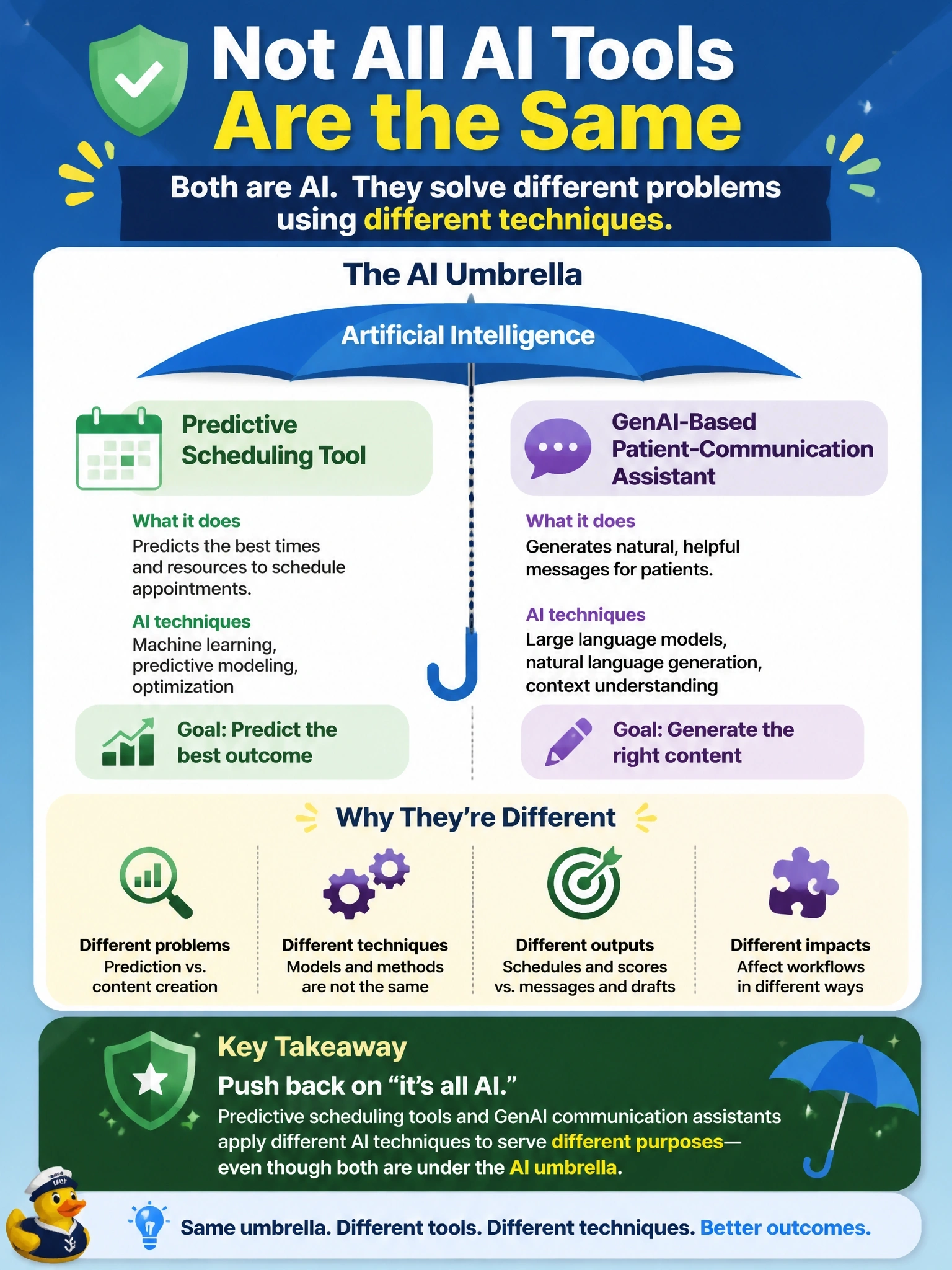
Short Explanation
Calling both tools "the same thing" because they're both AI is a bit like saying a thermostat and a chatbot are identical since both run on electricity — technically true, not helpful to you. Push back instead: your scheduling tool is likely doing prediction, an ML job, while your communication assistant is generating conversational text, a GenAI job, and sharing an umbrella term doesn't erase that gap.
Full Explanation
The accurate response is to push back on the vendor's claim, because a tool that predicts optimal appointment slots and a tool that generates conversational replies likely rely on different underlying techniques — prediction versus content generation — even though both are fairly described as AI. One distractor accepts the vendor's claim outright, treating "it's all AI" as sufficient grounds to assume the two systems function identically; that skips over real differences in reliability profile, failure modes, and oversight needs between a predictive tool and a generative one. Another distractor rejects both tools as not genuinely AI, reserving that label only for the newest generative models — this wrongly excludes well-established predictive and rule-based systems, which are legitimate, long-standing parts of the AI field. A third distractor tries to resolve the confusion by asking the vendor to rename the scheduling tool to GenAI so the labels match — that manufactures a false label rather than clarifying what the tool actually does, and would leave the CIO worse informed, not better. The practical takeaway: press for specifics on what technique powers each tool, since governance, monitoring, and risk review should differ between a predictive scheduler and a generative communication assistant, regardless of what umbrella term the vendor prefers to use.