
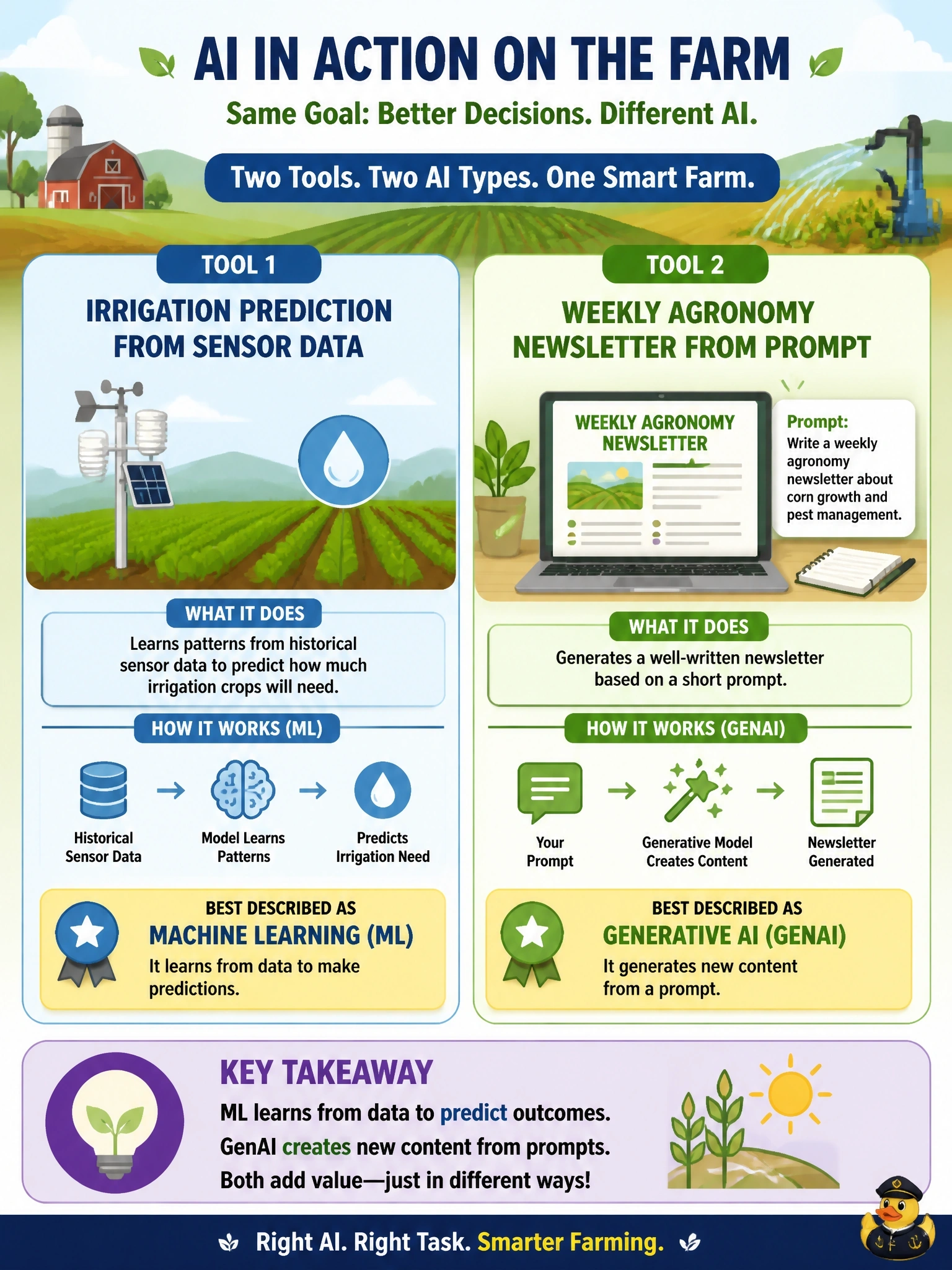
A farm cooperative is evaluating two tools: one predicts irrigation needs from sensor data trends, and another drafts weekly agronomy newsletters from a short prompt. Which statement correctly applies the AI/ML/GenAI distinction to these two tools?
Select an answer to reveal the explanation.
Short Explanation
Forecasting and writing are two different jobs, even when you lump them both under 'AI.' Your irrigation tool studies past sensor trends to forecast a need, a classic ML job, while your newsletter tool starts from a blank page and generates original text from a prompt, which is what GenAI does.
Full Explanation
The irrigation tool fits ML because its defining behavior is learning from historical sensor patterns to forecast an irrigation need — a prediction task. The newsletter tool fits GenAI because its defining behavior is producing new, original content from a short prompt — a generation task. One distractor swaps the labels, calling the sensor-based predictor GenAI and the content-writing tool "rule-based automation," reasoning only from the fact that both technically fall under the AI umbrella rather than from what each tool actually does — that's the wrong basis for the classification. Another distractor claims neither tool counts as AI at all because each performs a narrow, specific task; but narrow, task-specific systems are still squarely within the field of AI — genuine AI doesn't require general-purpose intelligence. A third distractor lumps both tools together as GenAI simply because both "rely on AI in some general form," which glosses over the fact that only one of them actually generates new content. The practical check: ask whether a tool is estimating or classifying from existing data (ML) or producing new content from a prompt (GenAI) — that answer should drive what oversight and evaluation criteria the cooperative applies to each.