
A hospital's innovation committee is drafting an internal glossary to align terminology before evaluating AI vendors. Which pairing correctly distinguishes AI, ML, and GenAI for non-technical staff?
Select an answer to reveal the explanation.
Short Explanation
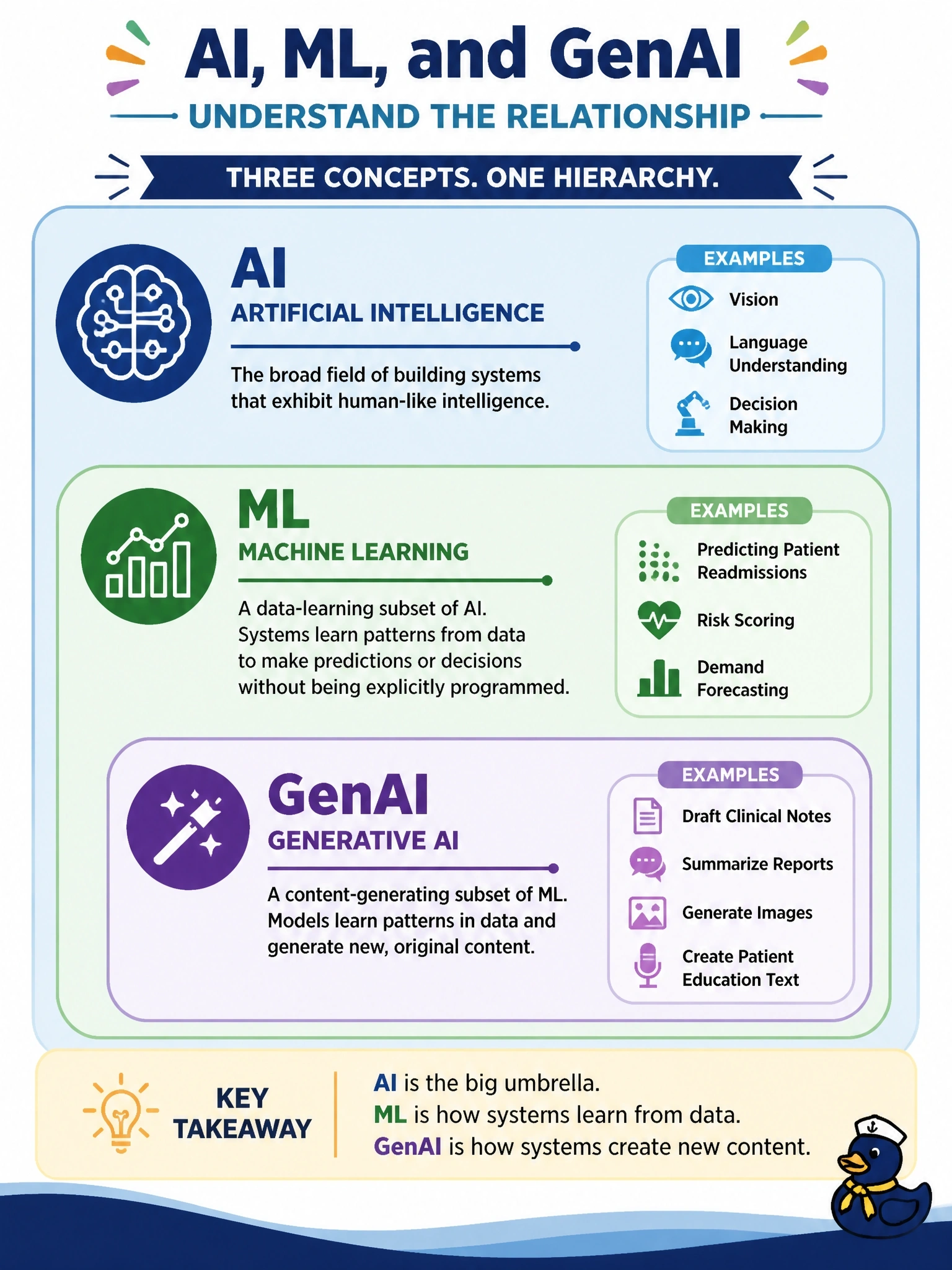
Sort every vendor pitch into three nested boxes and you'll never confuse these terms again: AI is the biggest one, any system built to act intelligently. ML is the smaller box inside it, for systems that learn from data instead of following fixed rules — and GenAI is the smallest box of all, tucked inside ML, for the systems that generate new content like text or images.
Full Explanation
AI is the umbrella field covering any system designed to perform tasks that normally require human-like intelligence. ML sits inside that umbrella as the subset of AI that learns patterns from data rather than following only hand-written rules, and GenAI sits inside ML as the narrower subset specialized in producing new content such as text, images, or audio. One distractor treats all three terms as interchangeable, which erases a meaningful distinction — a rule-based AI system and a content-generating GenAI tool behave very differently and demand different evaluation criteria, even though vendors sometimes use the words loosely. Another distractor claims ML is the broadest category, containing both AI and GenAI, which inverts the real hierarchy; ML is narrower than AI, not the other way around. A third distractor makes the same kind of error in reverse, placing GenAI — the narrowest of the three — at the very top, above both AI and ML. Getting the nesting right has a practical payoff: when a vendor pitches a tool as "AI-powered," the committee should ask which layer it actually occupies, since that determines whether it predicts, classifies, or generates content — and each of those carries different risks worth evaluating separately.