
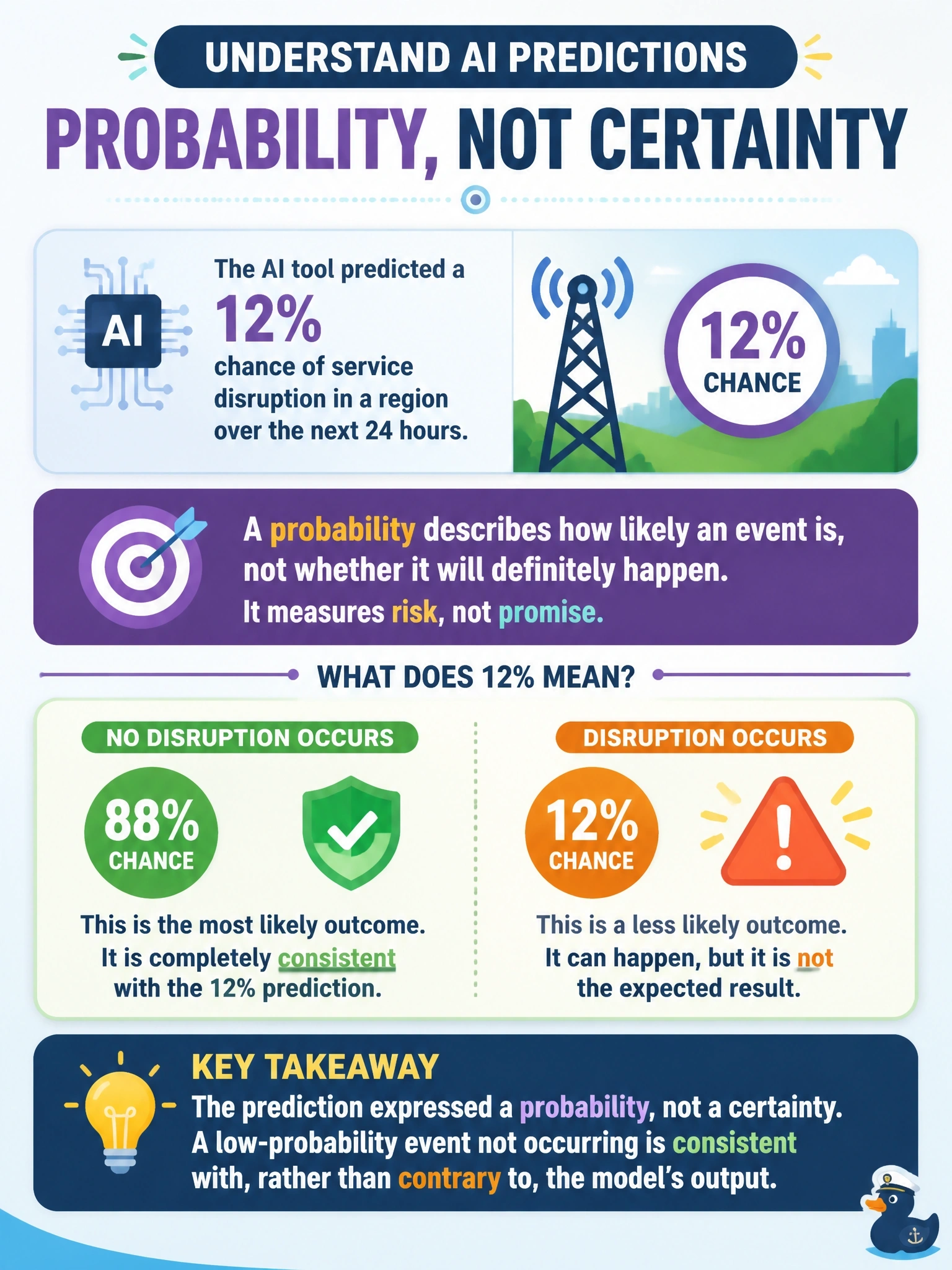
A telecom network-operations manager reviews a report showing an AI tool predicted a 12% chance of service disruption in a region over the next 24 hours. A colleague argues the tool "made a mistake" because no disruption occurred. What is the most accurate way to interpret the AI's original output?
Select an answer to reveal the explanation.
Short Explanation
Ever notice how a 12% chance of rain not showing up doesn't mean the forecaster was wrong? A low-probability event just not happening is exactly what you'd expect most of the time — a probability describes likelihood across many outcomes, not a promise about this one instance, so a single non-event doesn't mean the model failed.
Full Explanation
A 12% forecast is a statement about likelihood: it flags a disruption as plausible but unlikely, so when no disruption occurs, that outcome is entirely consistent with — not contrary to — what the model said. One distractor treats a single non-event as proof the model "failed" and needs immediate retraining, but judging a probabilistic model on one instance ignores that model quality is measured across many predictions over time, not by whether any single low-probability event happened to occur. Another distractor insists predictions are only valid at 100% certainty, which sets an impossible bar — almost no real-world forecast reaches absolute certainty, and demanding that would make any predictive tool useless for planning. A third distractor reframes the 12% figure as an outright guarantee that a disruption would happen, which misreads the number entirely; a low percentage explicitly signals the opposite of a guarantee. The operational check for a network-operations manager: track a model's calibration across many forecasts — do events labeled 12% actually happen roughly 12% of the time — rather than judging any single forecast as right or wrong in isolation.