
A farm cooperative's agronomy team is piloting an AI tool that estimates crop yield risk from weather and soil sensor readings. A board member asks the program manager to explain, in plain terms, what a "prediction" from this system actually represents. Which explanation is most accurate?
Select an answer to reveal the explanation.
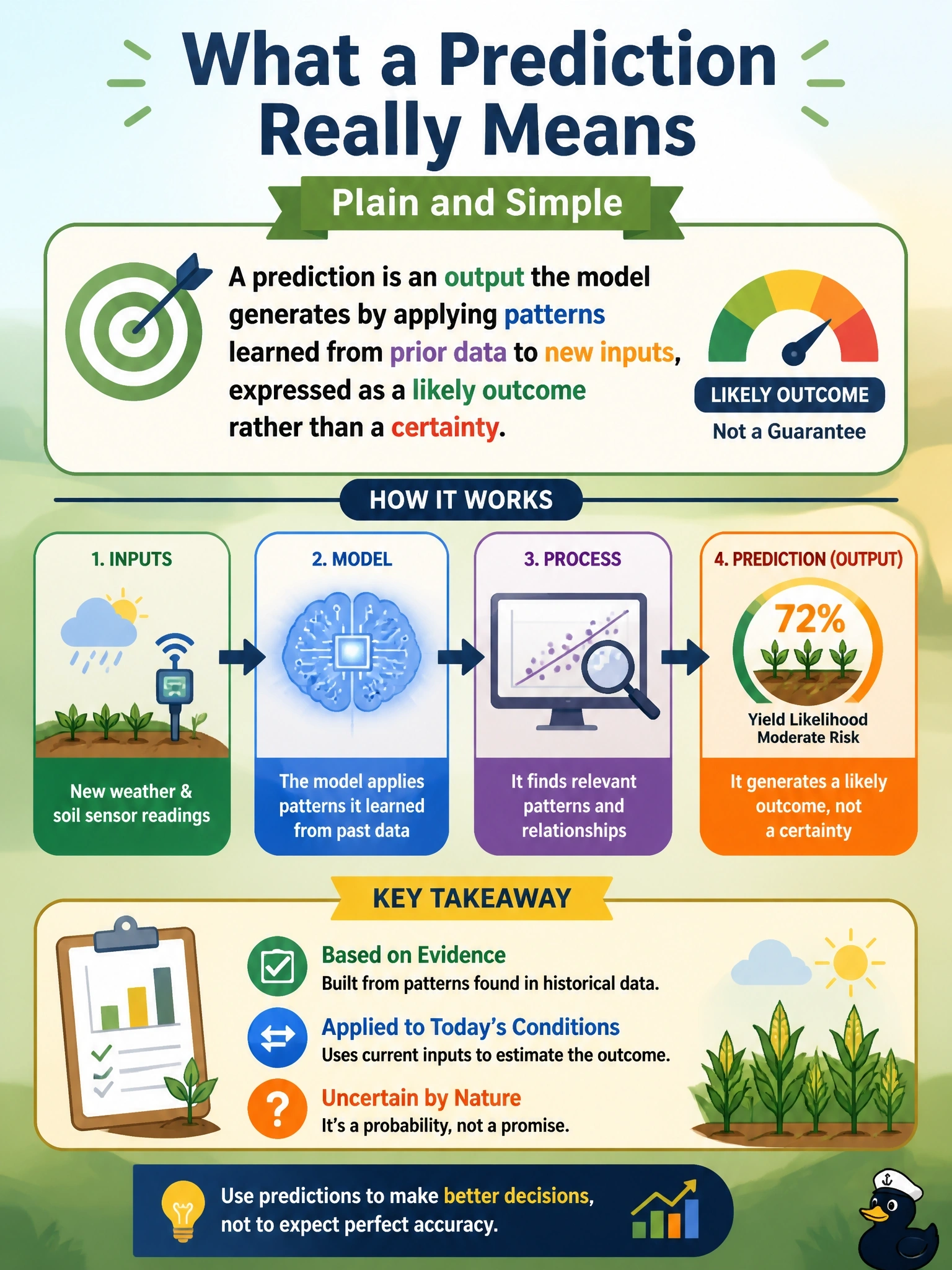
Short Explanation
A weather forecaster calling for a 30% chance of rain is making an informed estimate from past patterns, not a promise about tomorrow, and that's exactly what a prediction is here too. The model compares today's soil and weather readings to everything it learned in training and produces its best guess at yield risk, so you're looking at a likelihood, not a guarantee.
Full Explanation
A prediction is the model's output when it applies patterns learned during training to a fresh set of weather and soil inputs, and it's framed as a probable outcome rather than a locked-in fact — which is exactly why yield-risk tools report percentages or risk tiers instead of flat statements. One distractor describes a human agronomist typing in a forecast that the system merely displays unchanged; that skips the model entirely and describes data pass-through, not prediction. Another distractor claims the output is a guaranteed result from fixed formulas that never need updating, which contradicts the nature of a learned, probabilistic estimate — real predictions shift as conditions and retraining change what the model has learned. A third distractor claims predictions are random whenever a model lacks training data, but an untrained model doesn't generate meaningful predictions at all; it has no patterns to draw on, so there's no output worth trusting, random or otherwise. The operational takeaway for a board member: ask whether a reported number is a probability range or risk score, and treat it as a weighted estimate to inform a decision, never as a locked-in outcome to act on blindly.