
A regional hospital network's revenue-cycle team is reviewing a vendor demo for an AI billing-review tool. The vendor distinguishes between the "model" that flags likely coding errors and the "inference" step that runs each time a new claim arrives. Which statement most accurately describes the relationship between these two terms?
Select an answer to reveal the explanation.
Short Explanation
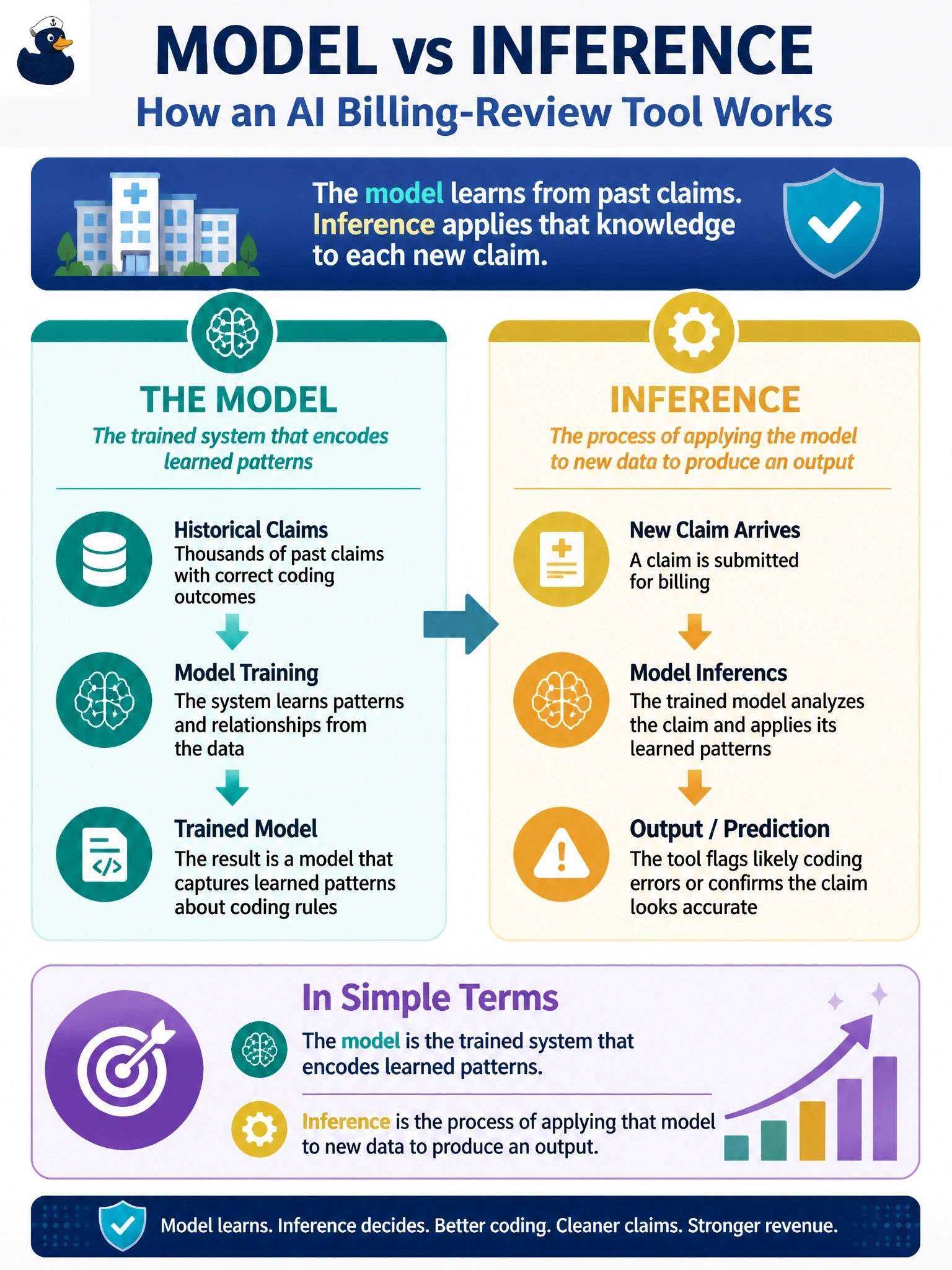
Think of the model like a recipe you've already perfected through practice, and inference like the act of cooking dinner with it tonight. You build the recipe once, during training, then you run it again and again every time a new claim comes in — that repeated cooking step is what inference actually is. The model doesn't change every time you use it; it just gets applied to fresh data.
Full Explanation
The model is the artifact produced once an algorithm has learned statistical patterns from historical claims data — it holds the knowledge, not the raw data itself. Inference is the separate, repeated act of running new, incoming claims through that trained model to produce an output, like flagging a likely coding error. One distractor gets this backwards, treating the model as nothing more than raw claims data and treating inference as an archival record kept for retraining — but neither term describes data storage at all; both describe an active process. Another distractor collapses training and inference into a single moment, claiming inference happens only once when the model is first built and the model simply keeps running on its own afterward — this ignores that a trained model doesn't operate by itself; it requires a fresh inference pass for every single claim that arrives. A third distractor treats the model and inference as the exact same step, which erases the useful distinction between building the system once and using it repeatedly. A practical check: if someone says a tool is "training" every time a claim is submitted, that's a red flag — training happens on a schedule, while inference happens continuously, one claim at a time, without altering the underlying model.