
A hospital administrator wants to explain the term "training" to clinical staff without technical jargon, ahead of a rollout of an AI scheduling assistant. Which description is most accurate for a non-technical audience?
Select an answer to reveal the explanation.
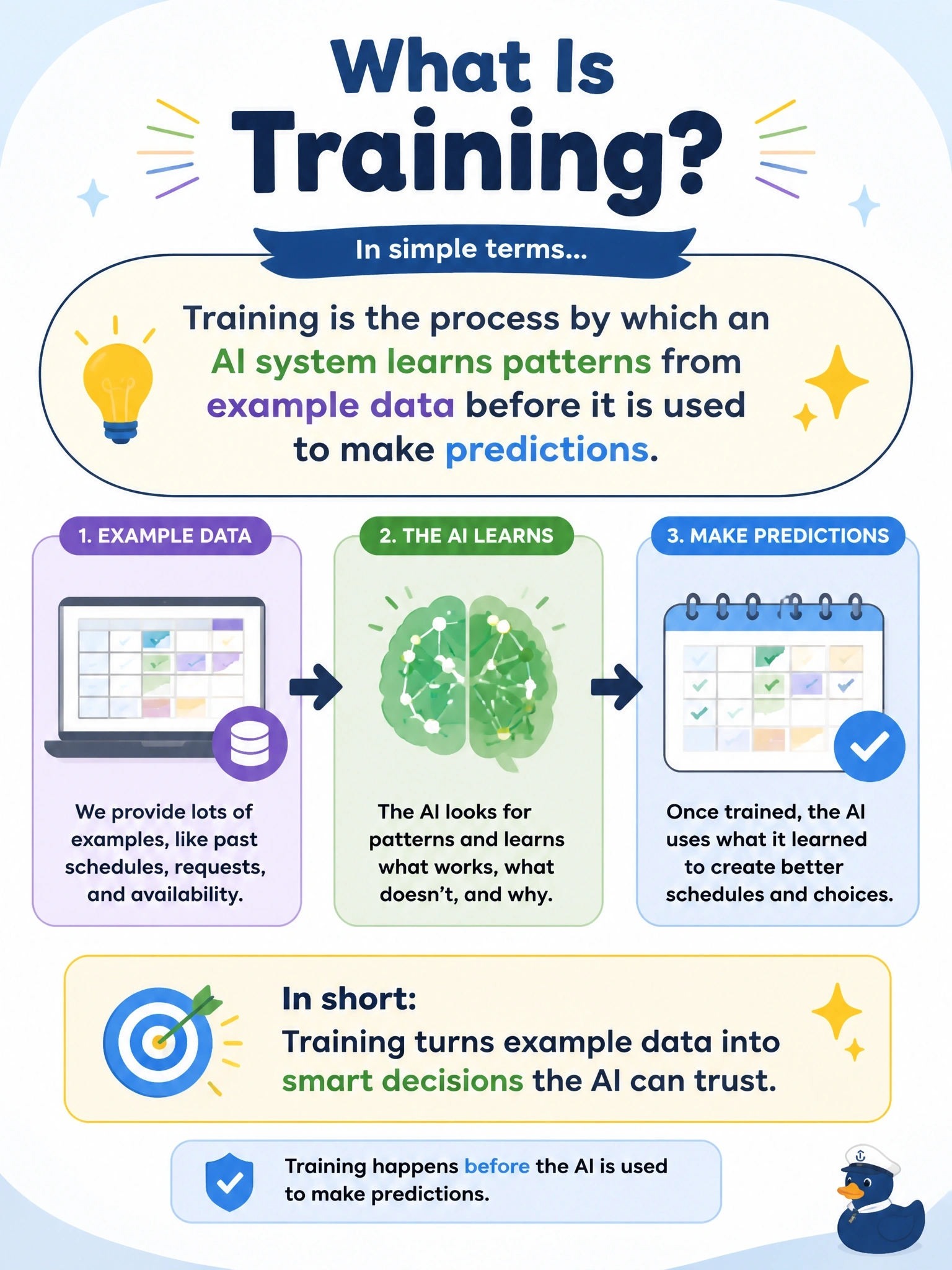
Short Explanation
Picture a new scheduler shadowing the department for a few weeks before ever touching a live schedule — that's basically what's happening during training. The system works through example data to learn patterns first, and only once you'd trust it to work solo does it start making live predictions.
Full Explanation
Training is the phase where the AI system works through a body of example data to learn the underlying patterns it will later rely on — it happens before the system is trusted to generate live predictions. One distractor equates training with installing software on hospital devices, but that's just IT setup; no learning from data occurs during installation at all. Another distractor describes staff reviewing every AI output before it reaches a patient — that's a human oversight safeguard layered on top of the system, entirely separate from how the system itself learns. A third distractor claims training happens automatically with every new prediction, which conflates training with inference; in reality the system is trained beforehand (and periodically retrained later), while day-to-day predictions run through an already-trained model without altering it each time. For clinical staff, the practical distinction is timing: training is a distinct, upfront (and periodic) phase, while predictions happen continuously afterward on a system whose learned patterns stay fixed between training cycles. That's the frame to use when explaining why the scheduling assistant won't visibly change after every single use.