
A medical-device manufacturer purchases custom sterile tubing from a supplier that holds an accredited ISO 9001 certificate. Because a tubing failure could cause patient harm and the manufacturer has unique dimensional tolerances, how should the audit program manager handle second-party auditing of this supplier?
Select an answer to reveal the explanation.
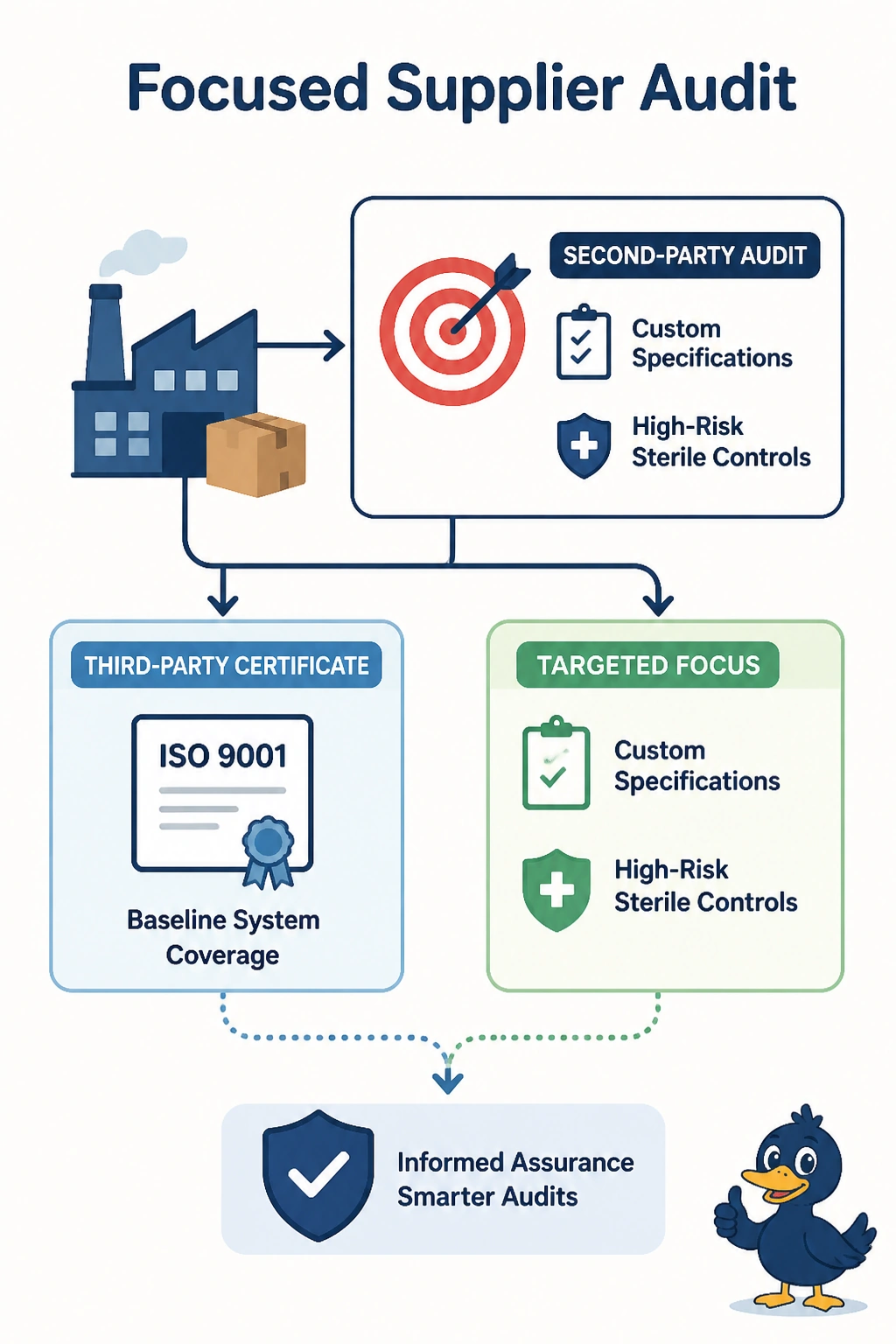
Short Explanation
Think of a third-party certificate like a driver's license: it proves baseline competence, not that your custom cargo will arrive safely. The trap is treating a generic certificate as a free pass to skip supplier oversight on critical, patient-facing specifications.
Full Explanation
An accredited quality management certificate confirms that a supplier's general system meets broad standard requirements, so the best decision is to Conduct a targeted second-party audit focused on custom specifications and high-risk sterile controls while leveraging the third-party certificate for baseline system coverage. This risk-based approach avoids duplicating basic system checks while verifying the exact tolerances and sterilization controls that protect patients. Choosing to Waive all second-party audits permanently because accredited third-party certification guarantees full compliance fails because third-party auditors do not audit your proprietary engineering drawings or customer-specific requirements. Attempting to Require the third-party registrar to share its confidential audit working papers before scheduling any supplier review fails because registrars are bound by confidentiality agreements with their clients and only the certificate or agreed summary is typically shared. Deciding to Replace all supplier audits with incoming visual inspection of finished tubing cartons at the receiving dock fails because visual checks cannot verify upstream sterile-barrier validation or process controls. Caveat: even for low-risk suppliers, relying on a certificate requires verifying its scope, validity dates, and accreditation body. Operational check: review the supplier's current certificate scope against your critical part list and schedule a focused on-site or hybrid audit for custom controls.
Prefer to study offline? Printable PDF study book + test engine ($7.50, unofficial). These questions stay free here.