
An auditor who previously found strong compliance at a precision-machining supplier is assigned to audit a newly launched anodizing line at the same facility. How should the auditor guard against confirmation bias during fieldwork?
Select an answer to reveal the explanation.
Short Explanation
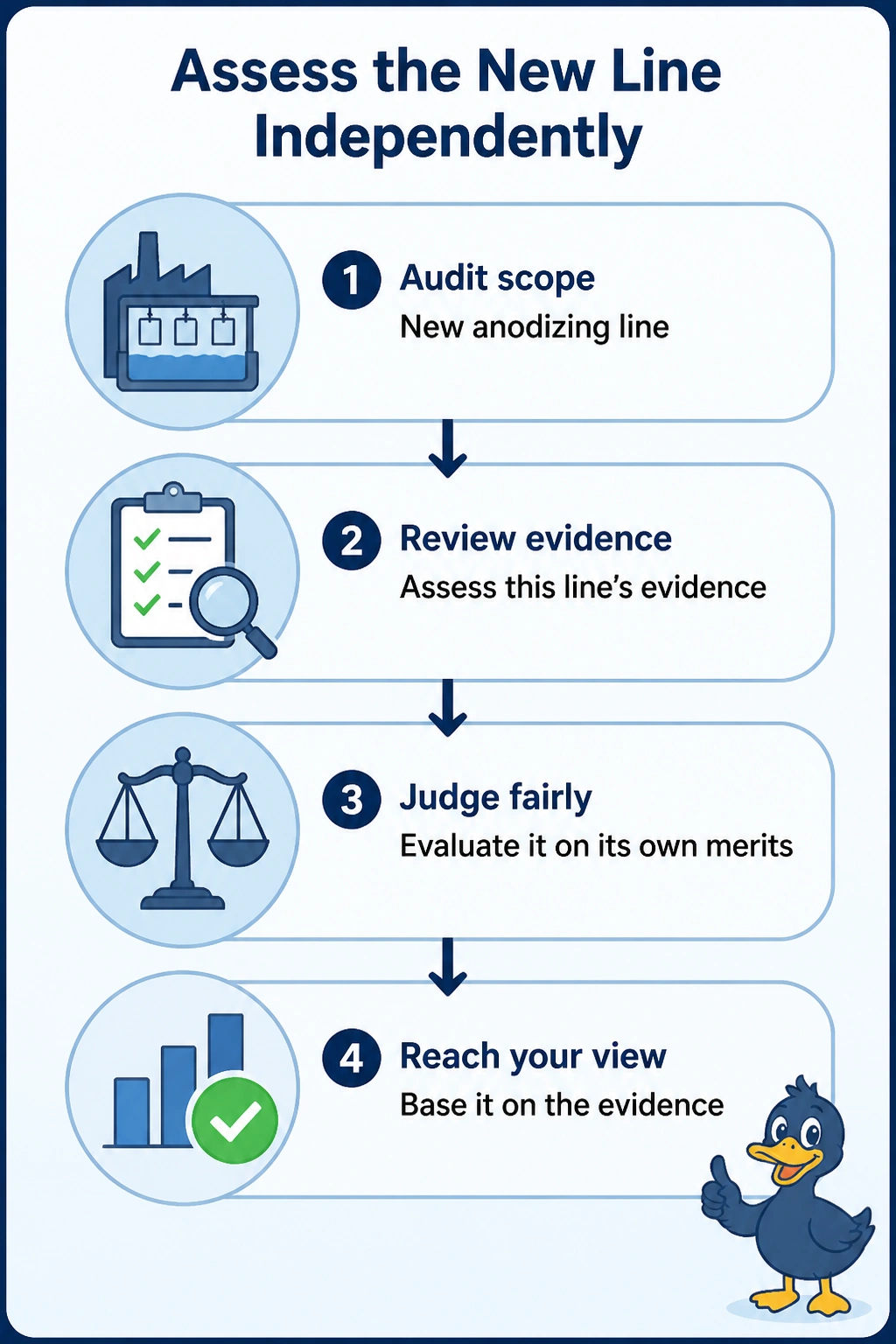
Past success in one department can lull you into expecting perfection everywhere else in the building. To beat confirmation bias, you have to treat the new anodizing line as a fresh test and let the evidence speak for itself. The trap is coasting on yesterday's clean report.
Full Explanation
To guard against confirmation bias—the tendency to look only for evidence that supports a preexisting favorable impression—the auditor must evaluate new line evidence strictly on its own merits against the applicable criteria. Choosing to use last year's clean audit report to reduce sample sizes improperly carries over past performance from an unrelated process to an unproven chemical line. Electing to skip operator interviews and review only summary dashboards filters out frontline anomalies and prevents the auditor from testing real-time tank controls and operator understanding. To assume the anodizing controls match the machining department ignores distinct process risks such as bath chemistry, racking, and effluent controls. Keep in mind the exam caveat that confirmation bias works in both directions: an auditor expecting a troubled site to fail can just as easily overlook compliant practices if they stop looking for balanced evidence. As a concrete operational check, build your anodizing sampling plan from the new line's process-flow diagram and risk register rather than prior machining checklists.
Prefer to study offline? Printable PDF study book + test engine ($7.50, unofficial). These questions stay free here.