
During an audit of a multi-product contract electronics assembler, the auditor must review solder-joint inspection records across three lines: a high-volume consumer line, a moderate-volume industrial line, and a low-volume aerospace line with strict reliability specs. Which sampling approach ensures proportional and risk-appropriate coverage across all three lines?
Select an answer to reveal the explanation.
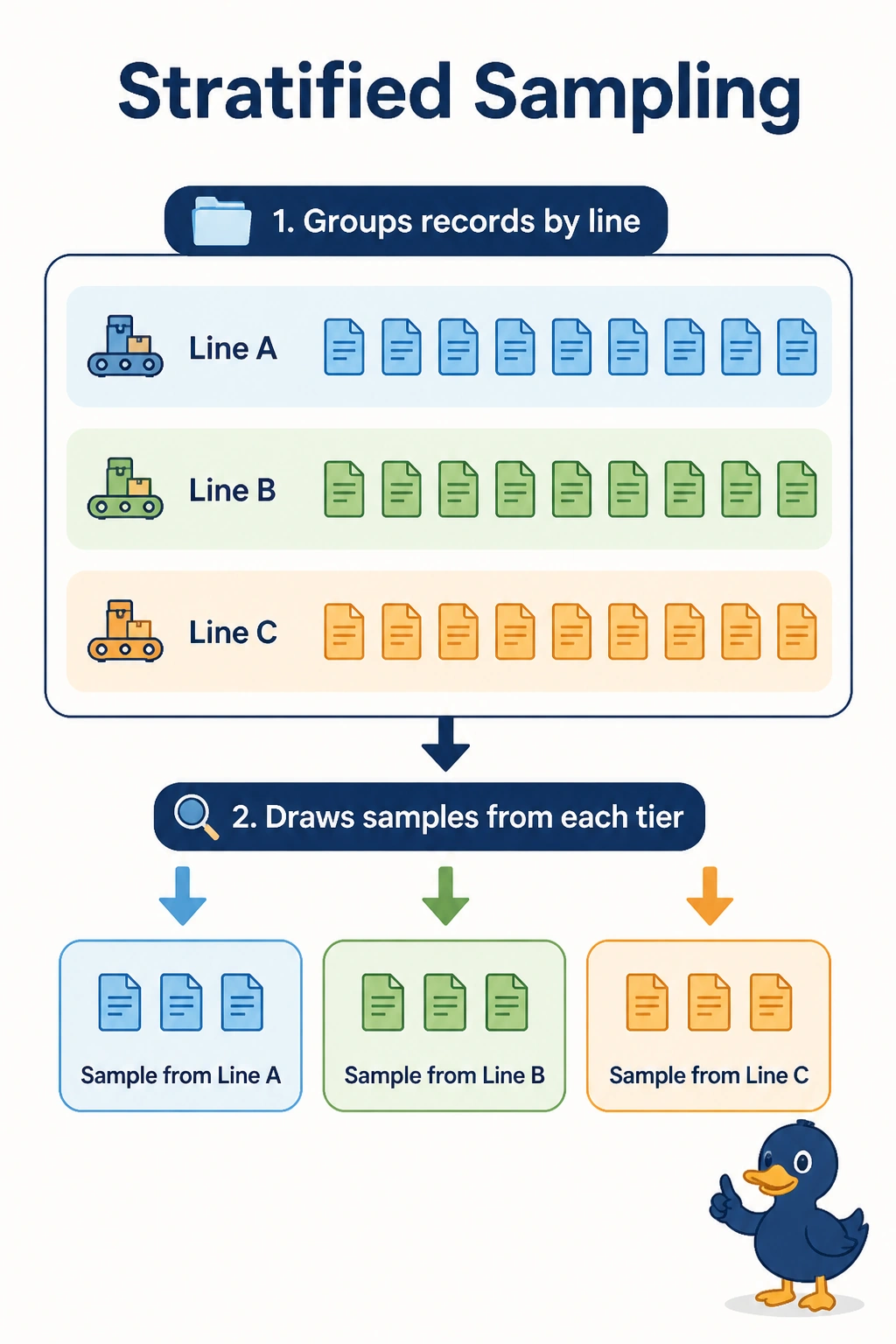
Short Explanation
If you toss all three production lines into one big hat, a low-volume aerospace line can easily get skipped by pure chance. Grouping the records by line first lets you ensure every risk tier gets examined.
Full Explanation
To guarantee coverage across distinct production tiers, the auditor should use Stratified sampling that groups records by line and draws samples from each tier. Stratification divides a heterogeneous population into meaningful subgroups so that low-volume, high-consequence lines are intentionally represented alongside high-volume lines. Using Convenience sampling of whatever binders happen to sit closest to the quality desk introduces severe selection bias and lets facility layout dictate audit scope. Relying on Simple random sampling drawn from one combined list of all three lines' inspection records risks under-sampling or completely skipping a critical product family simply because it accounts for fewer total lots. Choosing Haphazard sampling of whichever line is running when the auditor reaches the floor lacks systematic coverage and can leave industrial and aerospace controls unverified depending on timing. As a caveat, within each stratum you should still draw records systematically or randomly rather than letting the auditee hand-pick favorites. Before pulling files, list each distinct production line or risk tier and set a minimum sample count for every subgroup.
Prefer to study offline? Printable PDF study book + test engine ($7.50, unofficial). These questions stay free here.