
While auditing a hospital billing department, an auditor verifies that staff follow every step of the documented invoice-review procedure with zero errors, but notices that manual data re-entry slows processing. How should the auditor record this observation?
Select an answer to reveal the explanation.
Short Explanation
Think of a nonconformity as a broken promise, not a missed wish list—if the team met every written rule, you cannot write them up for a violation. The trap is letting personal efficiency preferences turn into a formal nonconformity when an opportunity for improvement fits.
Full Explanation
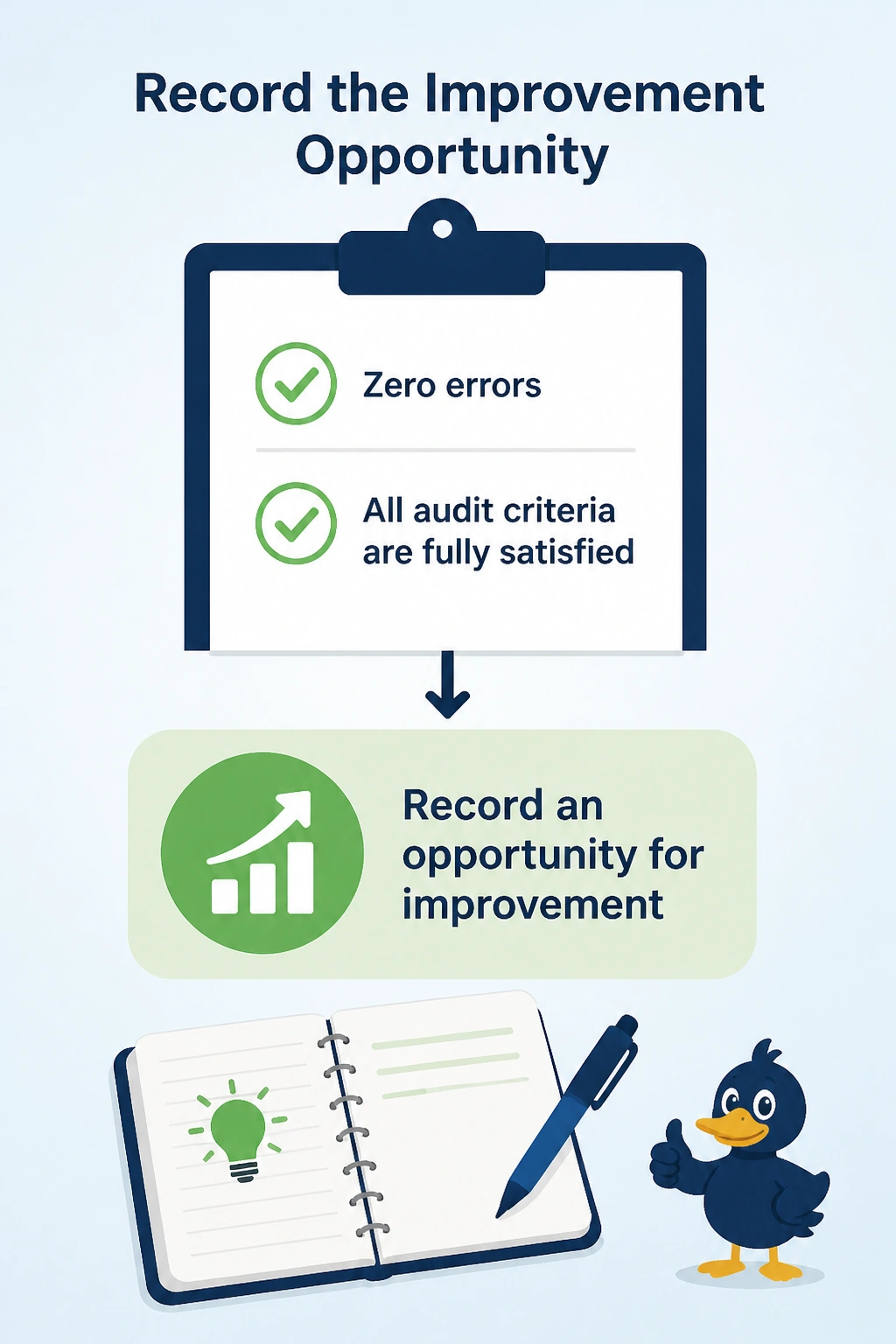
An audit finding is a nonconformity only when objective evidence shows a failure to fulfill a stated requirement, so the right classification is Record an opportunity for improvement since all audit criteria are fully satisfied. Sharing value-adding observations helps the organization streamline workflows without penalizing staff who followed the approved procedure accurately. Log a minor nonconformity because manual re-entry creates unnecessary operational waste is incorrect because an auditor cannot invent a requirement that does not exist in the procedure, standard, or customer contract. Issue a formal corrective action request requiring automated software integration fails twice: it treats a compliant process as nonconforming and improperly dictates a specific technical solution. Omit the observation completely because efficiency is outside quality audit scope misses the chance to deliver useful, non-binding feedback that supports continual improvement. As a caveat, an opportunity for improvement must always be clearly labeled as optional so the auditee does not mistake it for a mandatory finding. As an operational check, verify every proposed nonconformity against a specific, documented criterion before adding it to the draft report.
Prefer to study offline? Printable PDF study book + test engine ($7.50, unofficial). These questions stay free here.