
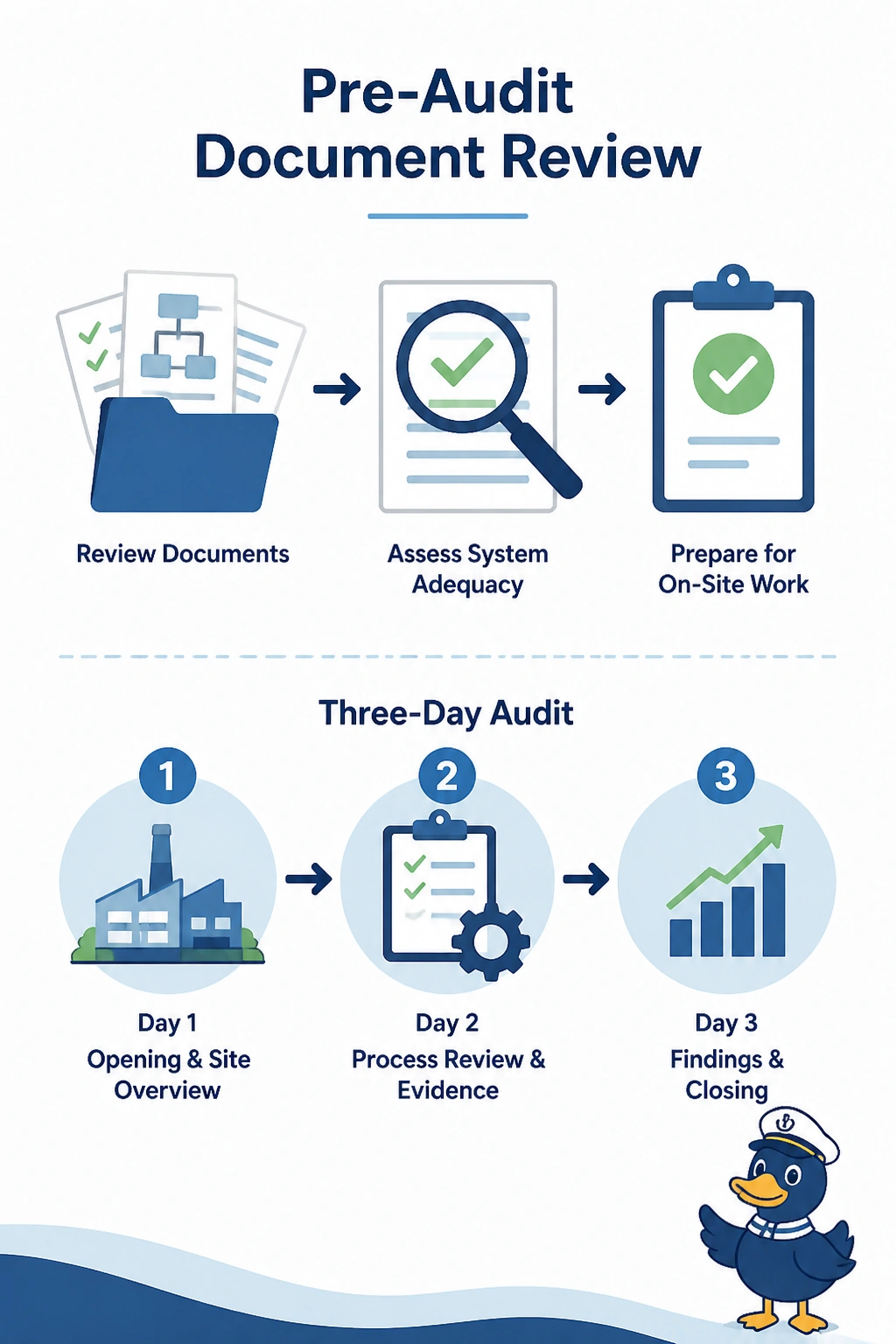
Before traveling to a diagnostic reagent plant for a three-day audit, the lead auditor reviews the facility's quality manual, document-control procedure, and recent management review minutes to verify whether the documented system addresses all applicable audit criteria. Which audit activity is the lead auditor performing?
Select an answer to reveal the explanation.
Short Explanation
Think of this step like reading the blueprint before you walk the job site. You want to confirm the documented system actually covers the rules on paper before spending scarce on-site hours. The trap is confusing preparation with fieldwork or closing out old findings.
Full Explanation
Performing "A document review to assess system adequacy prior to on-site work" allows the auditor to evaluate whether the auditee's written policies, procedures, and records align with the audit criteria before fieldwork begins. Identifying missing procedures or structural gaps early helps the audit team tailor checklists, allocate interview time, and flag major documentation deficiencies without wasting on-site days. By contrast, "An opening meeting conducted remotely to align on the audit schedule" focuses on logistics, scope confirmation, and communication protocols rather than evaluating manual adequacy. Similarly, "A follow-up verification to confirm closure of prior audit findings" occurs after corrective actions have been submitted from an earlier audit, not as an initial baseline adequacy check. Choosing "A trace-forward sampling exercise across completed production lots" describes an on-site execution technique used to test operational compliance across batch records rather than pre-visit system adequacy. As a practical caveat, passing a document review only proves the system is adequate on paper; it never guarantees operational effectiveness. Before arriving on site, confirm you have the current controlled revision of each procedure and log any documentation gaps to verify during interviews.
Prefer to study offline? Printable PDF study book + test engine ($7.50, unofficial). These questions stay free here.