
A middle-aged adult with chronic heartburn and suspected small hiatal hernia is scheduled for fluoroscopic barium evaluation, able to tolerate Trendelenburg and multiple positions. Which contrast examination and maneuver should the technologist prepare to best demonstrate reflux and sliding hernia?
Select an answer to reveal the explanation.
Short Explanation
You coax a shy hernia out by tipping gravity in your favor. Head-down RAO spots are your trapdoor test that invites reflux into view.
Full Explanation
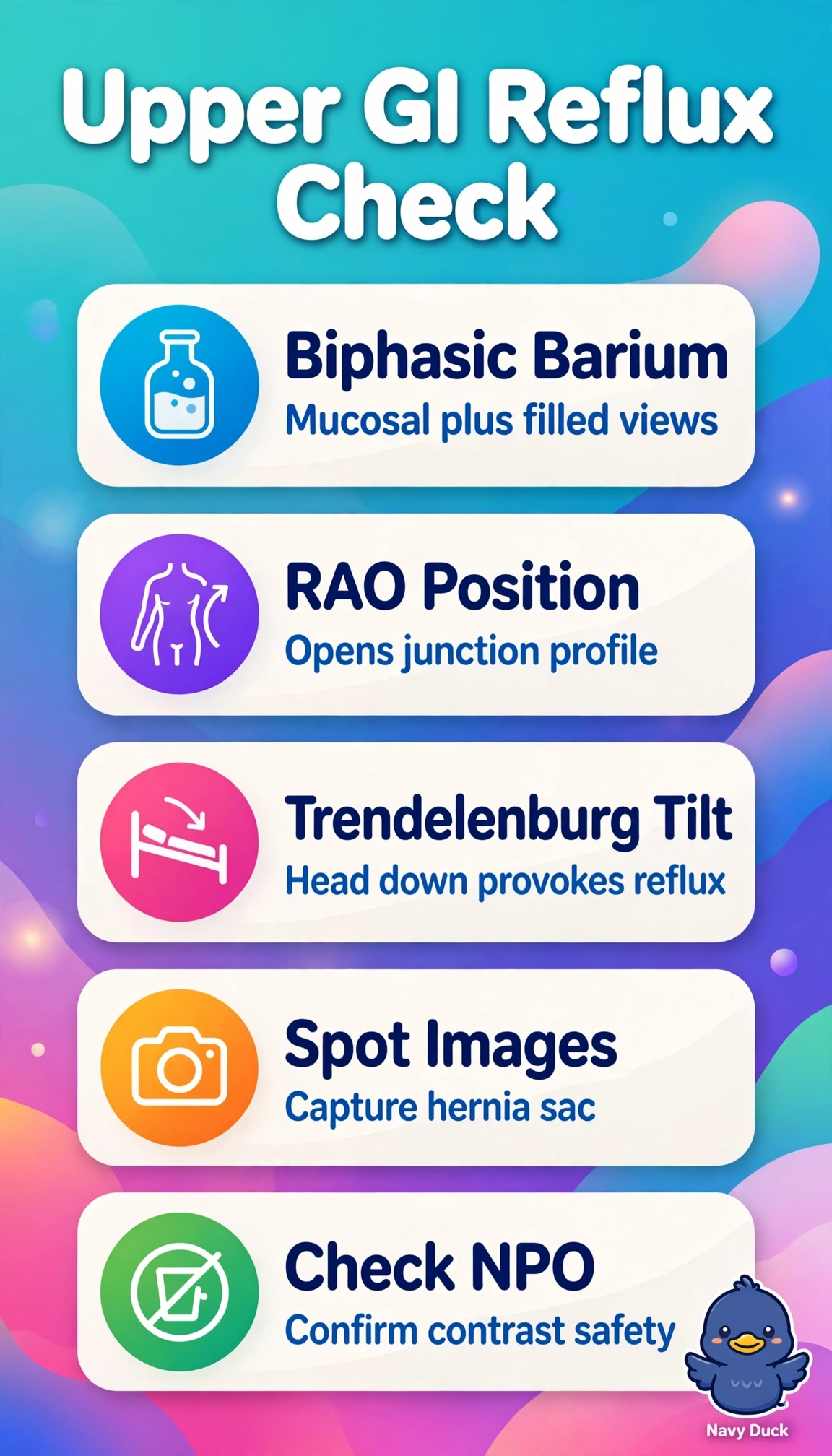
The biphasic upper GI is preferred for chronic heartburn with suspected small sliding hiatal hernia because it pairs double-contrast coating to detect esophagitis and subtle mucosal injury with single-contrast distension to assess motility and anatomy, while RAO positioning profiles the gastroesophageal junction away from the spine and Trendelenburg uses gravity to distend the fundus, stress the lower esophageal sphincter and provoke reflux and transient herniation during spot imaging with cough or Valsalva. The upright-only biphasic approach fails by physics because without head-down tilt a small reducible hernia stays reduced and reflux may not occur, lowering sensitivity despite good mucosal detail. The single-contrast Trendelenburg approach fails by contrast technique because dense full-column barium obscures fine mucosal disease that explains chronic symptoms, even though provocation is preserved. The dedicated biphasic esophagram with Trendelenburg fails by coverage because limiting views to the esophagus inadequately documents the cardia, fundus and diaphragmatic hiatus needed to confirm sliding hernia and exclude gastric disease. An exam caveat is that provocation is transient and operator dependent, so mistimed spots cause false negatives even with correct positioning. As a practical check, ensure both barium densities are ready, labeled RAO Trendelenburg spots show the hiatus during observed reflux, and symptoms during the maneuver are documented.