
A 38-year-old warehouse worker with chronic neck stiffness and prior whiplash needs assessment of atlantoaxial stability and neural foramina, able to flex and extend slowly without numbness. Which cervical spine projection series including flexion, extension, and obliques best answers the clinical question?
Select an answer to reveal the explanation.
Short Explanation
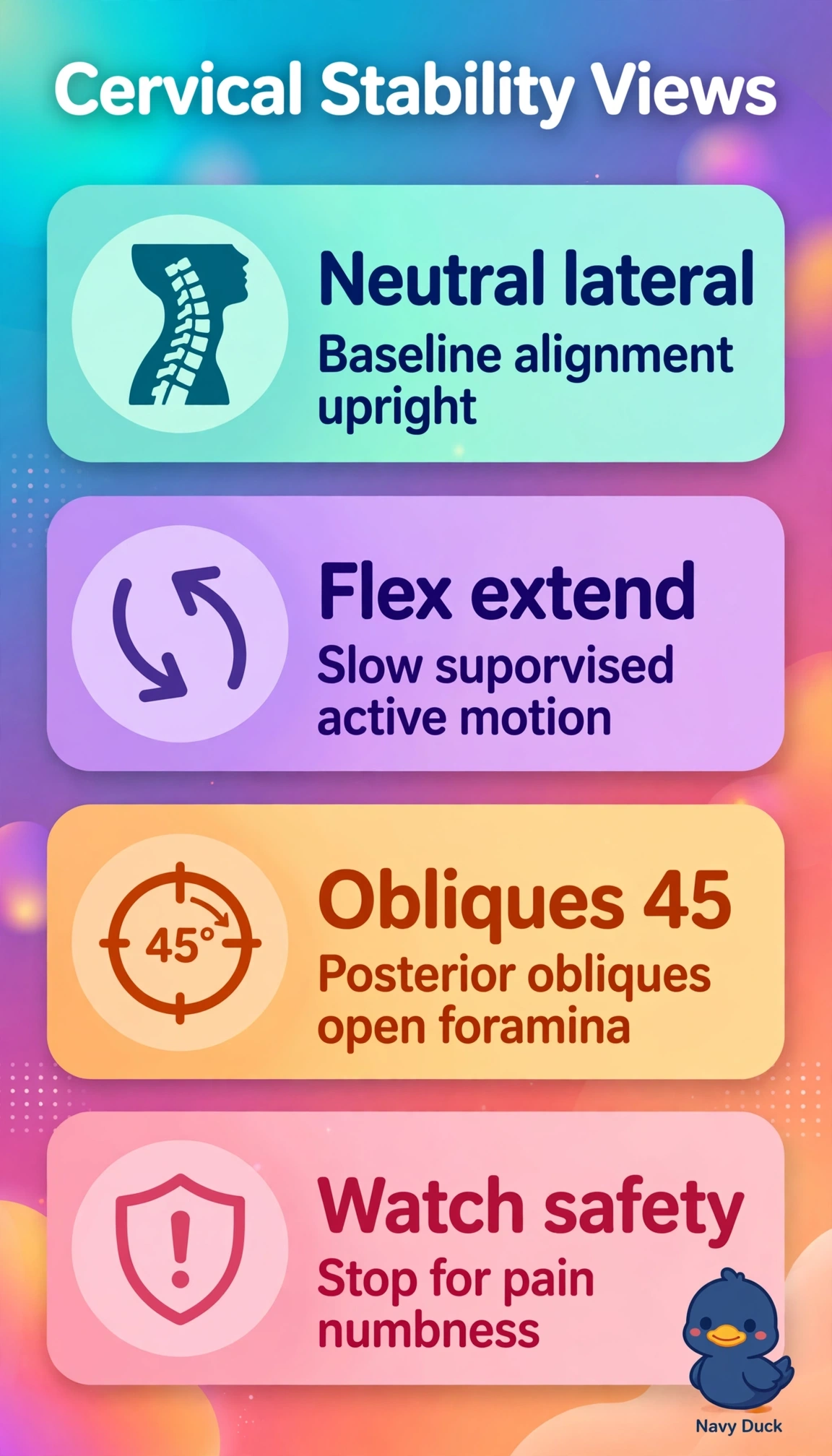
You need motion plus angled views to see stability and openings together. Neutral with controlled bends and 45-degree obliques opens both answers.
Full Explanation
The upright series with neutral lateral, active flexion-extension laterals, and bilateral 45-degree posterior obliques under support and supervision answers both clinical needs because neutral lateral gives baseline alignment, flexion-extension under physiologic load shows atlantoaxial motion and atlantodental interval change in a patient able to move slowly without numbness, posterior obliques at 45 degrees open the mid and lower cervical foramina for stenosis assessment, and erect supervised positioning preserves function with safety. The recumbent variant fails on biomechanics because supine unloading can reduce mobile instability and mask abnormal motion even when flexion and extension are performed. The unilateral oblique variant fails on completeness because foraminal symptoms require left-right comparison and one side leaves contralateral narrowing or osteophyte encroachment undetected. The flexion-only variant fails on dynamics because instability may appear only in extension, so one direction gives an incomplete stability study. An exam caveat is to screen clearance and stop motion at once for numbness, weakness, severe pain, or dizziness, never forcing movement with suspected acute unstable injury. A practical check is to verify true lateral positioning, true 45-degree obliquity with open foramina, stable support, and measured comparison of alignment across neutral, flexion, and extension.