
A newly pregnant radiologic technology student asks about risks from a correctly collimated abdominal exposure done before pregnancy was known, concerned about childhood effects and first-trimester organ formation. Which tissue radiosensitivity and somatic, embryo, and fetus effect explanation is accurate for counseling?
Select an answer to reveal the explanation.
Short Explanation
You can counsel with biology rather than dismissal by separating the different kinds of risk. Rapid cell division during organogenesis explains why timing matters, while threshold and no-threshold effects should not be confused.
Full Explanation
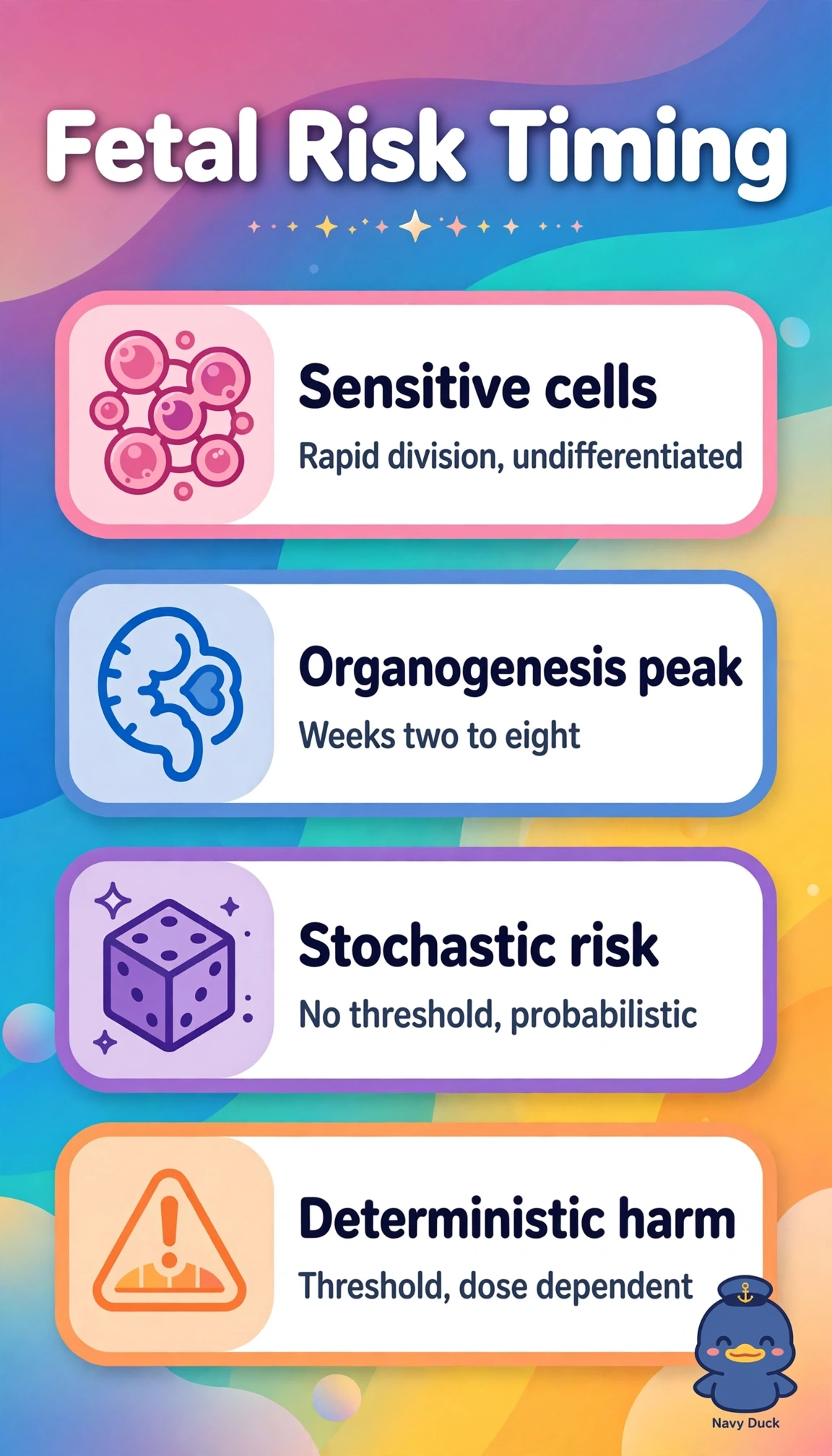
Accurate counseling reflects Bergonie-Tribondeau biology: rapidly dividing, undifferentiated embryonic cells are most radiosensitive during organogenesis, about 2–8 weeks after conception; differentiated late-fetal tissues are relatively resistant. Stochastic childhood cancer risk is modeled as having no threshold: probability increases with dose, with no known safe cutoff, although the absolute risk from one diagnostic abdominal exposure remains low. Deterministic effects, such as malformations and growth or neurologic deficits, require damage to critical cells and have thresholds, commonly referenced near 100–200 mGy; routine diagnostic doses are not expected to cause them. The claim that stochastic childhood risk occurs only above a safe threshold confuses these risk models and falsely implies zero risk below a cutoff. The claim that peak sensitivity occurs during late fetal growth confuses bulk growth with organ differentiation, understating first-trimester vulnerability. The claim that deterministic malformations have no threshold implies that any dose can cause them and overstates low-dose harm. Exam caveat: distinguish threshold from no-threshold effects and organogenesis from the fetal period, since stems may test this distinction. Practical check: establish gestational age at exposure, estimate fetal dose with a physicist when needed, document counseling, and reinforce collimation, ALARA, and future pregnancy screening without withholding indicated imaging.