
An adult with a painful shoulder after a fall cannot abduct the arm, and the physician suspects anterior dislocation with a Hill-Sachs defect. The technologist must choose views that avoid further injury. Which shoulder imaging combination best evaluates dislocation and humeral head defects without abduction?
Select an answer to reveal the explanation.
Short Explanation
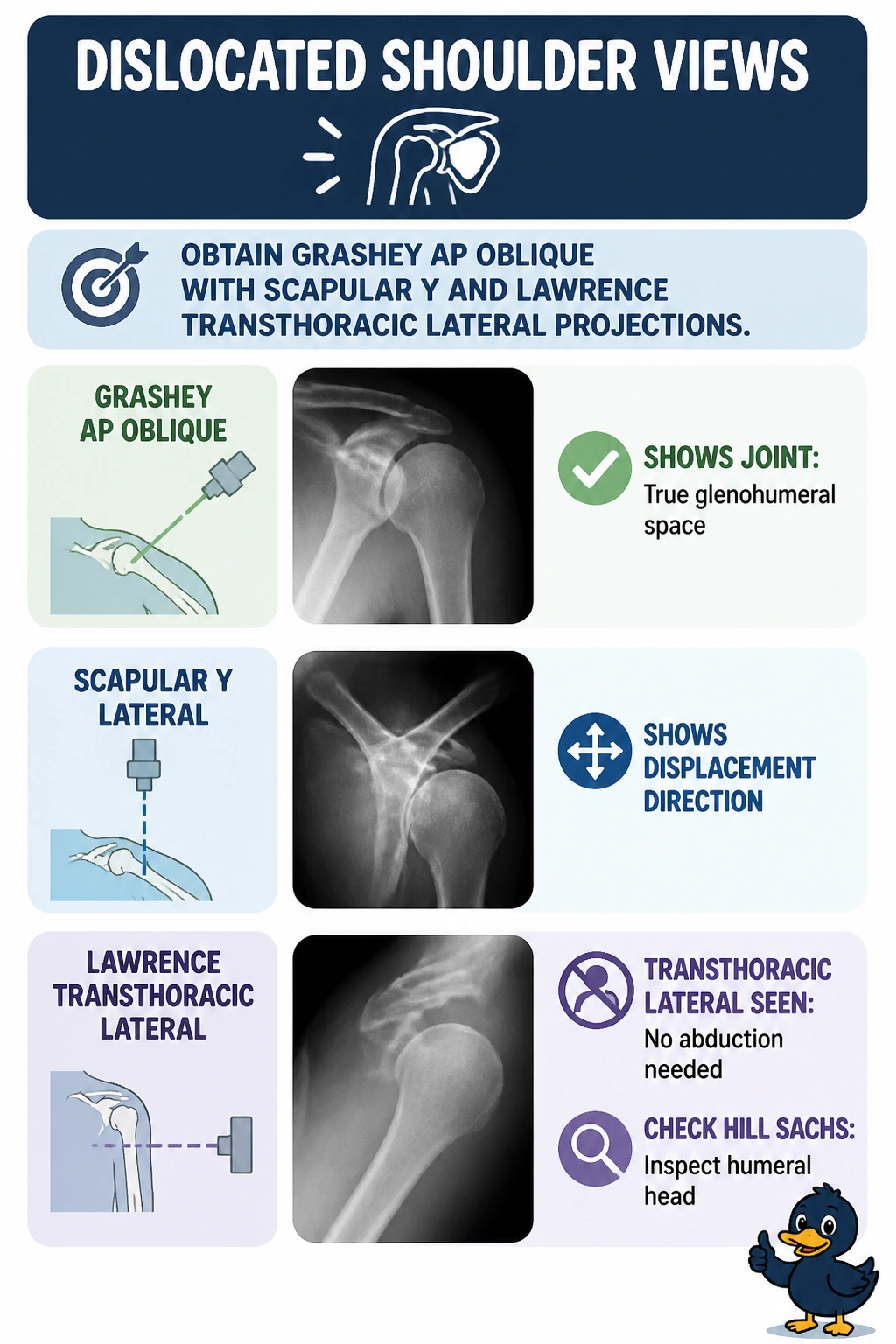
You protected that shoulder while still getting the dislocation story from three angles. Scapular Y reveals humeral head position like a side view of a ball on a tee.
Full Explanation
The correct combination succeeds because the Grashey true AP oblique opens the glenohumeral joint in the scapular plane without moving the injured arm, the scapular Y provides a perpendicular oblique demonstrating anterior versus posterior displacement of the humeral head relative to the glenoid and coracoid, and the Lawrence transthoracic lateral supplies a second lateral projection with the arm at the side by imaging through the thorax, together confirming dislocation direction and showing a large Hill-Sachs impaction when present, all without abduction or rotation that could worsen injury. The axillary-based combination fails by positioning concept despite excellent articular detail, because the inferosuperior axillary view requires abduction to clear the joint space, violating the stated no-abduction safety constraint for a patient who cannot abduct after trauma. The rotation plus Stryker-based combination fails by orthogonality concept, because although AP views in internal and external rotation and the Stryker notch tangential view elegantly profile the posterolateral humeral head for a Hill-Sachs lesion, they provide no true scapular Y or transthoracic lateral to establish dislocation direction and they demand arm rotation and, for the Stryker notch view, raising the hand over the head, which an acutely dislocated shoulder cannot tolerate. The outlet-based combination fails by indication concept, because the supraspinatus outlet view is designed to assess acromial morphology and subacromial space for impingement rather than to provide lateral assessment of humeral displacement or tangential detail of a Hill-Sachs defect. Exam caveat is to distinguish a trauma shoulder series without abduction from routine or impingement series that assume cooperative motion. Practical check is to keep the injured arm adducted at the side, rotate the body rather than the arm for obliques, and verify neurovascular status and immobilization before exposure.