
A radiography student is holding a trauma patient during mobile C-arm fluoroscopy in the ED, wearing a lead apron but unsure where to stand relative to tube, patient and detector. Which positioning best minimizes personnel exposure from the dominant exposure source?
Select an answer to reveal the explanation.
Short Explanation
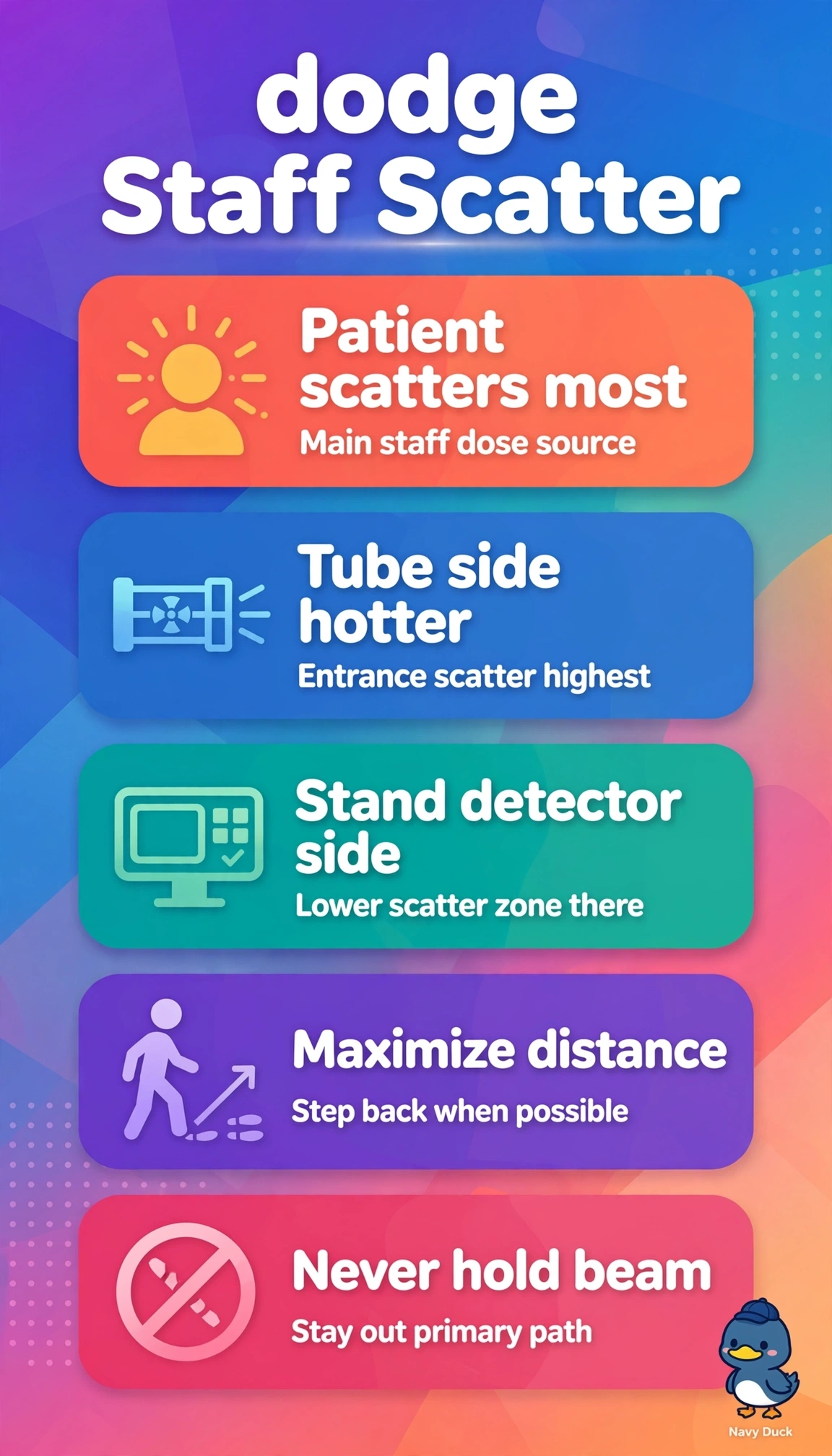
You’re right to think about where the scatter comes from: the patient is its main source during fluoroscopy. Stand on the detector side, away from the tube, and step back as your holding duties allow.
Full Explanation
In mobile C-arm fluoroscopy, the patient is the dominant source of staff exposure: Compton scatter from the irradiated volume radiates outward, and entrance-side scatter on the tube side is several times more intense than exit-side scatter toward the detector. Standing on the detector side, away from the tube, and as far from the patient as your holding duties allow combines favorable geometry with distance for ALARA. Standing close to the patient on the detector side is not made safe by the tube housing, which does not absorb essentially all scatter; proximity still leaves hands, face and other unshielded tissues in a higher fluence. Stepping well back on either side uses distance, but treats the sides as equivalent and ignores the marked tube-to-detector asymmetry, so the same distance provides less protection on the tube side. Holding close to the table while relying on a wraparound apron and thyroid collar is also insufficient: apparel attenuates only covered anatomy and does not replace time, distance and positioning, leaving the head, eyes and extremities exposed. Exam caveat: do not confuse low-level tube-housing leakage with patient scatter; C-arm rotation can move the high-scatter entrance side. In practice, identify the tube before exposure, confirm tube versus detector side, hand off holding if possible, step back on the detector side during live fluoroscopy, and use tight collimation and pulsed technique to reduce the scattering volume.