
Primary diagnostic monitors in a busy outpatient center look washed out in bright ambient light, with subtle liver lesions harder to see than on neighboring displays despite identical images. Which display monitor QA action using GSDF and luminance best restores consistent diagnostic presentation?
Select an answer to reveal the explanation.
Short Explanation
You cannot judge subtle contrast on an uncalibrated screen in glare. Measured light levels tied to GSDF keep grays honest across monitors.
Full Explanation
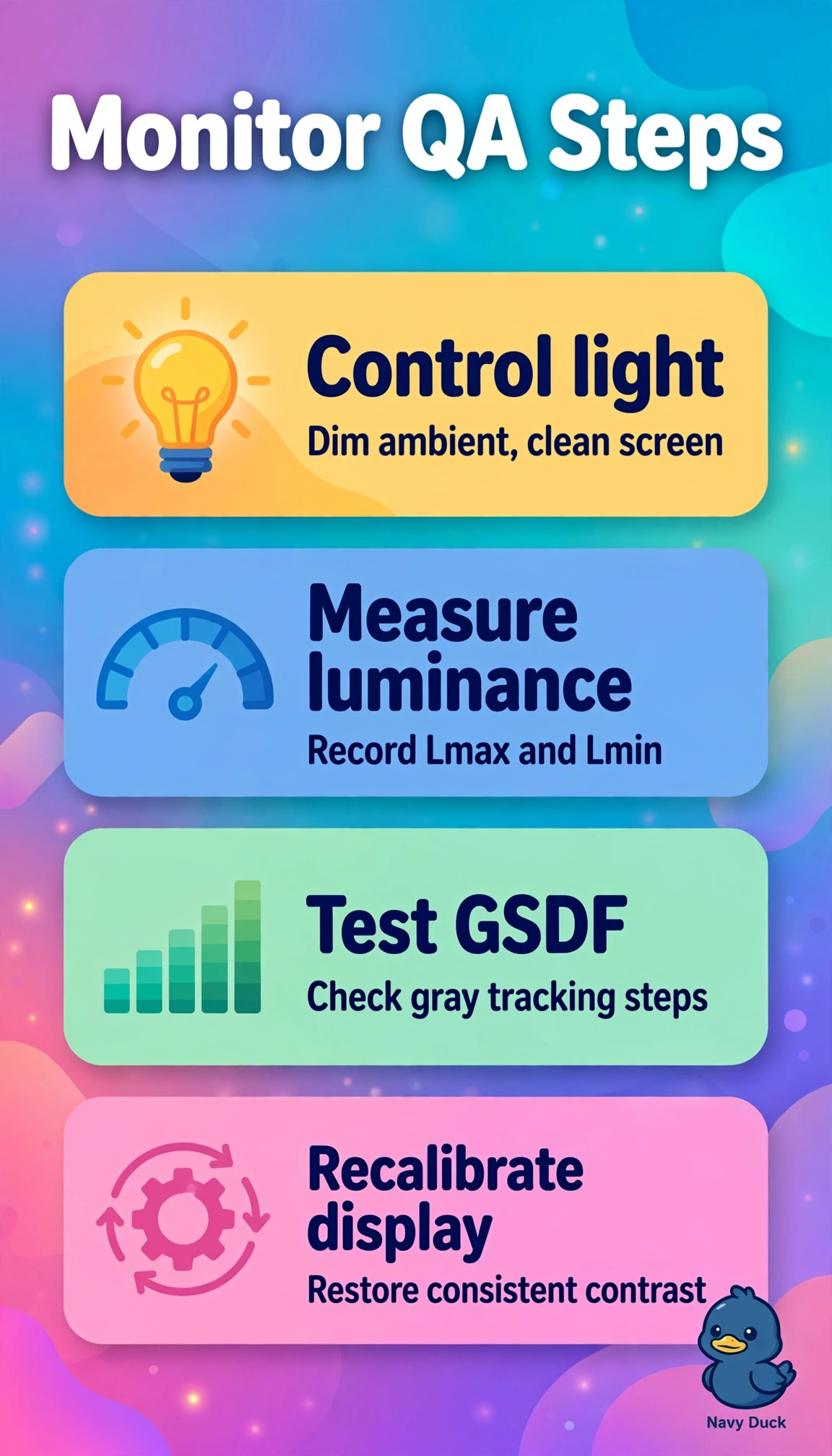
Consistent diagnostic presentation requires controlling viewing conditions and verifying perceptual linearity, so dimming bright ambient light reduces veiling glare that washes out low contrast, cleaning removes scatter that lowers effective contrast, measuring both Lmax and Lmin establishes the range and ratio under actual use, verifying conformance to the Grayscale Standard Display Function confirms uniform just-noticeable differences across grays, and recalibrating restores matching for subtle liver lesions. Leaving bright ambient illumination unchanged while cleaning, measuring, verifying GSDF and recalibrating fails by reflection physics because added ambient lifts blacks and compresses dark-region contrast even when the curve is correct. Adjusting only to target luminance ratio and brightness after dimming and measuring without checking GSDF tracking fails by standardization because peak ratio alone does not guarantee equal perceptual steps, so mid and dark grays can still diverge. Measuring only peak Lmax and high-level conformance after dimming and cleaning fails by low-end sensitivity because subtle hepatic lesions depend on near-black discrimination where Lmin elevation and glare matter most, so omitting Lmin leaves the relevant threshold untested. Exam caveat is that visual adequacy or peak luminance acceptance never substitutes for measured GSDF conformance across the full range with a calibrated meter. Practical check is to warm up the monitor, set light to reading specification, clean the faceplate, measure Lmax and Lmin with ambient present, evaluate GSDF deviation and recalibrate then reverify before resuming interpretation.