
An emergency adult with severe abdominal pain cannot stand, and the surgeon needs to know if free intraperitoneal air is present before calling the operating room. Supine images show no clear extraluminal gas. Which abdominal position should the technologist use next to best demonstrate pneumoperitoneum without an upright view?
Select an answer to reveal the explanation.
Short Explanation
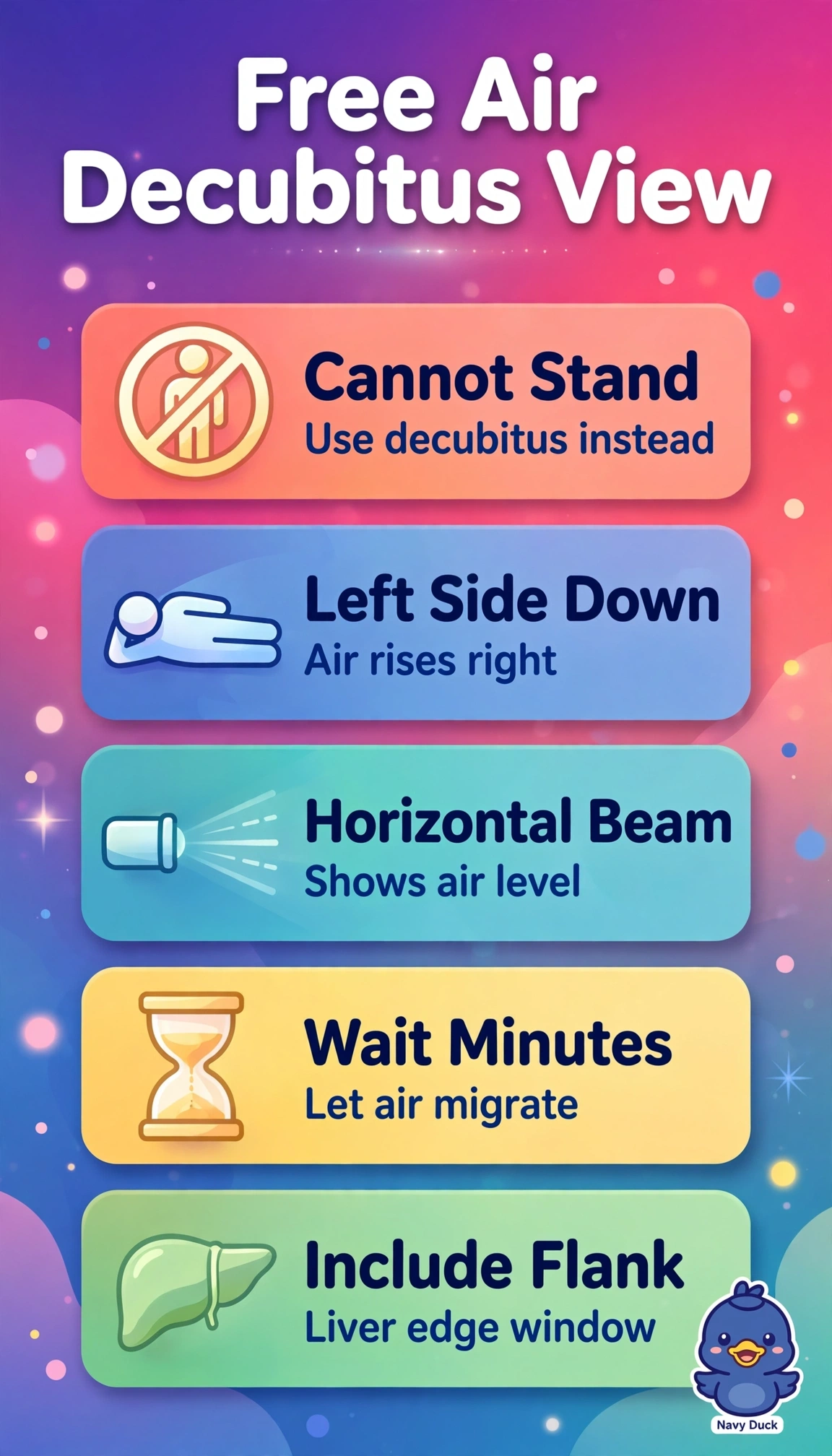
You can let sneaky free air rise where it is easier to see. With the patient left side down, a horizontal beam gives you a bubble level for pneumoperitoneum.
Full Explanation
Left lateral decubitus with a horizontal central ray is the best choice because free intraperitoneal air rises to the nondependent right flank, between the liver and abdominal wall. Allow several minutes in this position so the air can migrate; this makes the view a useful substitute when the patient cannot stand. Supine positioning with a vertical beam and immediate exposure does not use gravity or a horizontal ray to separate small amounts of free air, which may remain anterior and be obscured by bowel gas, as in the unclear initial images. Prone positioning with anterior abdominal compression is intended to displace bowel or redistribute gas within the bowel lumen, not to show extraluminal air rising to a nondependent interface; pressure may also worsen pain without creating the needed air-fluid level. Right lateral decubitus with an angled cephalad beam and immediate exposure makes the liver dependent, obscures the optimal right-flank window, and omits both the horizontal beam and the time needed for air to rise. Exam caveat: decubitus positioning only helps when the beam is horizontal and the patient has time to let free air collect. Practical check: keep the patient left side down for about five to ten minutes per protocol, use a horizontal beam, include the diaphragm or flank fully, and mark the side.