
Two forearm images show different problems: one has uniform sand-like grain over bone and soft tissue, the other has elongated radial heads with sharp edges but wrong shape. Technique charts and processing were verified. Which image evaluation should the technologist record to distinguish contrast, resolution, distortion and mottle?
Select an answer to reveal the explanation.
Short Explanation
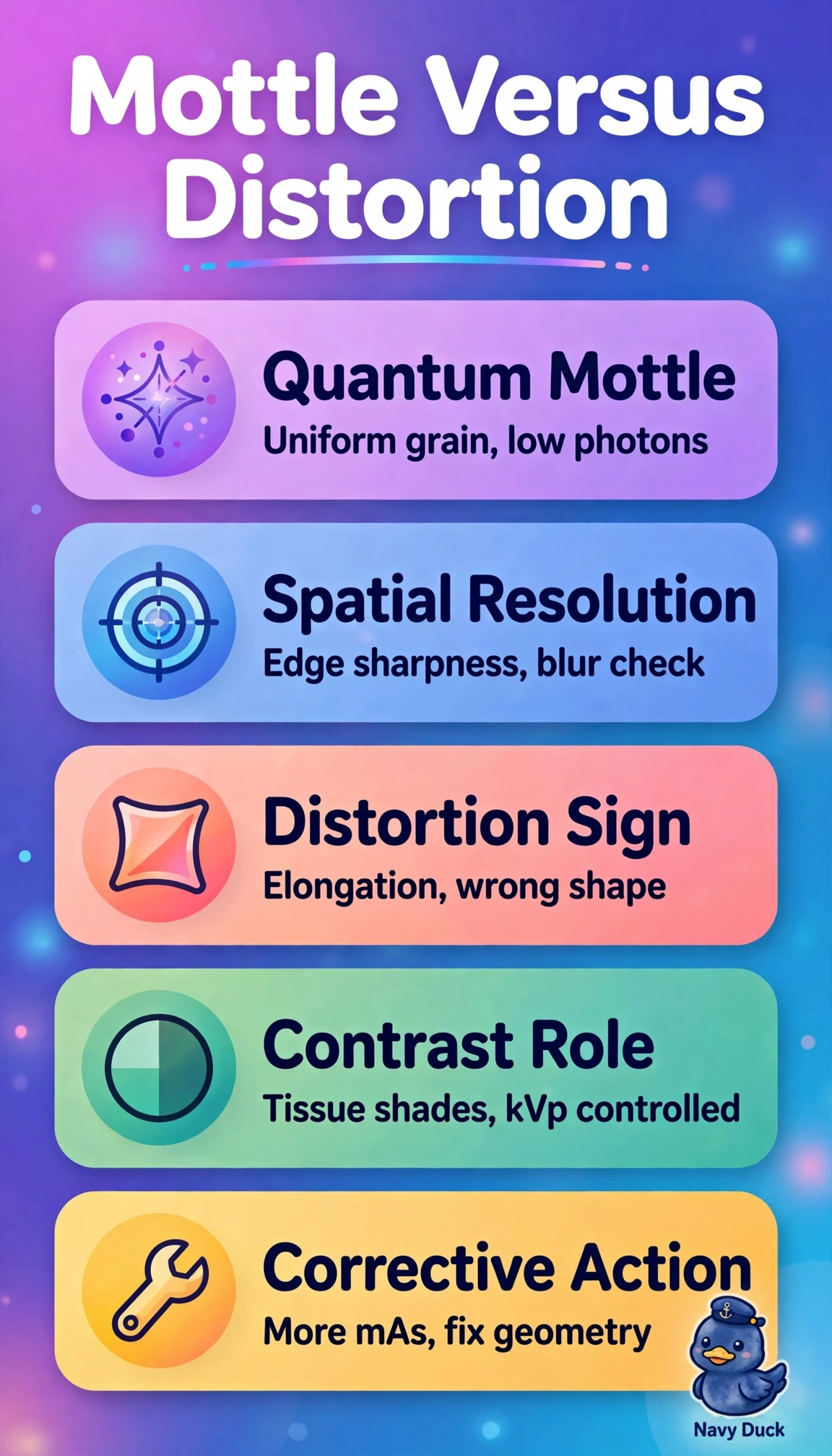
You're sorting noise from shape shift here. Spotty mottle means starved photons while stretch means geometry stretched, like bad reception versus funhouse mirror.
Full Explanation
The grainy image fits quantum mottle because too few photons reaching the detector produce random statistical noise seen as uniform sand-like grain over both bone and soft tissue, which persists despite verified technique charts and processing and therefore points to underexposure rather than chemistry or contrast settings, while the elongated radial heads with sharp edges but wrong shape fit geometric shape distortion from tube angulation or positioning because shape is altered without loss of edge sharpness, preserving spatial resolution and differing from contrast which controls gray-scale separation. The magnification-from-OID description fails by concept because increased object-detector distance produces uniform size enlargement with preserved proportions, not selective elongation with incorrect shape, so it misclassifies shape distortion as size distortion. The low-contrast-from-scatter description fails by concept because contrast governs fog and gray-scale range, not discrete grain noise, and the stem explicitly states technique and processing were verified, ruling out scatter fog or processor error as the cause of uniform mottle. The lost-resolution-from-motion description fails by concept because resolution governs sharpness and fine-detail separation, whereas the stem states edges remain sharp despite wrong shape, which excludes motion or focal-spot blur that would soften edges. Exam caveat is to test what changed: grain over all densities suggests mottle, altered grays suggest contrast, soft edges suggest resolution, and wrong shape with sharp edges suggests distortion rather than magnification or blur. Practical check is to verify positioning, centering, and tube angle with anatomic markers for the elongated view and to review exposure index and repeat with adequate mAs for the grainy view rather than only changing kVp, window, or focal spot.