
A 54-year-old needs 100 mL of iodinated contrast for CT angiography through a new IV, with small hand veins and a large antecubital vein available, and the power injector will use a high flow rate. Which venipuncture technique and route best ensures safe high-rate contrast delivery?
Select an answer to reveal the explanation.
Short Explanation
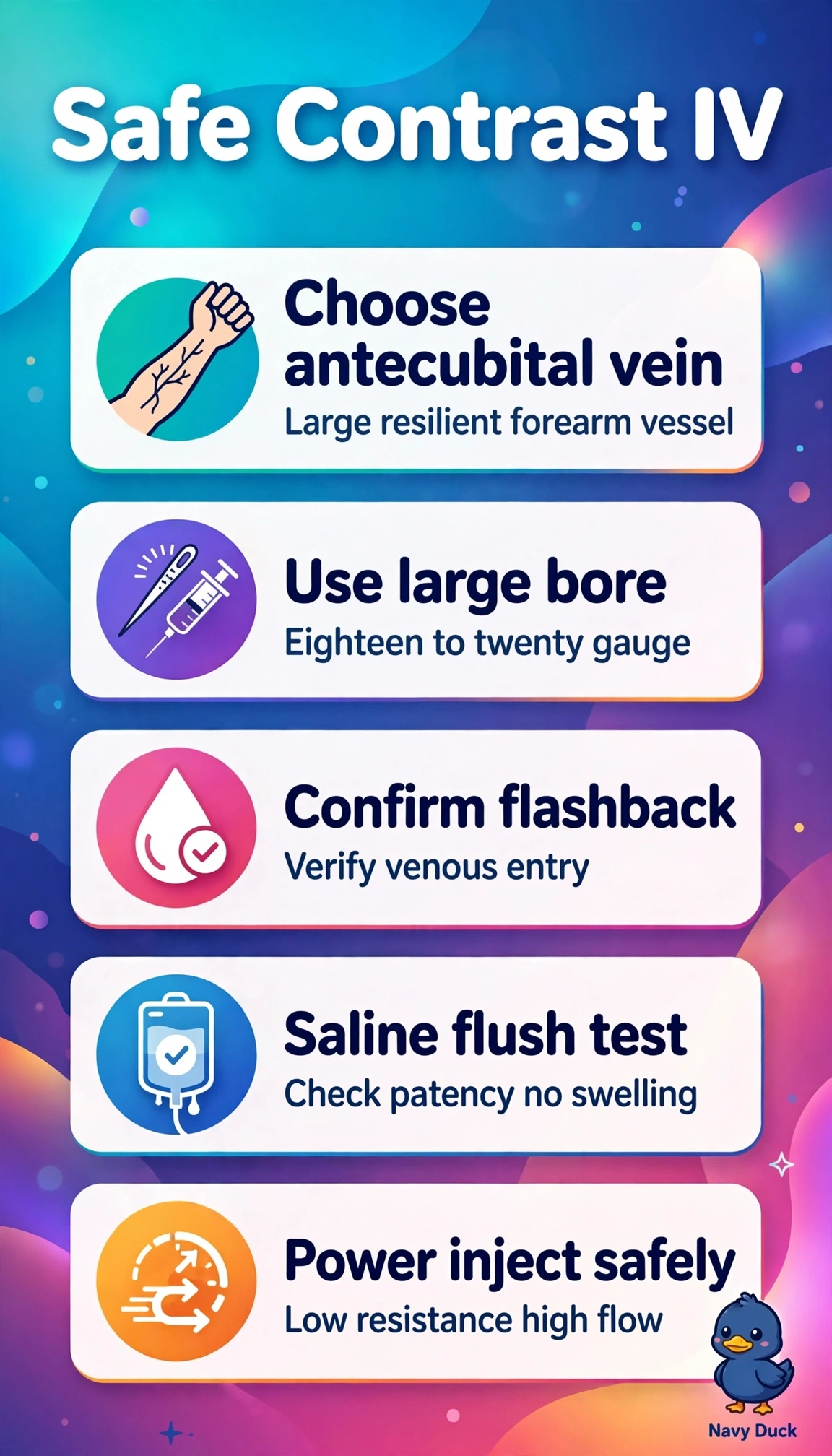
You'll want your contrast going through a wide-open lane, like a freeway rather than a tiny side street, so choose the large antecubital vein with an 18- to 20-gauge catheter. Don't forget to check it's working well with a saline flush so you've got safe flow without leaks under high pressure.
Full Explanation
High-rate CT angiography with 100 mL iodinated contrast by power injector requires large-caliber low-resistance access that remains patent under pressure, which is achieved by cannulating the large high-flow antecubital fossa vein with an 18- to 20-gauge catheter and confirming integrity with a saline test flush that mimics injection dynamics without contrast extravasation. Using the same antecubital site and saline check but with a 22-gauge catheter fails on flow physics because narrow lumen sharply increases resistance and required pressure, preventing reliable high flow and increasing catheter deformation, slowing of bolus timing, and extravasation risk. Using a dorsal hand vein with the same large bore and saline check fails on vascular capacity because small distal veins are thin, valvular, tortuous and poorly supported, so they cannot distend to accept a rapid large-volume bolus and readily rupture causing pain and contrast infiltration. Using correct antecubital large-bore access but verifying only by passive blood return fails on pressure testing because flashback proves intravascular position but not vessel integrity under power pressure, which only a brisk saline flush can reveal through resistance, pain or swelling. An exam caveat is that gauge is inverse to diameter, so power injection demands low-number large bores in large proximal veins, not routine small cannulas. As a practical check, briskly flush saline and inspect for easy flow without resistance or swelling before connecting the injector.