
An outpatient with productive cough, fever, and suspected pulmonary tuberculosis waits in a small holding area before chest imaging. Staff have surgical masks and an airborne room available. Which infection-control action should the team take to correctly interrupt the chain of infection at the mode of transmission?
Select an answer to reveal the explanation.
Short Explanation
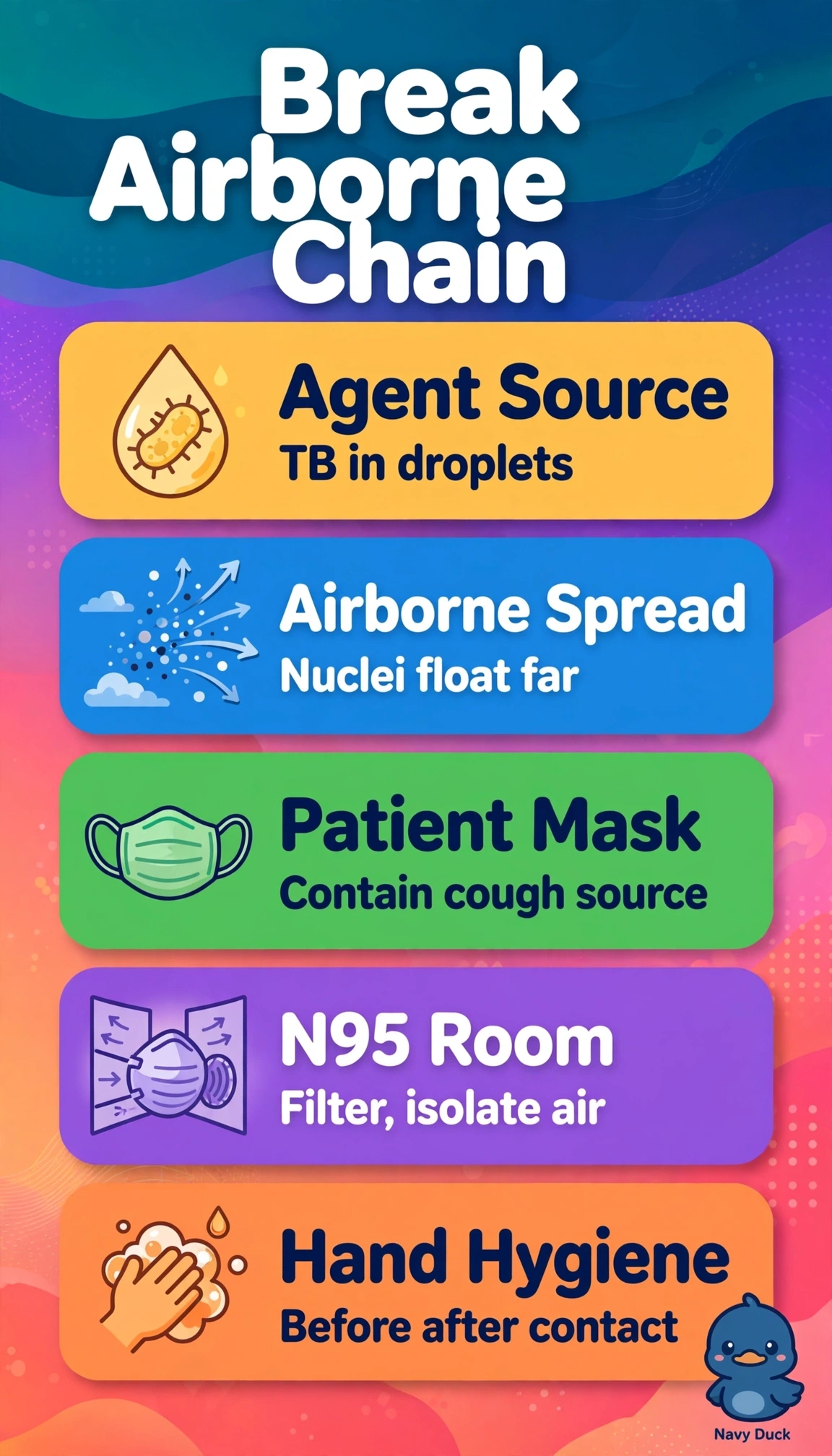
You stop tuberculosis where it travels, through the air across the room. Airborne separation is your closed door that breaks that specific link.
Full Explanation
The correct intervention targets the mode of transmission because Mycobacterium tuberculosis spreads by airborne droplet nuclei that remain suspended and travel with air currents, so source control with a patient mask plus an airborne infection isolation room, N95 or higher respirators, and limited transport interrupts inhalation exposure. Contact precautions with gown and gloves in a shared waiting area fail by concept because they address direct and indirect contact with surfaces and body fluids, not prolonged airborne suspension, leaving inhalation intact while adding unnecessary barriers for this pathogen. Staff surgical masks alone fail by concept because they provide droplet and splash protection but do not seal or filter small airborne nuclei to the required efficiency, so the respiratory protection link remains broken for staff. Droplet precautions in an open area fail by concept because droplets fall quickly within short distance while airborne nuclei persist, so keeping the patient in shared air without negative pressure and respirators misclassifies the transmission dynamics. Exam caveat: match tuberculosis, measles, and varicella to airborne versus influenza or pertussis to droplet on the exam, and practical check is to mask the patient immediately, close the room door, limit personnel, hand-hygiene before and after, and notify infection prevention.