
In fluoroscopy scheduling a 68-year-old with prior mild hives after ionic contrast needs an upper GI, has normal renal function, and asks why barium is chosen for bowel and a different agent is used for vessels despite both being called contrast. Which contrast property should the radiographer explain to justify agent selection and reaction risk?
Select an answer to reveal the explanation.
Short Explanation
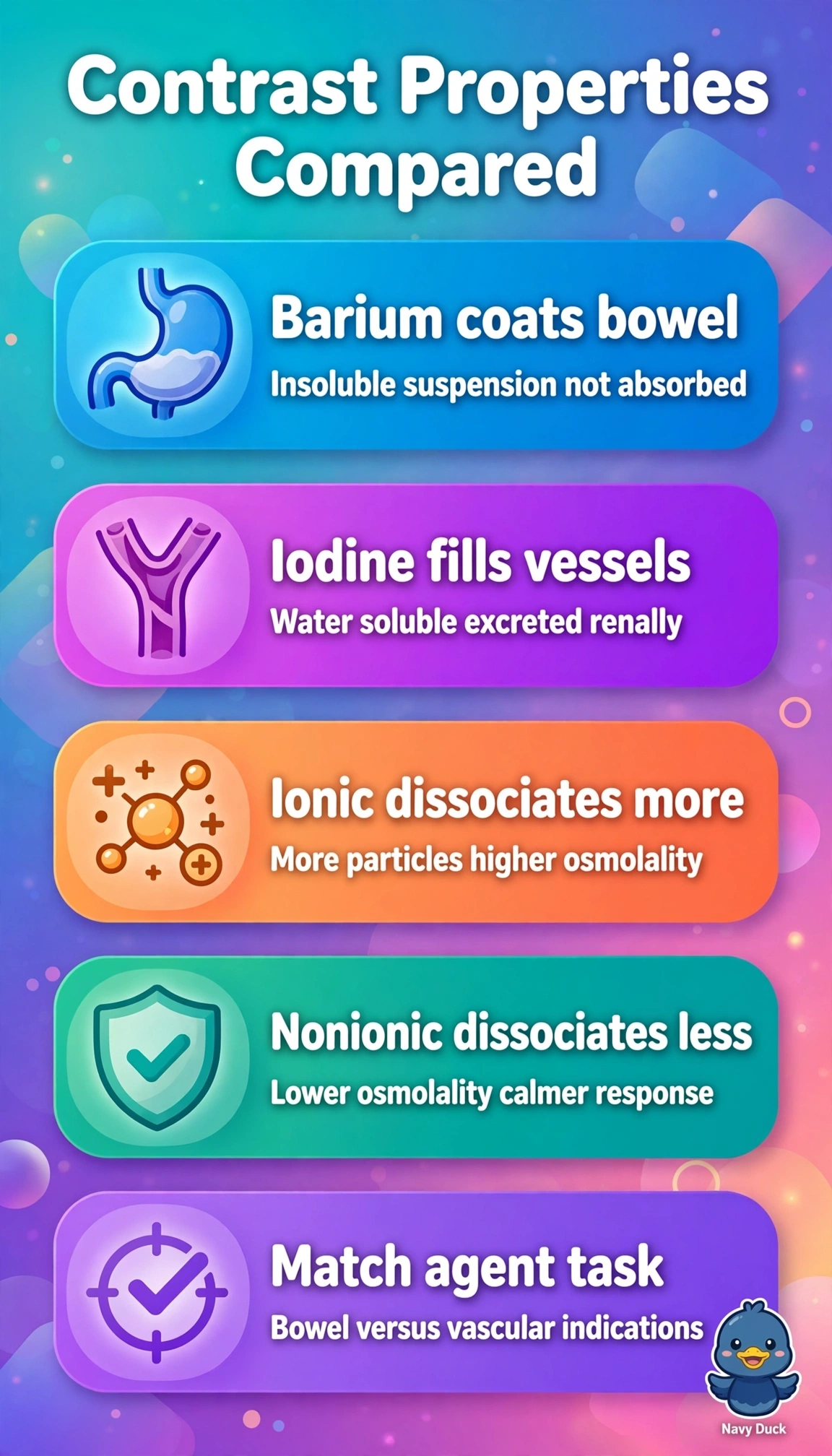
You're untangling why one drink coats and another injection flows. Fewer particles in solution means lower osmolality and a calmer vascular response.
Full Explanation
Contrast types divide by use and chemistry where barium sulfate is an insoluble high-atomic-number suspension that coats bowel mucosa without absorption, while iodinated agents are water-soluble vascular and urinary agents whose ionic versus non-ionic structure determines dissociation into particles, osmolality, viscosity, and chemotoxic risk. Non-ionic agents dissociate less, produce fewer osmotically active particles, and at similar iodine content have lower osmolality than ionics, explaining their selection for higher-risk vascular patients despite higher cost. Describing barium as water-soluble and absorbable for vessels reverses true properties and would imply dangerous intravascular barium use, missing normal renal function and bowel indication. Stating ionics never dissociate and cause fewer reactions inverts the core distinction, since ionics dissociate into two or more particles with higher osmolality and historically higher reaction rates. Claiming interchangeability ignores solubility, absorption, and safety where barium in vessels or airways can cause embolism or chemical pneumonitis. Exam caveat: link ionic dissociation to higher osmolality and higher mild-reaction likelihood, not to allergy certainty. Practical check: confirm study type, prior reaction details, renal function, and that barium is never for suspected perforation without orders.