
An adult is ordered an AP lumbar spine with the technologist palpating the iliac crests supine, aligning the midsagittal plane perpendicular to the table, and centering the cassette to include T12 to sacrum. The requisition emphasizes topographic accuracy and orthogonal planes. Which central ray path should the technologist use to satisfy positioning principles for planes and landmarks?
Select an answer to reveal the explanation.
Short Explanation
You're navigating by bony landmarks, not guessing. Hitting midline at the crest for L4-L5 is like using a map grid coordinate to find center.
Full Explanation
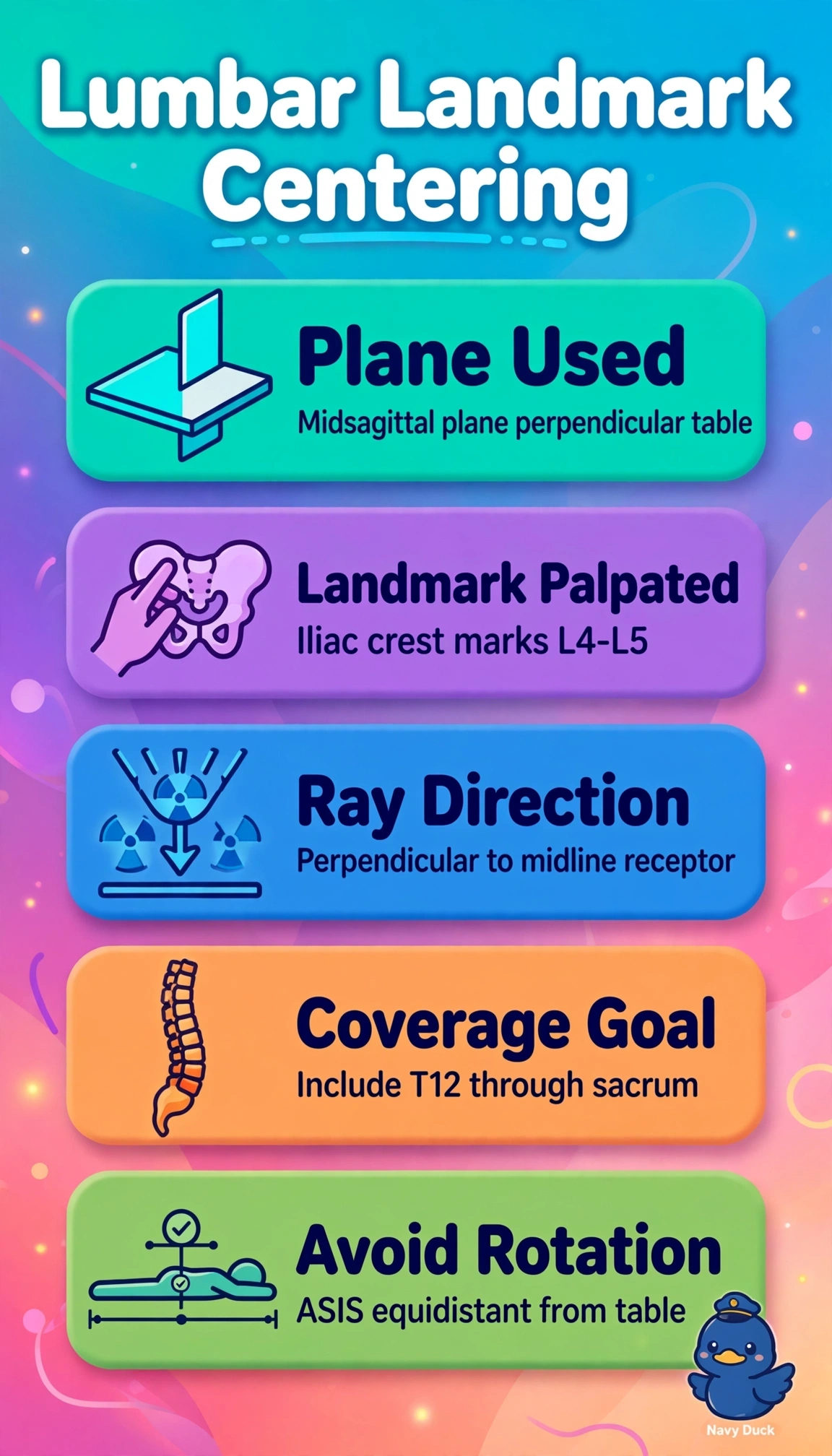
Positioning principles require relating sagittal, coronal, and transverse planes to body positions and topographic landmarks, with the AP lumbar central ray directed perpendicular to the image receptor along the midsagittal plane at the iliac crest, which overlies the L4-L5 interspace, to center the lumbar column from T12 to sacrum. A ray parallel to midline toward the xiphoid for T7 fails by concept because the thoracic spine uses the midcoronal plane at a higher level near T7 with perpendicular incidence, not a lumbar landmark or parallel path. An angled cephalad ray to the pubic symphysis fails by concept because that path describes an AP axial sacrum or coccyx projection with different centering and angulation, not a non-angled lumbar survey. A perpendicular ray to the coronal plane at the ASIS for L2 fails by concept because the ASIS lies below the crest near S2 and a coronal reference misstates the AP lumbar geometry, which is referenced to the midsagittal plane. Exam caveat is to keep recumbent versus erect and anatomic versus radiographic positions straight when describing decubitus and oblique planes. Practical check is to palpate both crests, confirm no rotation of spinous processes, and collimate tightly before exposure.