
A student asks why raising kVp hardens the beam and creates a different spectrum than increasing mA during a morning tube-physics review with no patient present. Which target-interaction explanation should the instructor give to correctly contrast bremsstrahlung and characteristic radiation?
Select an answer to reveal the explanation.
Short Explanation
You separate them by asking where the speeding electron went. Near-miss versus direct hit is your fork in the road for the two spectra.
Full Explanation
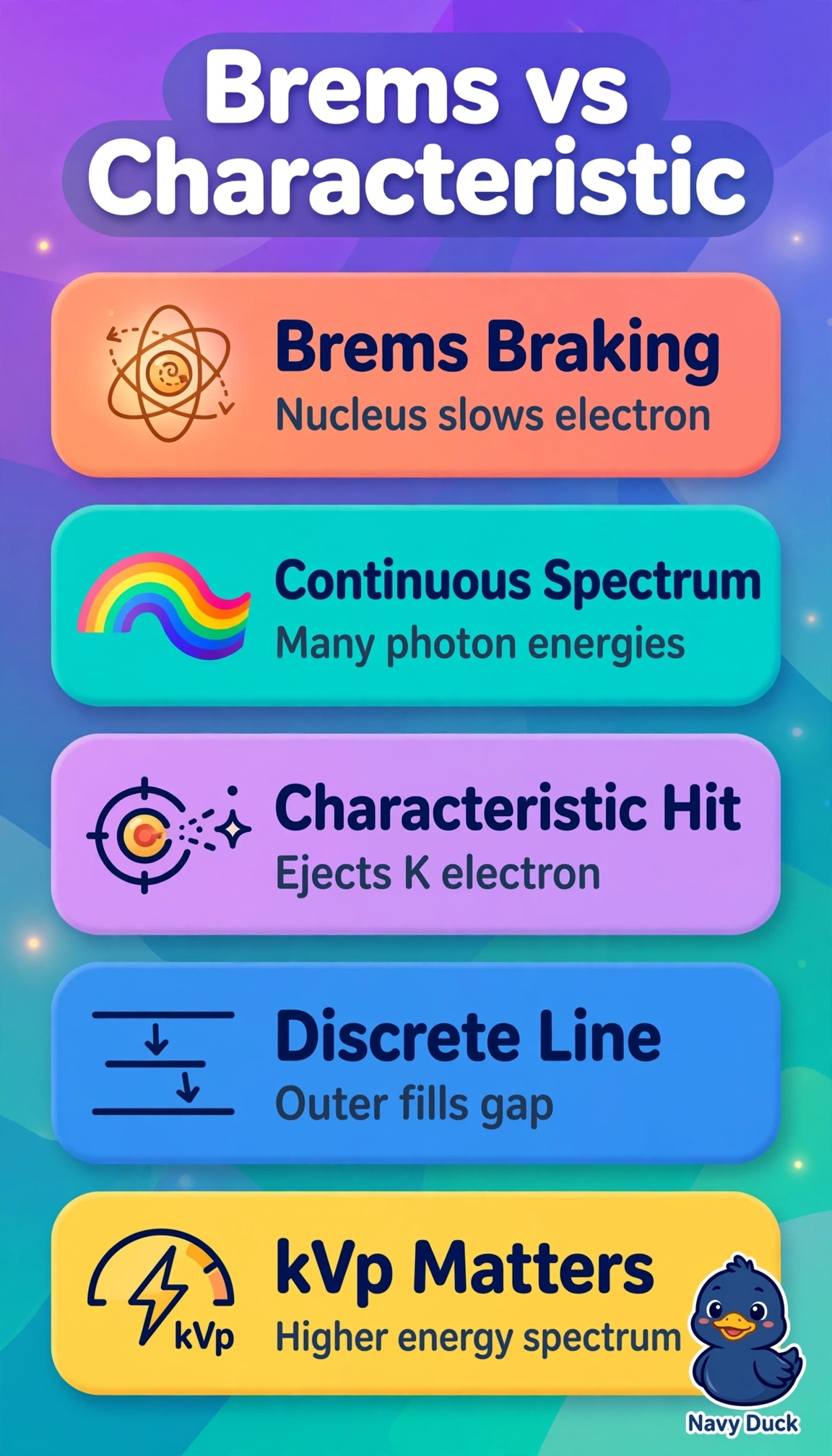
The correct explanation distinguishes braking near the nucleus producing continuous bremsstrahlung with variable energy loss from K-shell ejection and refill producing discrete characteristic lines, so raising kVp increases maximum and average photon energy, hardens the beam, and once incident energy exceeds the tungsten K-edge near 69.5 keV enables K-lines, while mA only changes electron number and photon quantity. The braking plus outer-shell refill controlled by mA claim fails by shell and parameter concept because characteristic photons require a K-shell vacancy created by threshold kVp, not outer-shell transitions driven by more current. The swapped-origin claim fails by mechanism concept because it assigns continuous nuclear braking to characteristic and discrete ejection-refill to bremsstrahlung, reversing their physics. The mA-hardens claim fails by exposure-parameter concept because higher mA scales photon number without changing energy distribution, whereas higher kVp shifts bremsstrahlung upward and adds peaks. Exam caveat: with no patient present, do not confuse target-level spectrum creation with downstream hardening by filtration or attenuation, which alters quality after production but does not create bremsstrahlung versus characteristic. Practical check: at constant mAs compare half-value layer and spectra for higher kVp versus higher mA at fixed kVp to verify changed penetration and K-peaks only with kVp.