
In the emergency department a 32-year-old fall patient holds the arm adducted in pain, the routine AP shows overlap of the humeral head and glenoid, and the physician needs humeral head position without abducting the injured shoulder to rule out anterior dislocation. Which shoulder projection should the radiographer obtain next to show glenohumeral relationship in this trauma setting?
Select an answer to reveal the explanation.
Short Explanation
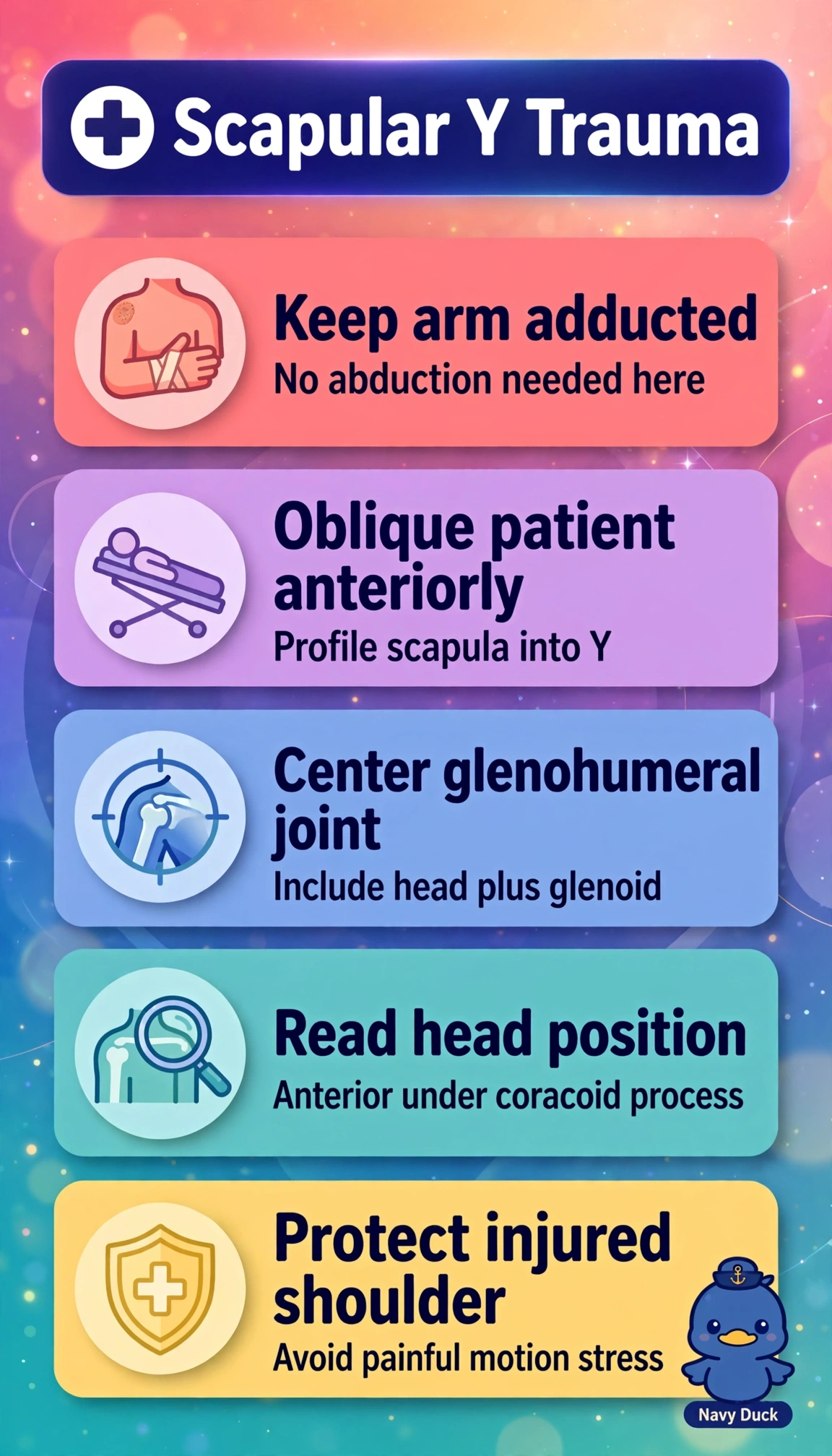
You're solving a painful puzzle without lifting that arm. The Y view side-steps abduction and spotlights dislocation direction in one angled shot.
Full Explanation
The scapular Y lateral is correct because with 30- to 45-degree anterior oblique positioning and the arm fully adducted it places the scapular body, acromion and coracoid in true lateral profile, so the glenoid is seen on end at the junction of the Y and the humeral head should be centered over it, with anterior dislocation shown displaced anteriorly beneath the coracoid without abduction, rotation or manipulation, which directly answers the overlapping AP in this trauma setting. A Grashey true AP oblique is routine and valuable for uniform joint space, arthritis and Hill-Sachs or Bankart assessment while keeping the arm adducted, yet it remains a frontal-plane view and cannot resolve anterior versus posterior displacement when overlap is already present, so the dislocation question stays unanswered. A transthoracic Lawrence lateral also keeps the arm adducted and can suggest gross displacement when no other lateral is possible, yet it projects the humeral head through the thorax with superimposition of ribs, lung and spine plus respiratory blur, so it fails to sharply profile the glenohumeral articulation. A Neer supraspinatus outlet uses very similar oblique adducted positioning and is commonly used, yet it is tangential to the outlet to evaluate acromial shape and impingement rather than glenoid-humeral alignment, so it misses the stated rule-out dislocation goal. For exams, outlet versus scapular Y look alike in setup but differ in central ray angle and indication, and the practical check is to confirm a true Y without rotation with the humeral head relationship documented and no attempt to abduct the painful shoulder.