
A portable DR chest looks very noisy with blotchy grain, bony detail is lost but no saturation or clipping is seen, and the exposure indicator is markedly outside the target range toward underexposure. Which image-evaluation conclusion about exposure indicator and gross exposure error is most accurate?
Select an answer to reveal the explanation.
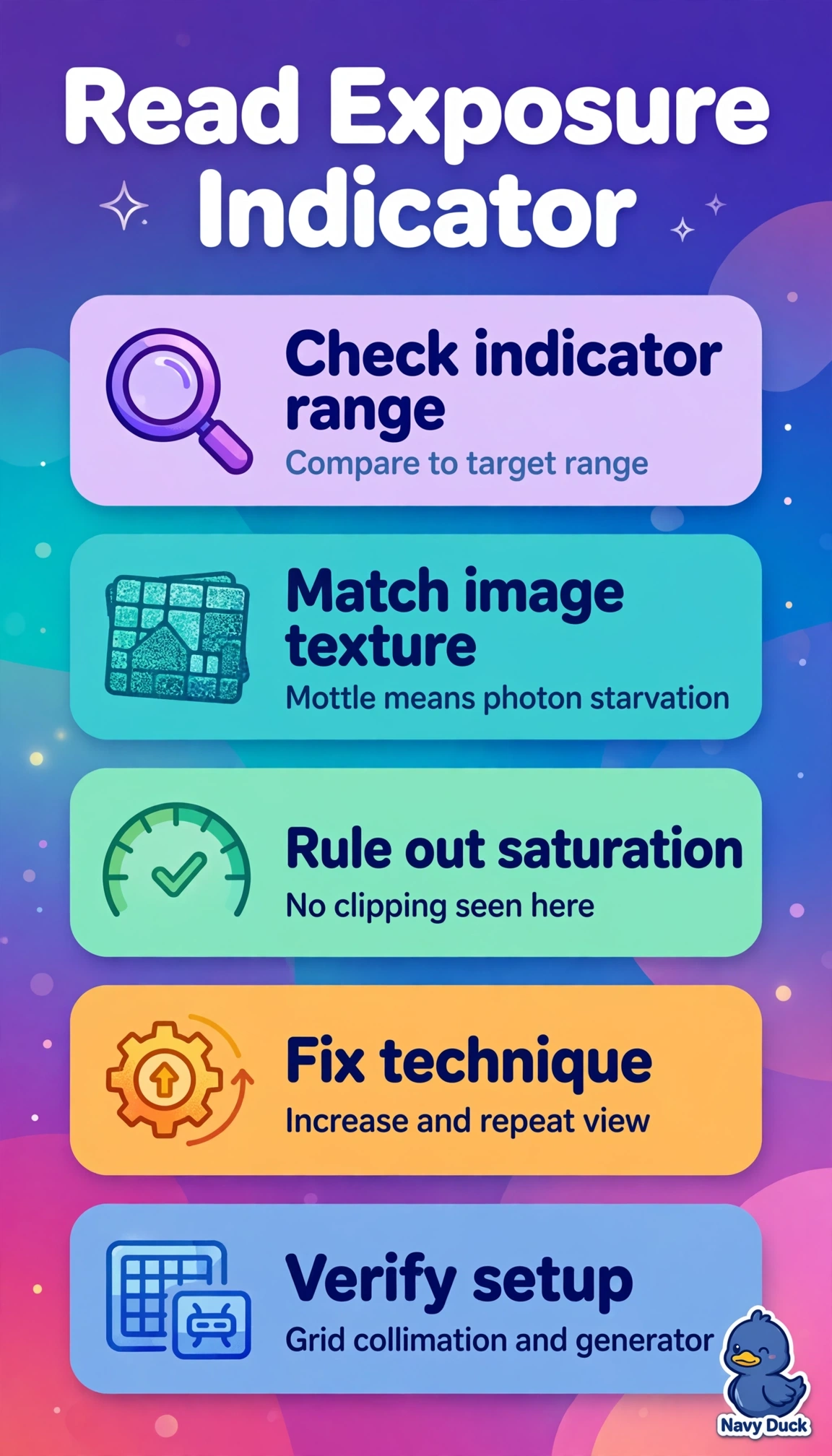
Short Explanation
Grainy plus low signal means the detector starved, not flooded. Exposure-indicator drift paired with mottle is your cue to add technique, not tweak display.
Full Explanation
The exposure indicator estimates detector exposure relative to the department target, so a marked deviation toward underexposure combined with visible quantum mottle, loss of low-contrast detail and absence of saturation directly indicates too few photons reached the detector and image data are irretrievably noisy, which requires corrective repeat with increased mAs or kVp as appropriate after checking positioning, grid, and generator function. The saturation interpretation reverses the physics, because overexposure produces high indicator values, loss of contrast from clipping, and smooth but burned-out areas rather than photon-starved grain, so decreasing technique would worsen the actual error. The monitor-calibration interpretation confuses acquisition exposure with display postprocessing, because window width and level can brighten appearance but cannot restore missing photon statistics or correct the indicator, making display adjustment alone inadequate for gross error. The scatter-fog interpretation misattributes uniform gray fog and reduced contrast from scatter to photon starvation, when added filtration would further reduce detector exposure and increase mottle without addressing the low technique. For the exam, pair indicator direction with image texture before deciding, then verify clinically by comparing to target range, checking technique chart and confirming collimation and grid use before repeating.