
A 68-year-old after a fall has left hip pain and cannot abduct the leg, with concern for femoral neck fracture and possible posterior dislocation. The surgeon needs a lateral hip view without moving the injured femur. Which pelvis and hip projection best demonstrates the lateral hip under this constraint?
Select an answer to reveal the explanation.
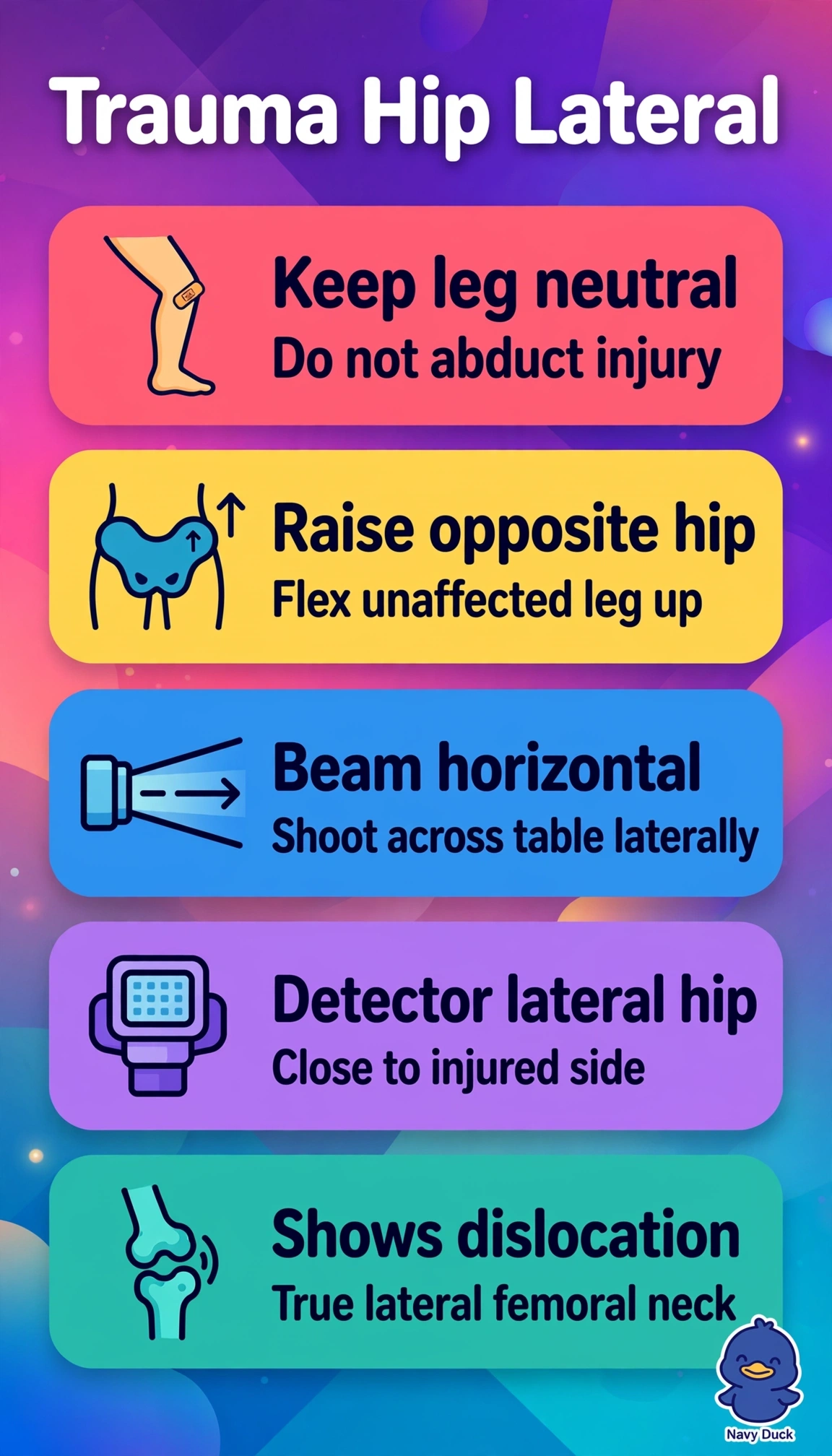
Short Explanation
You can’t force a painful hip to move, so you move the beam instead. Danelius-Miller brings the lateral view to the patient while the injured leg stays neutral.
Full Explanation
The Danelius-Miller axiolateral with unaffected side raised and horizontal beam is correct because leaving the injured femur extended in neutral rotation while elevating the sound limb on supports yields a lateral to the injured hip, preserving alignment for femoral neck fracture while showing anterior versus posterior head displacement relative to acetabulum without abduction or rotation. The Clements-Nakayama bilateral axiolateral fails by concept because keeping both extended legs in the field is a non-trauma survey that superimposes opposite femur and soft tissue over the injured neck and joint, obscuring fracture lucency and dislocation direction needing cleared unilateral lateral. The Judet iliac oblique fails by concept because 45-degree rotation profiles acetabular rim and head containment for dislocation and acetabular fracture but is an oblique not an orthogonal lateral, so it neither shows femoral neck in true lateral profile nor establishes anterior-posterior displacement. The vertical-beam Danelius-Miller variant fails by concept because axiolateral geometry requires horizontal beam with crosswise detector, while vertical beam is inferosuperior requiring abduction the patient cannot perform, violating the no-movement constraint. Exam caveat: distinguish unilateral Danelius-Miller with sound-side elevation from bilateral and cross-table methods by which limb moves and beam orientation. Practical check: verify markers and grid, place detector lateral to injured hip, keep unaffected limb clear, collimate with horizontal ray, and stabilize injured side without rotation.