
A mobile radiographic unit used at two nursing homes is due for quality review after tube maintenance, and the supervisor asks for verification of beam congruence and ray centering before resuming bedside examinations. The unit will be tested at 100 cm SID on a flat cassette with room lights dimmed for edge visibility. Which quality-control method best verifies light-field to radiation-field alignment in this unit?
Select an answer to reveal the explanation.
Short Explanation
You’re proving what you see is what you get. Marking the light edges then exposing shows any drift at a glance, and congruence keeps the beam honest after maintenance.
Full Explanation
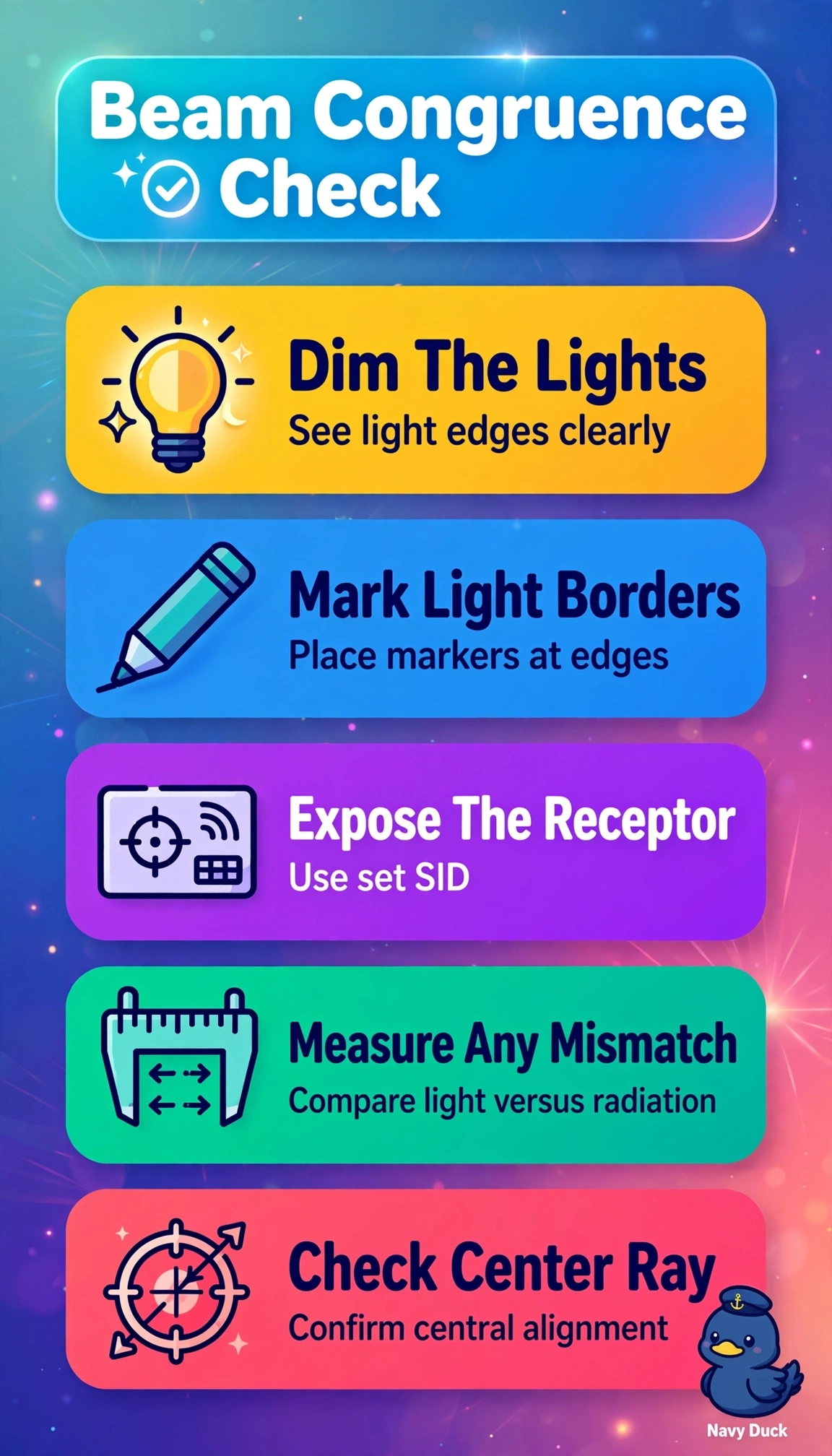
The correct method directly visualizes congruence by placing radiopaque markers at the visible light-field borders defined at 100 cm SID on a flat cassette with dimmed light, then exposing and measuring marker images versus radiation-field edges and center offset, confirming coincidence and centering required after tube maintenance before mobile bedside work. The pinhole camera approach is legitimate post-maintenance control but characterizes effective focal-spot size and spatial resolution rather than coincidence of light and radiation fields, so sharp images could still mask misalignment. The level and arrow tool is also standard mobile control but evaluates central-ray perpendicularity to the receptor rather than border coincidence and centering, so a perpendicular beam could still be shifted or incorrectly sized. The marker method performed at 100 cm SOD misapplies geometry because tolerances are defined by source-to-image distance with the receptor flat, and substituting object distance alters magnification and edge positions. Exam caveat is to separate coincidence, perpendicularity, and focal-spot tests and recall the typical 2% of SID edge tolerance and 1% centering tolerance. Practical check is to dim lights, tape markers just inside each light edge, keep the cassette flat and perpendicular at exactly 100 cm, expose at low technique, and measure marker-to-edge gaps.