
A fixed DR room shows a faint repeating grid-like nonuniformity and slight sensitivity drift across images despite correct technique. No artifact is visible on the collimator or grid. Which detector calibration and uniformity test should the technologist perform first to restore consistent response?
Select an answer to reveal the explanation.
Short Explanation
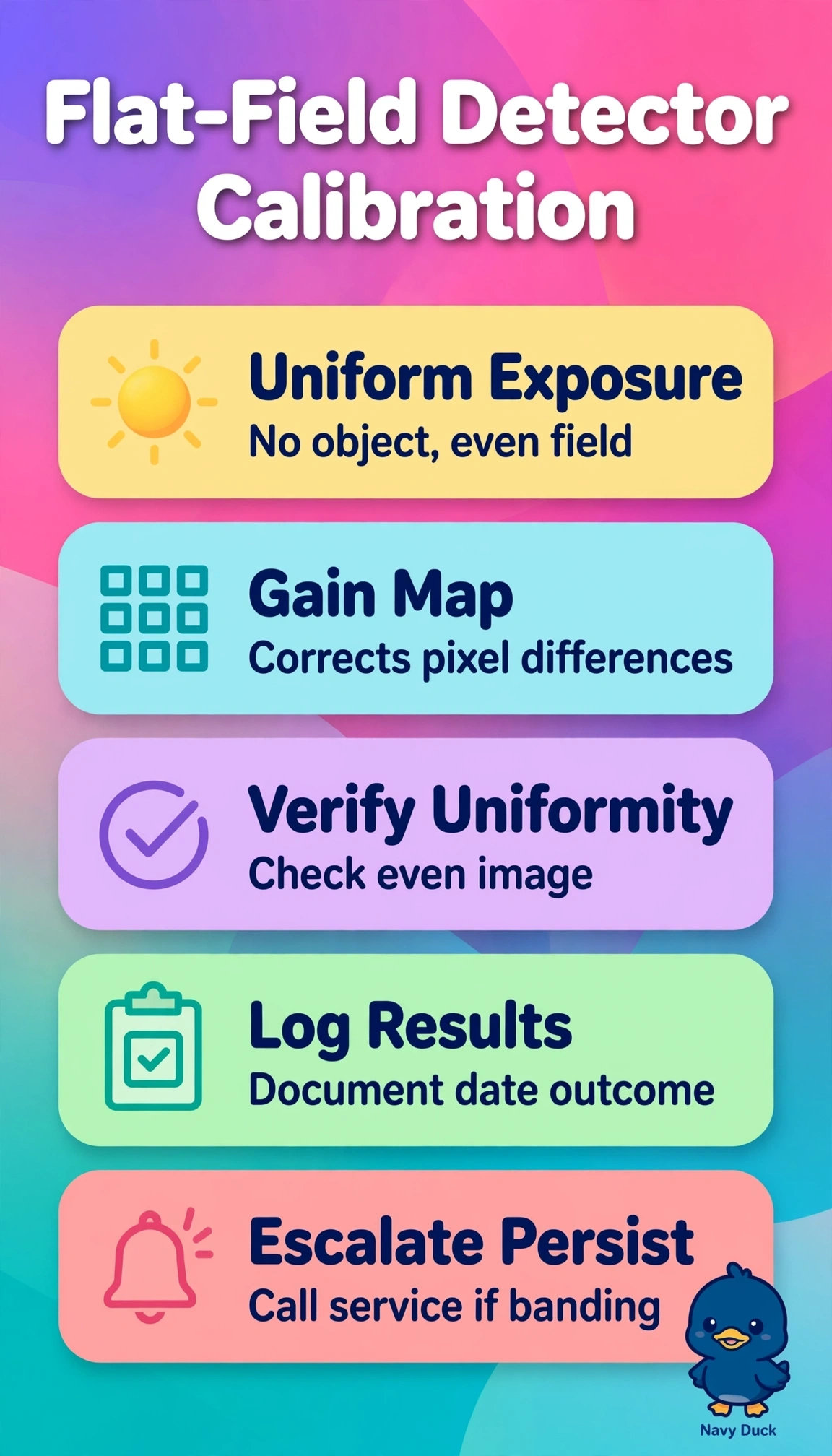
You fix the sensor itself before blaming technique or monitors. A fresh flat-field map is your reset button that evens out pixel-to-pixel gain differences.
Full Explanation
The faint repeating fixed-pattern nonuniformity with drift despite correct technique points to detector gain variation rather than tube, positioning, or display failure, and the manufacturer flat-field calibration directly corrects this by exposing the detector uniformly to map pixel-to-pixel sensitivity differences and applying a gain correction, with post-calibration uniformity verification confirming consistent response across the field. A dark offset calibration with closed shutter is routine and valuable for electronic background and baseline drift, but it uses no X-ray exposure and therefore cannot characterize X-ray sensitivity differences that create grid-like gain nonuniformity. An AEC reproducibility test with phantoms is a standard method for dose and density consistency, but it evaluates the exposure control system and generator output, not pixel gain, so it leaves detector nonuniformity uncorrected despite addressing drift-like symptoms. Grid-alignment evaluation at varied SID is appropriate for suspected Moire, cutoff, or misaligned stationary grids, but the stem states no visible grid artifact and describes sensitivity drift, so alignment testing diagnoses geometry rather than restoring detector calibration. Exam caveat: do not confuse dark offset, defect-pixel mapping, and flat-field gain correction, as questions often pair drift with nonuniformity to test whether both offset and gain are addressed, with uniformity verification as the required endpoint. Practical check: use the vendor QA phantom and exposure specified for calibration, ensure the entire detector is uniformly covered with no grid cutoff or scatter, repeat per vendor schedule, and trend uniformity and exposure-indicator values before returning to clinical use.