
An adult with a direct blow to the anterior chest has focal sternal pain without dyspnea. The physician needs a sternal fracture check without spinal overlap, and the patient can lie semi-prone. Which sternal projection should the technologist select to best display the sternum clear of the spine?
Select an answer to reveal the explanation.
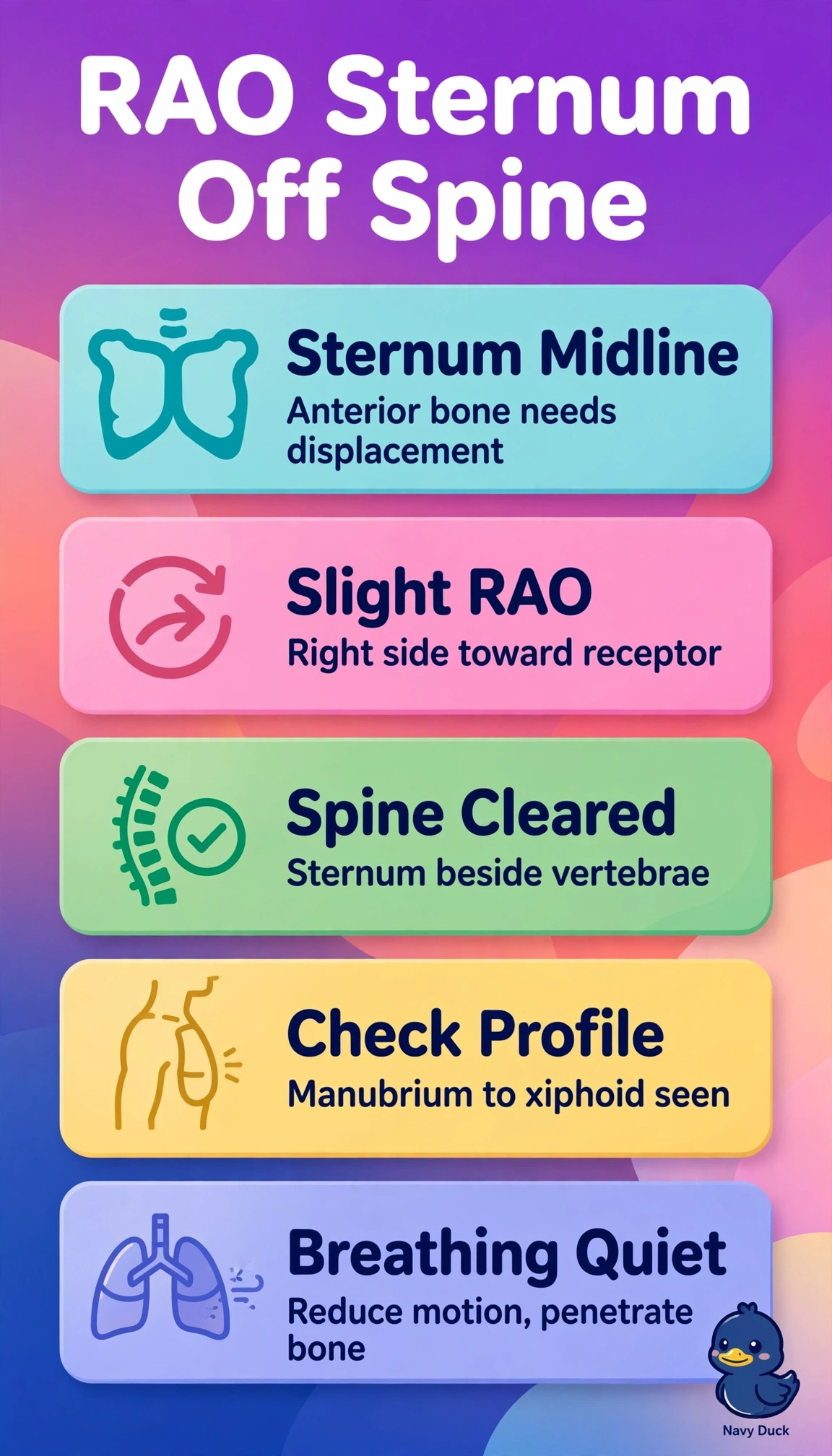
Short Explanation
You earn this one by shifting the sternum off the spine rather than shooting straight through it. A shallow RAO is your off-ramp, swinging the sternum beside the thoracic vertebrae.
Full Explanation
A 15- to 20-degree RAO with the patient prone or semi-prone is the best choice: on a frontal projection, the sternum lies directly over the thoracic spine, and rotating the right anterior body toward the receptor shifts the sternum left, off the spine and onto the homogeneous cardiac shadow. That even background provides good contrast for the thin bone while keeping it close to the receptor. A slight LAO fails because rotating the opposite way shifts the sternum toward the right, over aerated lung and the spine’s edge rather than the uniform heart shadow, reducing its contrast. A routine lateral chest fails because it is a lung and cardiac projection, with the arms raised and ribs superimposed; a dedicated lateral sternum uses arms pulled back, tight collimation, and sternum-specific technique, and it does not provide the oblique frontal view requested. An upright PA chest with full inspiration fails because it is designed for lung expansion, clavicle symmetry, and cardiac assessment, while the sternum remains superimposed over the spine. Exam caveat: pair the RAO with a lateral sternum, and do not confuse the sternal oblique with rib or sternoclavicular oblique routines. Practical check: verify the marker, 15 to 20 degrees of obliquity, the sternum projected over the heart without clipping the manubrium, and adequate sternal penetration without overexposing the lung.