
An emergency department adult presents with severe abdominal distension and suspected sigmoid volvulus with possible perforation. The surgeon requests a contrast enema under fluoroscopy, emphasizes low pressure, and remains available for complications. Which contrast enema protocol best addresses suspected perforation with surgical risk?
Select an answer to reveal the explanation.
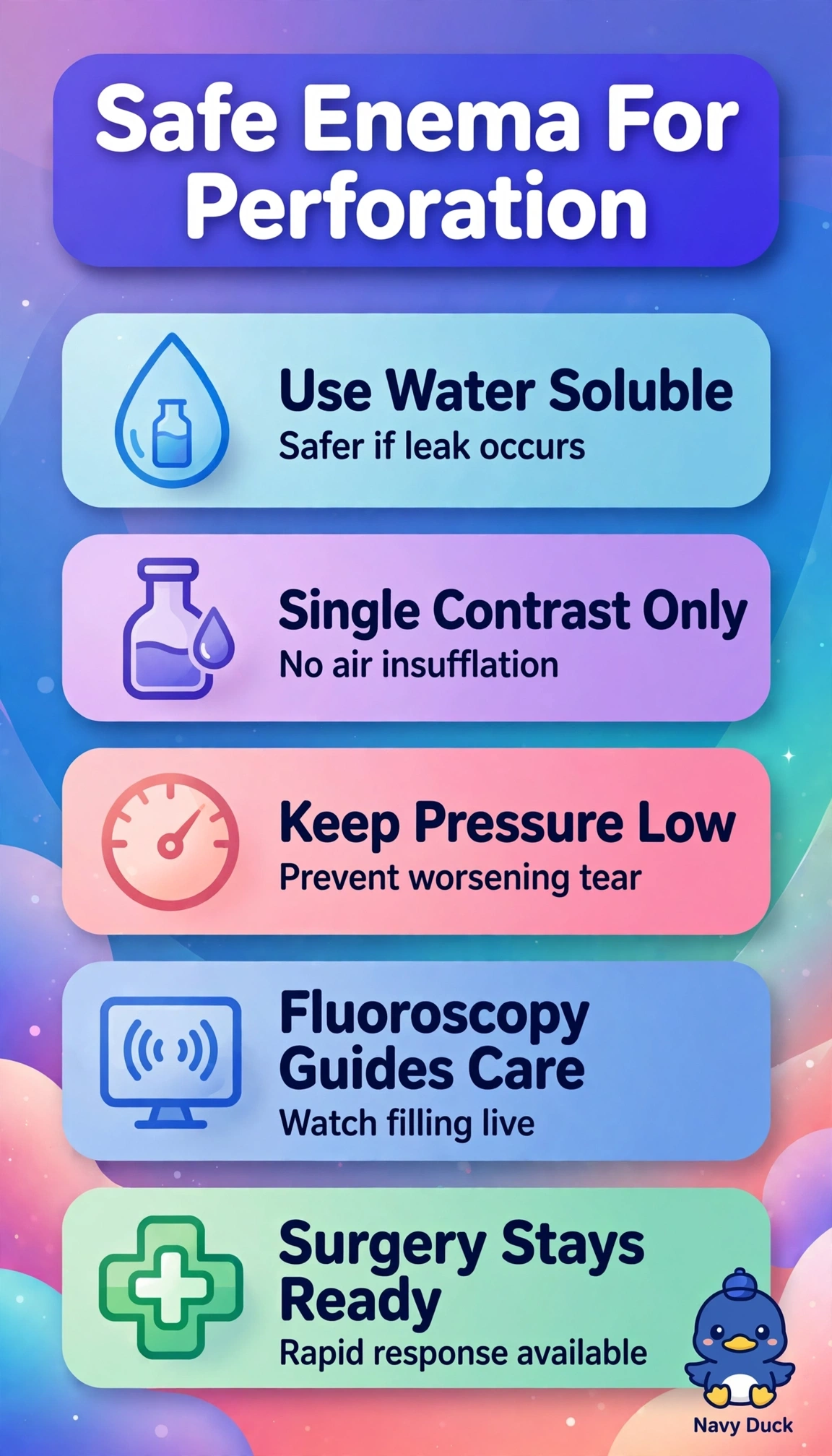
Short Explanation
You made the safe call: water-soluble contrast is safer if it leaks. Single-contrast low-pressure filling is like using a gentle garden hose rather than a pressure washer near a cracked pipe.
Full Explanation
For severe distension, suspected sigmoid volvulus, and possible perforation, use low-pressure water-soluble single contrast under live fluoroscopy with the surgeon available. This can show a tapered obstruction or extravasation while allowing the operator to control filling and stop promptly; leaked water-soluble contrast is absorbed, unlike barium, which can cause persistent chemical peritonitis and complicate surgery. A low-pressure thin barium single-contrast enema under fluoroscopy with surgical backup provides good coating for uncomplicated obstruction, but barium leakage can cause granulomatous peritonitis and adhesions, worsening the operative outlook. A low-pressure water-soluble double-contrast enema with gentle air is used for mucosal detail in stable elective settings, but air insufflation can increase tension in an ischemic, dilated loop and extend a contained leak or cause tension pneumoperitoneum. A water-soluble single-contrast enema with delayed overhead films and no surgical standby uses the safer agent and pressure, but lacks live monitoring to titrate filling or stop at the first sign of leakage, and lacks immediate surgical rescue. Exam caveat: suspected perforation favors water-soluble single contrast even when volvulus reduction is being considered. Practical check: confirm the agent, pressure limit, fluoroscopy readiness, surgeon availability, consent, vital signs, and stop rules for pain or leakage.