
A young adult arrives with snuffbox tenderness after a fall on an outstretched hand, swelling is mild, and the physician suspects a nondisplaced scaphoid fracture needing subtle fracture detail. Which wrist projection should the radiographer include to best demonstrate the scaphoid without overlap?
Select an answer to reveal the explanation.
Short Explanation
You're stretching the scaphoid into view. Ulnar-deviation opens that little bone so a hairline break can't hide.
Full Explanation
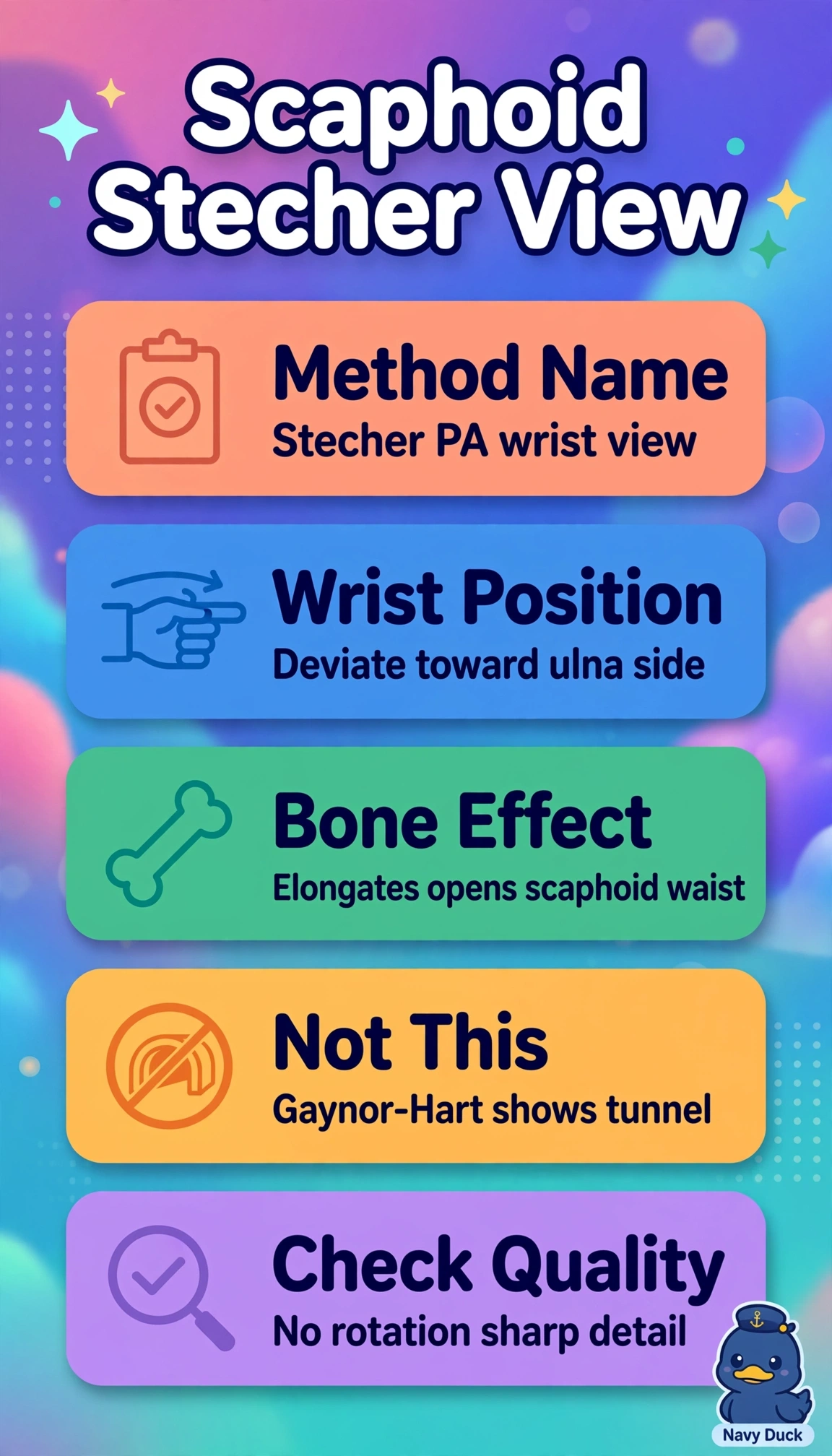
The Stecher PA wrist in ulnar deviation is required here because ulnar deviation draws the scaphoid away from the distal radius, places its long axis parallel to the receptor, elongates the bone and opens the waist without superimposition, which best reveals subtle nondisplaced fracture lucency after a fall with snuffbox tenderness. The neutral PA wrist with the hand flat is routine for distal radius detail and carpal spacing, yet without ulnar deviation the scaphoid stays foreshortened and partly overlapped by the radius and trapezium, so a faint waist fracture remains hidden. The 45-degree PA oblique with semi-supination is routine for the lateral carpus and opens the trapezium-trapezoid articulation, yet rotation foreshortens and superimposes the scaphoid, violating the need for elongation without overlap. The true lateral wrist is routine for dorsal displacement and carpal alignment, yet it superimposes the scaphoid on the capitate, lunate and radius, obscuring nondisplaced lines. For examinations, distinguish a routine wrist series from a dedicated scaphoid series that adds ulnar deviation and sometimes cephalic angulation, and practically confirm marked ulnar deviation, no rotation, close collimation and firm immobilization to preserve cortical detail.