
A 78-year-old Vietnamese-speaking patient with hearing aids and acute rib pain after a fall looks away, gives short answers, and the technologist must explain upright breathing instructions for chest imaging. Which verbal and nonverbal communication strategy best overcomes language, sensory, and emotional barriers?
Select an answer to reveal the explanation.
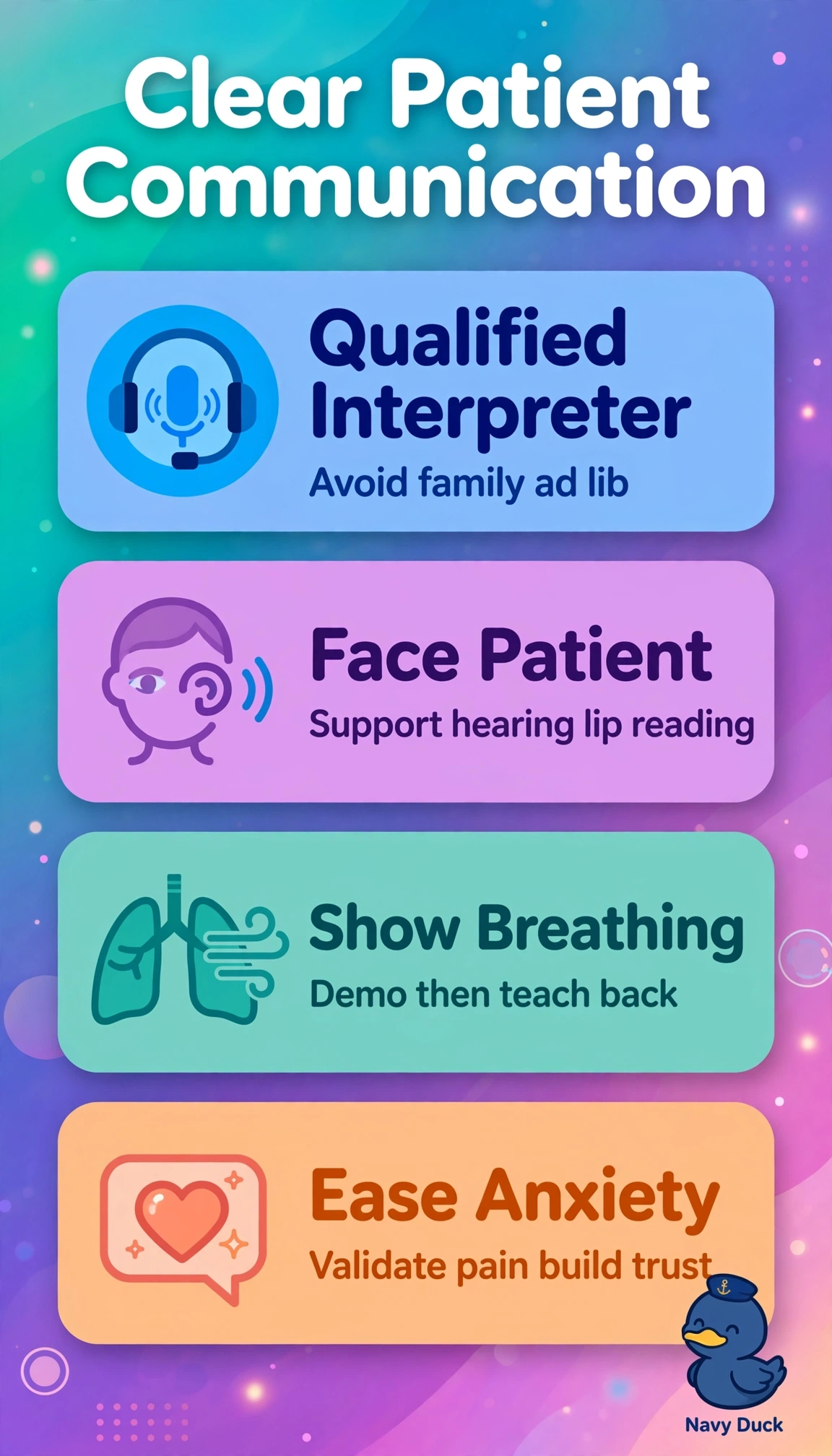
Short Explanation
You are tuning three weak signals at once, not shouting louder. Pairing language help with calm modeling builds rapport and clear breath-holds.
Full Explanation
The correct strategy succeeds because it addresses every barrier together: a qualified interpreter ensures accurate Vietnamese communication and cooperation, slow speech plus facing the patient maximizes hearing, hearing-aid input, lipreading and nonverbal trust, live demonstration makes the upright inspiratory effort understandable despite language and sensory limits, and validation of rib pain, fear, and withdrawal builds rapport and willingness to attempt a painful maneuver. The beside-patient positioning approach fails on sensory accommodation because coaching from the side, despite retaining interpreter use, demonstration and empathy, prevents face-to-face speechreading, facial expression reading, and directed voice projection to hearing aids. The verbal-coaching-only approach fails on health-literacy and sensory redundancy because explanation through an interpreter with facing and empathy alone lacks visual-motor modeling of breathing and breath-hold needed with acute pain, hearing loss, and limited English proficiency. The efficiency-focused completion approach fails on emotional rapport because urging prompt completion, though well-intentioned, omits acknowledgment of pain and concern needed to reduce anxiety and enlist cooperation. A key exam caveat is to choose the response resolving language, hearing, demonstration need, and affect together rather than one handling three domains well but omitting the fourth. A practical check is to face the patient, give one short interpreted instruction at a time, demonstrate the breath, then use interpreted teach-back and pain reassessment before exposure.