
A first-year radiography student observes a radiographic tube warming procedure in a 40-student lab, notices the filament glows before exposure, hears the rotor spin, and asks why electrons suddenly surge across the tube only during exposure. The instructor reviews thermionic emission through deceleration. Which x-ray production sequence best explains electron creation, acceleration, focusing, and deceleration in the tube?
Select an answer to reveal the explanation.
Short Explanation
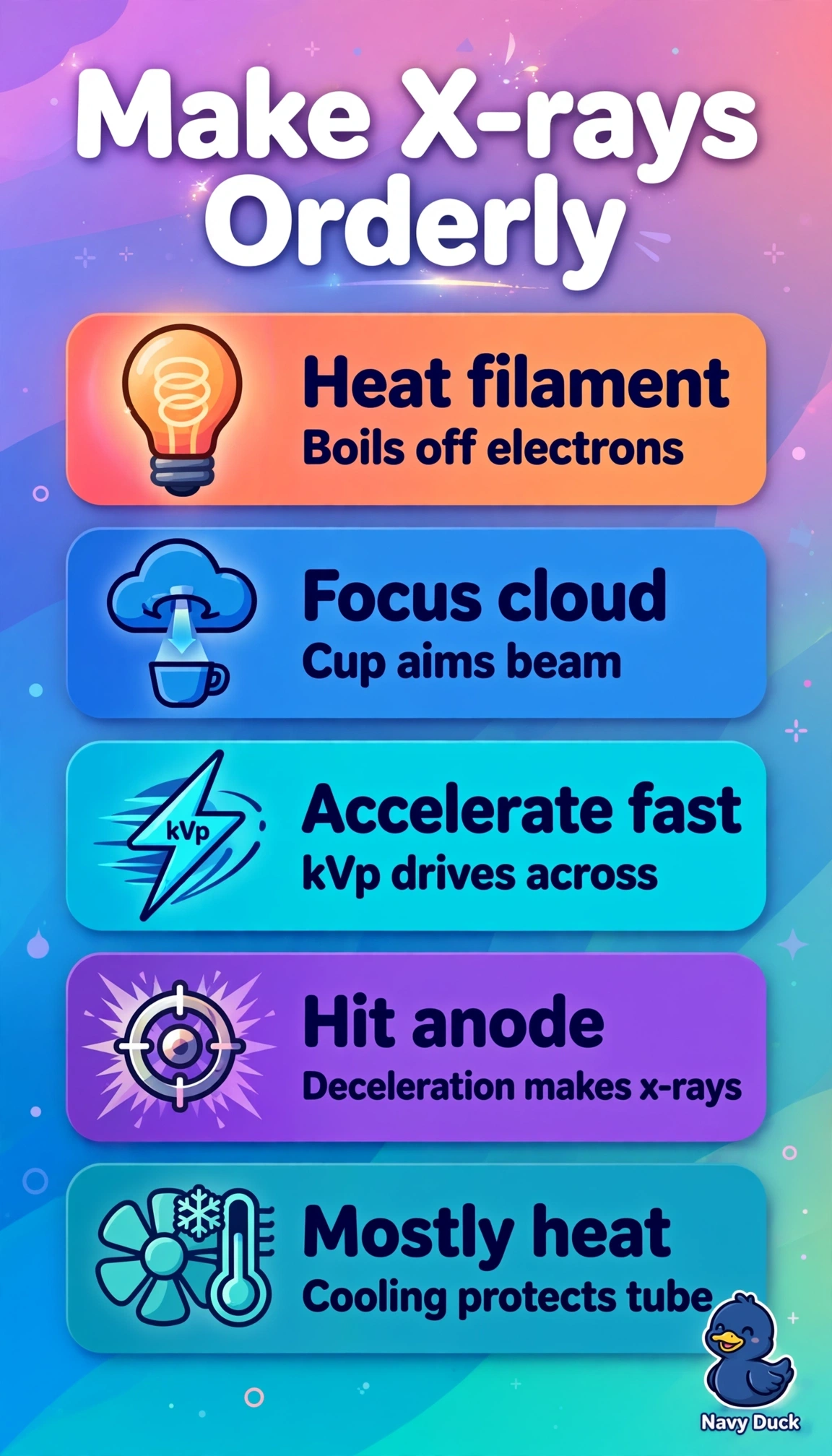
You can picture heat boiling electrons off the filament, with the focusing cups aiming them before high kilovoltage sends them across the tube. Their sudden stop at the anode produces x-rays through thermionic emission followed by deceleration.
Full Explanation
The sequence in which heat boils electrons from the filament, focusing cups aim them, high kilovoltage accelerates them, and the anode stops them is correct. Filament-circuit heat liberates electrons into the space charge; negatively charged focusing cups confine and direct that cloud. During exposure, high kilovoltage across cathode and anode provides the potential difference that accelerates the electrons. Their rapid deceleration and interaction with the tungsten anode target convert kinetic energy into bremsstrahlung and characteristic x-rays. This explains why the filament can glow before exposure without an electron surge until kilovoltage is applied, even while the rotor is already spinning. The sequence assigning acceleration to high tube current confuses electron quantity with energy: milliamperage controls the number of electrons available through filament heating, while kilovoltage controls their acceleration, velocity, and penetrating power. The sequence assigning focusing to the spinning rotor confuses two functions: the rotor turns the anode disk to spread heat over a larger track; the cups focus electrons electrostatically. The sequence placing electron emission at the anode and deceleration at the cathode reverses the electrodes: the filament and cups are in the cathode, and the tungsten target receiving electrons is in the anode. Exam caveat: distinguish filament current and heating from tube current and kilovoltage when a stem mentions glow, spin, and surge. Practical check: in lab, confirm that filament glow and rotor whine precede exposure, while dose and the exposure indicator occur only when kilovoltage is energized; increasing mA changes filament drive, not beam quality as changing kVp does.