
A spine clinic sees a middle-aged driver with chronic neck stiffness needing instability assessment and a warehouse worker with oblique low-back pain radiating down one leg. The orders request motion evaluation of C-spine ligaments and posterior element detail of L-spine. Which projection combination best evaluates cervical instability and lumbar posterior elements?
Select an answer to reveal the explanation.
Short Explanation
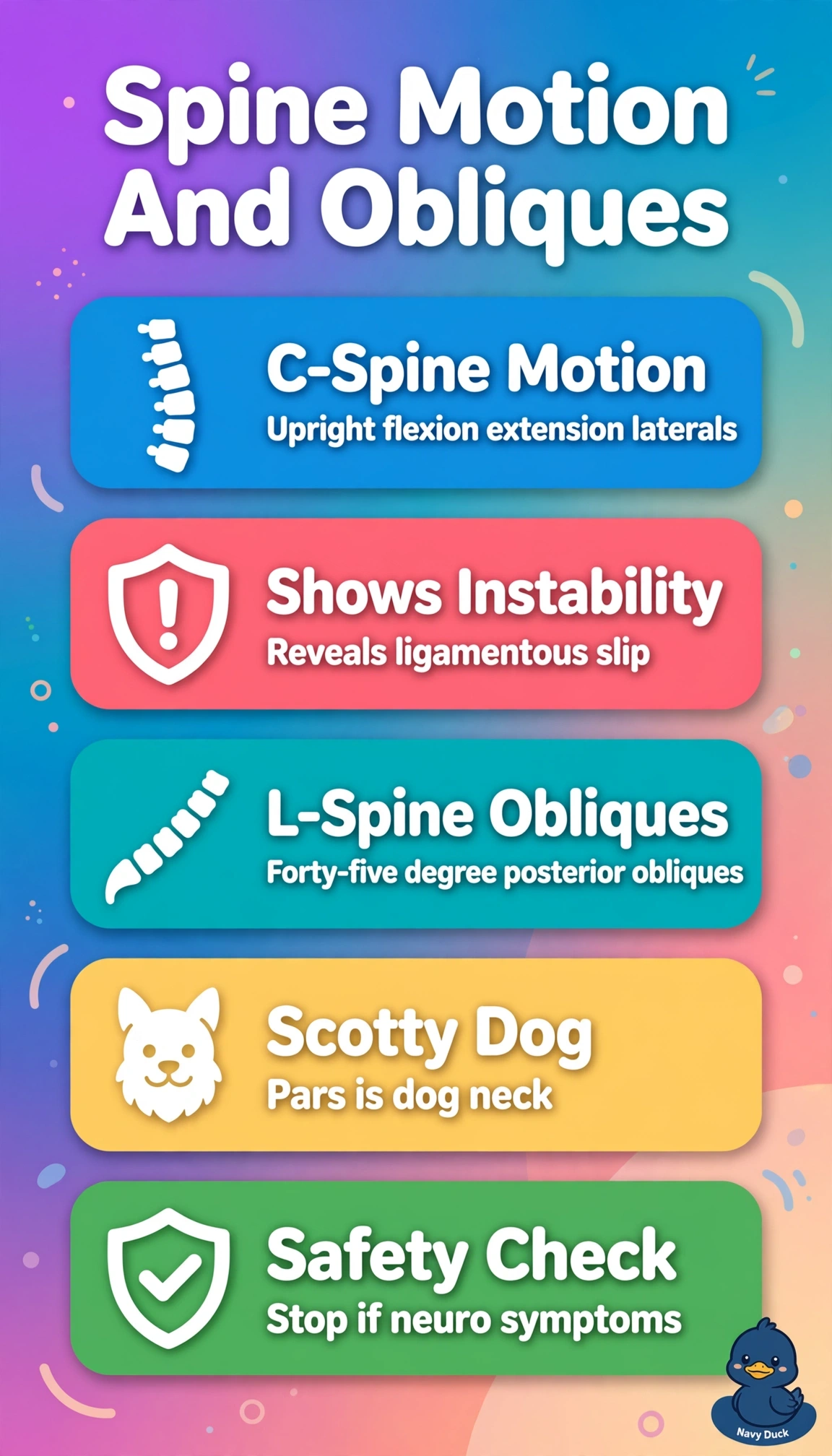
You’re matching motion to the right joints here. Bending necks reveal slip, angled lumbars reveal the Scotty dog, like turning a puzzle to see hidden edges.
Full Explanation
Upright flexion and extension laterals stress cervical ligaments and reveal anterolisthesis or widened interspinous spaces indicating instability that neutral views hide, while 45-degree posterior obliques rotate lumbar posterior elements into profile to display the Scotty dog with neck representing pars interarticularis for spondylolysis and facets for arthropathy. The distractor using open-mouth only plus AP and lateral misses dynamic instability and posterior detail because dens views show C1-C2 alignment only; the distractor using neutral C-spine laterals and lumbar lateral flexion misplaces motion assessment since lumbar flexion laterals assess body movement not pars defects; the distractor using cervical obliques only and AP lumbar extension confuses foraminal views with ligament testing and adds inappropriate motion. Exam caveat: ensure physician supervision and patient tolerance before flexion-extension, and stop with neurologic symptoms. Practical check: verify true laterals without rotation, confirm flexion-extension effort from mandible and spinous motion, and check oblique rotation at 45 degrees.