
A 34-year-old patient with recurrent urinary tract infections is scheduled for fluoroscopic voiding cystourethrography in the late morning, has no known contrast allergy, has emptied the bladder on arrival, and the urologist requests evaluation of the bladder and urethra during filling and voiding. Which contrast administration principle should the radiographer prepare to support for this cystography-based examination?
Select an answer to reveal the explanation.
Short Explanation
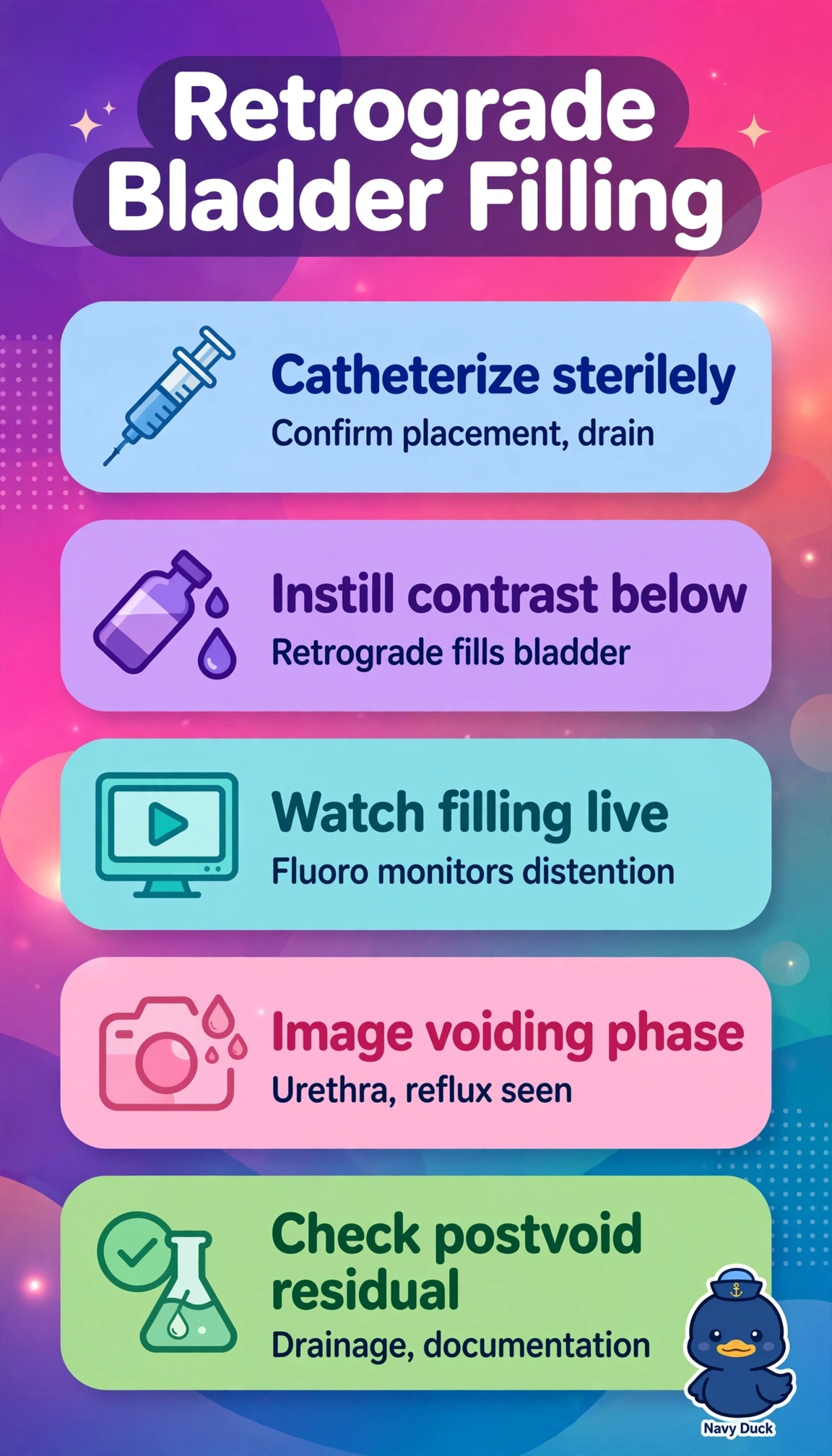
You have to fill the bladder from below to see it leak. Retrograde instillation puts contrast exactly where voiding happens.
Full Explanation
Cystography and voiding cystourethrography are retrograde examinations in which sterile catheterization allows controlled instillation of dilute iodinated contrast directly into the bladder, followed by fluoroscopic spot images during filling, with the bladder full, during voiding, and postvoid to assess capacity, reflux, urethral anatomy, and residual, requiring sterile technique, gravity drip or syringe filling without overdistention, and radiation protection during voiding. Intravenous injection with delayed imaging describes excretory urography, which opacifies kidneys and ureters systemically but does not distend the bladder under controlled pressure for reflux or urethral evaluation. Oral barium transits the bowel and never reaches the bladder in diagnostic concentration, applying gastrointestinal contrast principles to a urinary study and providing no urethral detail. Cervical instillation for hysterosalpingography outlines the uterine cavity and tubes for infertility workup, anatomically and procedurally distinct from bladder filling and unable to evaluate voiding function. Exam caveat is to distinguish retrograde filling from intravenous excretion and from uterine studies that share pelvic anatomy but use different access, and practical check is to confirm catheter placement, use prescribed contrast dilution, monitor filling volume and patient discomfort, and capture voiding images promptly.