
A department evaluates two digital systems for low-dose chest imaging in a high-noise emergency setting. System X offers higher DQE, wider dynamic range, and greater bit depth than System Y at matched exposure. The physicist asks what outcome best predicts cleaner lung detail. Which imaging characteristic relationship best explains reduced quantum noise and higher SNR?
Select an answer to reveal the explanation.
Short Explanation
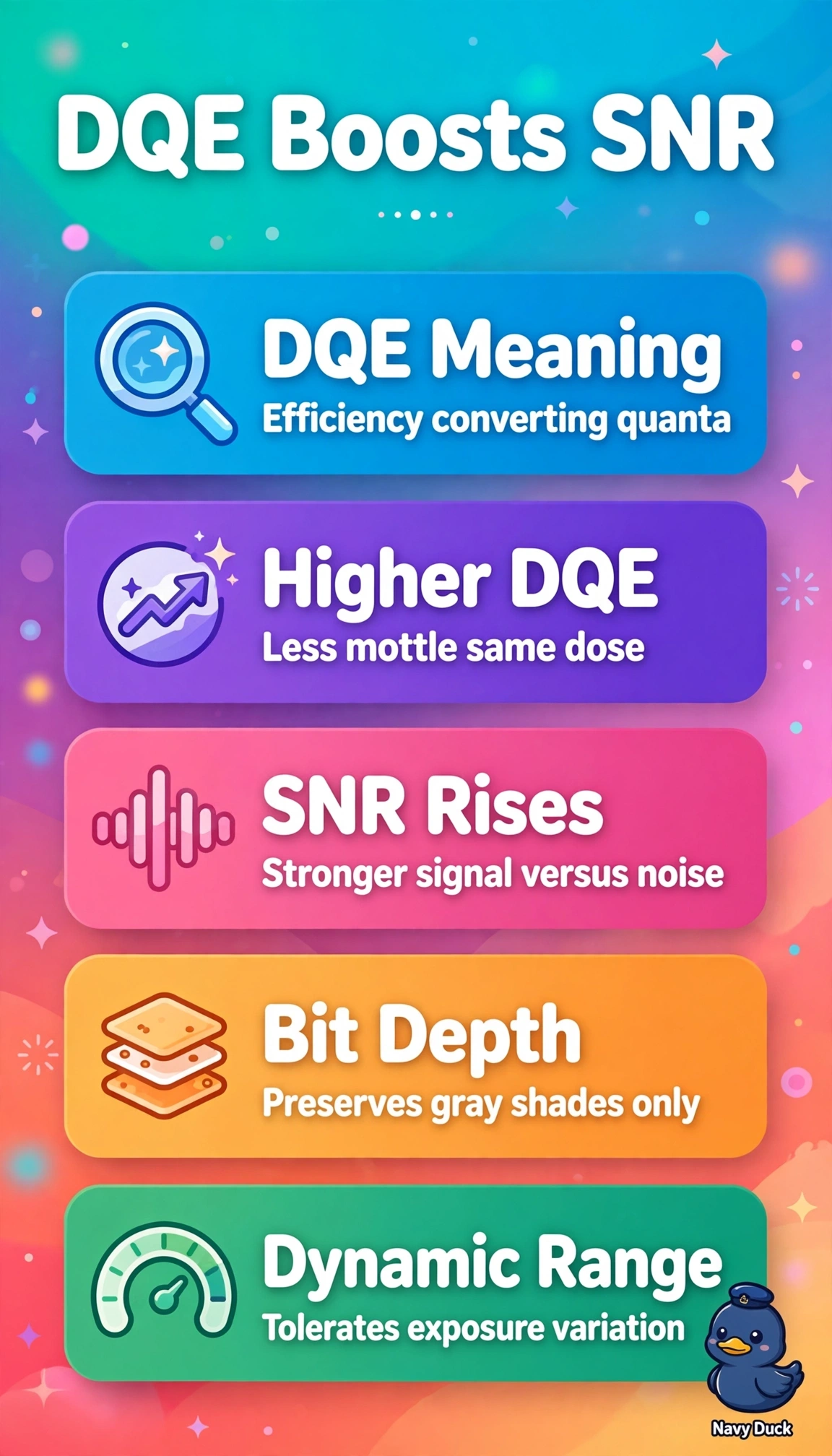
You’re focusing on how efficiently each system uses the available photons, not just on the image’s tonal range. Better photon use reduces quantum mottle and raises SNR, making DQE your guide to cleaner lung detail.
Full Explanation
System X predicts cleaner detail because higher detective quantum efficiency means a greater fraction of incident quanta forms useful signal at the same exposure, reducing the Poisson variation that causes quantum mottle and raising SNR in low-dose chest imaging. Greater bit depth preserves subtle lung contrast steps and helps avoid banding during post-processing, supporting quantization fidelity and windowing flexibility; however, it acts after detection and cannot change photon statistics, so it does not reduce quantum noise. Wider dynamic range can retain both mediastinal and lung detail without saturation, providing exposure latitude in high-contrast anatomy; however, handling a broad input range is not the same as using quanta efficiently and does not lower mottle. Optimized scatter rejection can improve subject contrast and reveal lung detail with less fog; however, contrast improvement from less scatter is distinct from reducing statistical noise through higher DQE. An exam caveat is to distinguish SNR and dose efficiency from latitude and quantization precision: a system may offer all these advantages, but only DQE directly explains reduced quantum noise here. As a practical check, compare measured DQE and phantom SNR at matched exposure while keeping kVp, grid, and processing fixed, then score mottle in the lung region.