
During a busy mobile round a technologist images two intensive care patients back-to-back, uses adhesive markers, and must finalize correctly labeled images before sending to PACS despite pressure to batch-send quickly. Which image identification and legal practice best ensures the radiographs remain admissible and correctly attributed?
Select an answer to reveal the explanation.
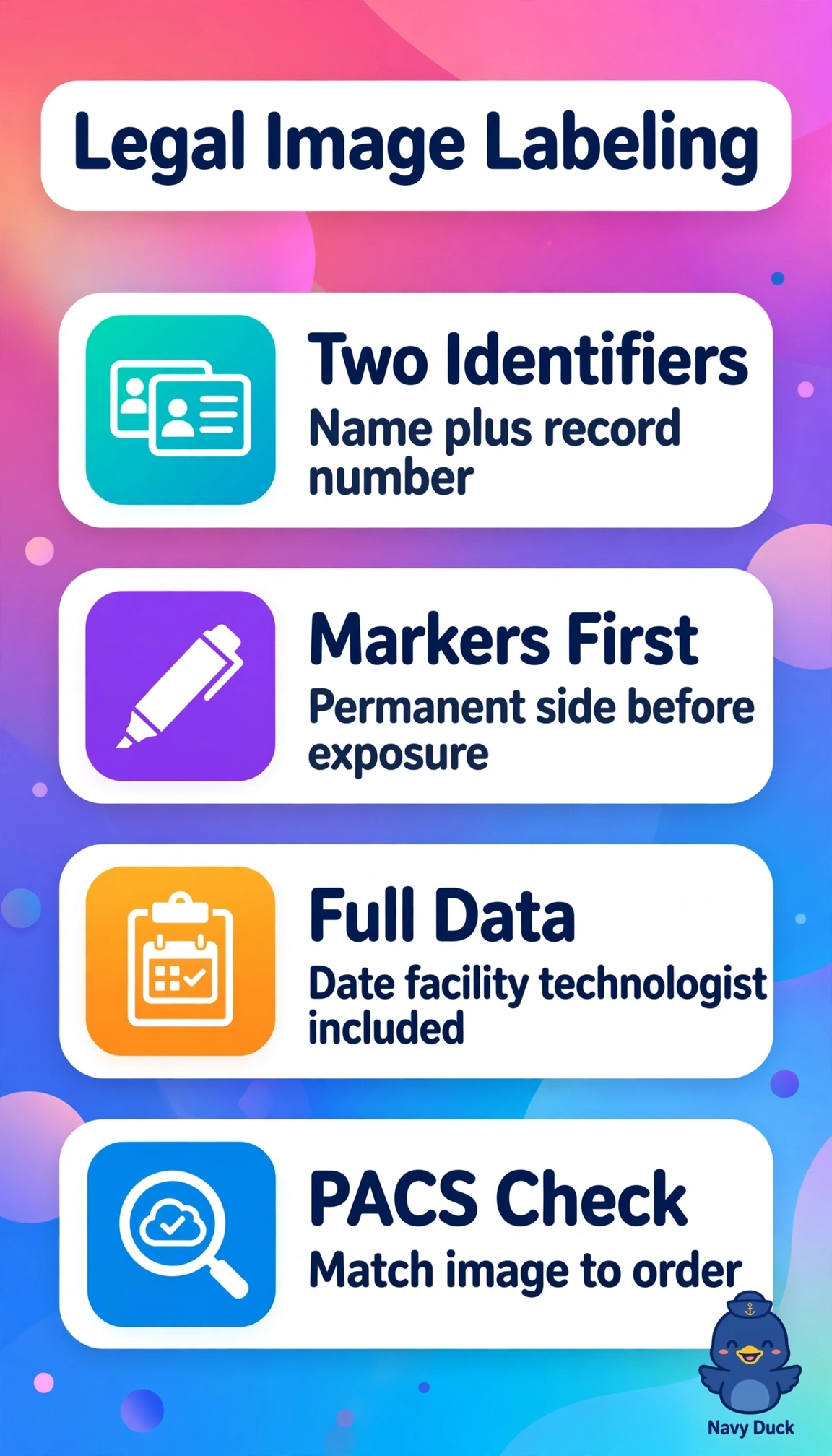
Short Explanation
You would not mail two legal contracts without signatures and addresses. Locking identity early keeps identification permanent, traceable, and court-ready.
Full Explanation
The correct practice combines positive identification, permanent pre-exposure laterality, and pre-transmission reconciliation, which together prevent the classic mobile error of attributing images from two back-to-back ICU patients to the wrong accession and preserve legal admissibility. Verifying two direct identifiers on the wristband or equivalent meets regulatory identification standards, placing lead markers within the collimated field before exposure creates anatomic evidence that cannot be altered or mistyped later, and confirming that annotation and demographics match the active PACS order before sending ensures attribution is fixed at acquisition rather than corrected after archiving. The transmit-first approach fails on sequencing because once images enter PACS they may be viewed for clinical decisions, so post hoc reconciliation does not undo misattribution risk under time pressure. The worklist-only approach fails on identification because selecting a name from a list assumes the list is correct and the correct patient was opened, without independent verification on the patient. The electronic-only annotation approach fails on permanence because typed laterality added during processing is editable and lacks the evidentiary weight of an exposed lead marker, even though it looks tidy and is common in digital workflow. Exam caveat: questions often reward efficient digital shortcuts, but when stem language emphasizes admissibility, permanent markers, and confirmation before sending, efficiency that skips verification is incorrect. Practical check: at the bedside pause after exposure to read the wristband identifiers, visualize lead marker orientation and placement, and match the console accession to the written order before pressing send for each patient separately.