
A 78-year-old patient with a suspected hip fracture arrives on a stretcher, in severe pain with limited mobility, a short stature and barrel chest, plus chronic lung disease. Moving the leg is contraindicated until cleared. Which procedural adaptation best obtains diagnostic hip images while respecting habitus, trauma, pathology and age?
Select an answer to reveal the explanation.
Short Explanation
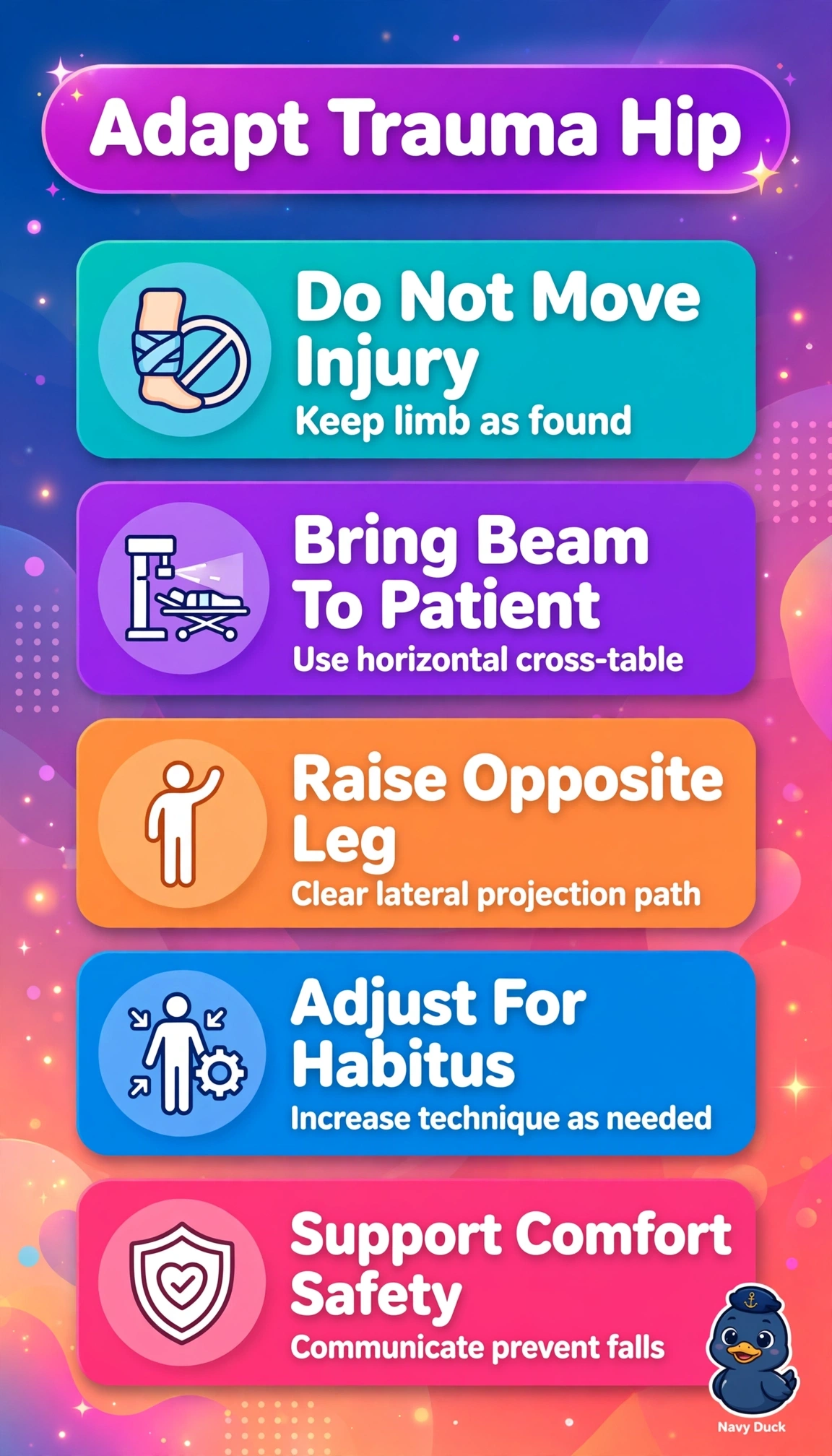
You're bringing the exam to the injury, not the injury to the exam. A cross-table lateral keeps things still while you tune technique for their trauma-adapted build.
Full Explanation
The correct adaptation succeeds because it satisfies trauma, habitus, pathology and age together: remaining on the stretcher avoids painful transfer in a 78-year-old, the trauma axiolateral obtained by raising only the unaffected leg yields an orthogonal lateral without rotating or abducting the suspected fracture, and technique is tailored to the measured hip and pelvis thickness, since a short, barrel-chested patient with chronic lung disease may have atypical proportions that make a chart-based adult technique unreliable. The stretcher series with both feet internally rotated and increased exposure fails on trauma principle despite correct stretcher care and habitus technique, because rotating the injured limb transmits torque to the femoral neck, risking displacement and severe pain, and no routine positioning overrides a do-not-move precaution. The stretcher trauma series with standard adult factors fails on exposure principle despite correct immobilization and lateral adaptation, because exposure on the stretcher, with a grid, should be individualized to the measured hip thickness, and unadjusted standard adult factors risk a nondiagnostic image. The table-based trauma series with habitus adjustment fails on handling principle despite correct positioning and technique, because avoidable transfer of a patient in severe pain with limited mobility violates minimal-movement care and risks further injury. Exam caveat: distinguish routine hip laterals requiring injured-side motion from trauma laterals using the sound side. Practical check: confirm grid alignment on the stretcher, elevate the sound leg clear, set adjusted factors, assess pain and circulation, and verify markers and anatomy before exposure.