
A technologist must repeat a supine adult abdomen that was noisy and underexposed using manual technique, and the department stresses cutting dose without losing diagnostic quality for bowel gas evaluation. Which exposure-factor adjustment should the technologist select to minimize patient dose while preserving image quality?
Select an answer to reveal the explanation.
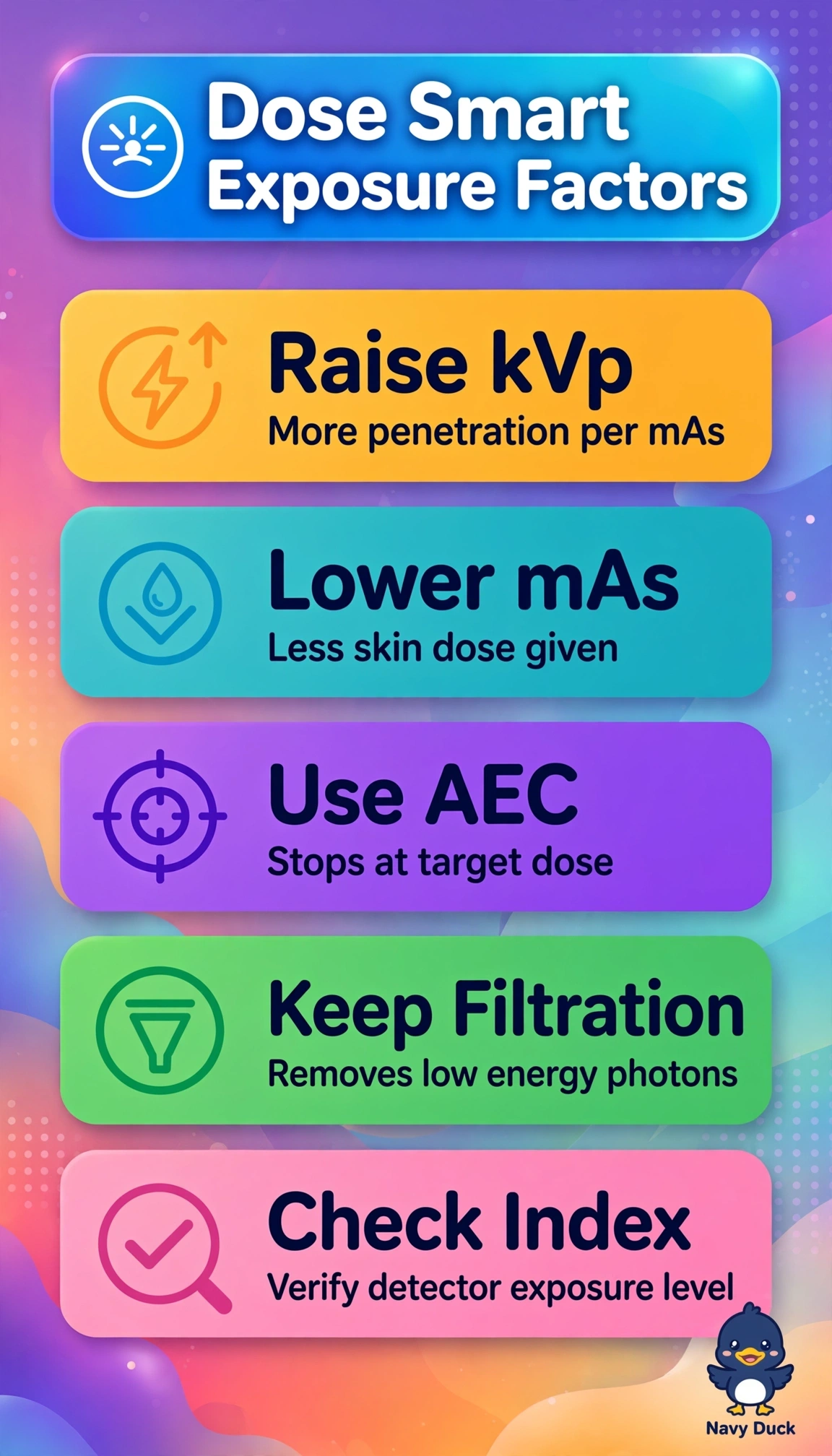
Short Explanation
You're trading a little contrast for a lot of dose savings. kVp up with mAs down keeps exposure while sparing skin.
Full Explanation
Correct technique uses modest kVp rise plus mAs reduction because higher penetrability raises detector signal per mAs, so lowered mAs maintains exposure index and quantum noise while entrance skin dose falls, preserving low-contrast bowel gas visibility under ALARA. The lower-kVp with higher-mAs choice fails on dose optimization because reduced penetration demands markedly more mAs to restore detector exposure, so contrast improves but skin dose rises sharply, violating minimization. The higher-kVp with unchanged-mAs choice fails on dose balance because penetration and noise improve and repeat underexposure is avoided, yet detector exposure and patient dose increase rather than decrease. The higher-ratio-grid with lower-mAs choice fails on scatter versus dose tradeoff because improved cleanup helps thick abdomen contrast but greater primary absorption normally requires more mAs, negating intended saving. Exam caveat is the 15-percent kVp rule requiring about halved mAs applies only within suitable diagnostic range, since excessive kVp reduces subject contrast and obscures subtle gas patterns despite low noise. Practical check is to verify exposure index near target, acceptable noise with preserved mucosal and gas margins, and documented dose-area product lower than prior noisy image.