
A radiographer must remain in the room for a fluoroscopic voiding study in a small room with a fixed protective barrier, wearing a wraparound apron and thyroid shield. The case will need several short exposures near the table. Which time, distance, and shielding practice with apron and barrier lead equivalence best minimizes personnel dose?
Select an answer to reveal the explanation.
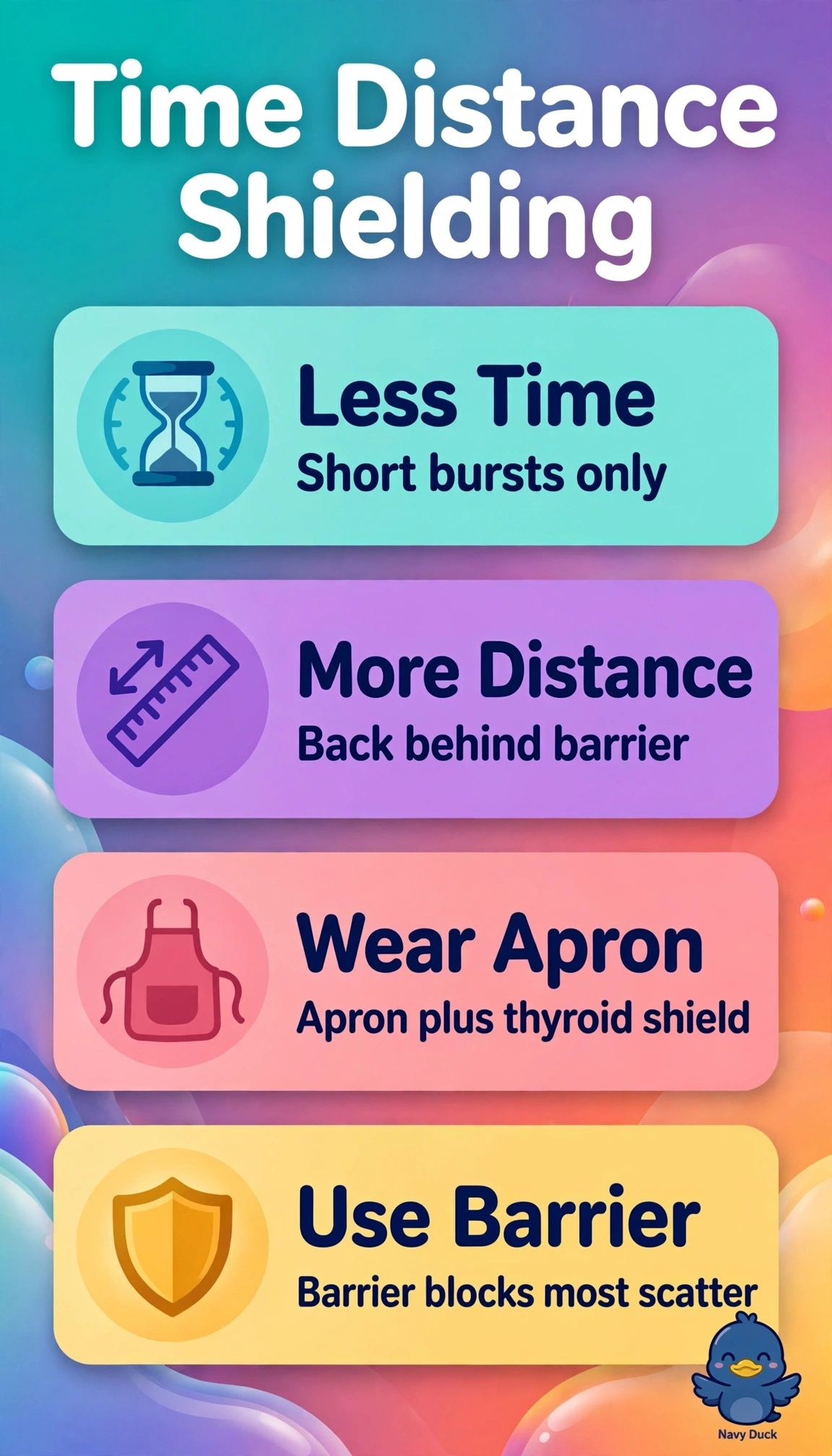
Short Explanation
You're spending less time in the rain, standing farther under cover. Quick work plus distance and cover wins with barrier-protection.
Full Explanation
The correct practice integrates ALARA time, distance, and shielding: brief pulsed beam-on limits total output and scatter, maximal step-back plus full use of the fixed barrier adds inverse-square reduction and structural attenuation, and wraparound apron with thyroid shield preserves required lead-equivalent coverage for trunk and neck during near-table scatter. The routine-length pulsed variation fails time as a concept because personnel dose rises essentially linearly with beam-on duration, so normal pulse width maintains image smoothness but adds avoidable scatter when minimized pulses would answer the voiding question. The table-side assistance variation fails distance and barrier protection because scatter is most intense close to the patient entrance field, so continuous proximity without interposed barrier negates distance gains even when apron and thyroid shield are worn correctly. The front-only apron variation fails shielding geometry because wraparound design was specified to cover flank and back during turning in a small room, so front-only leaves lateral-posterior paths open to multi-angle scatter despite good time and distance. Exam caveat: last-image-hold or pulsed mode alone does not equal full ALARA if distance, barrier, and specified equivalence are incomplete. Practical check: verify console fluoroscopy time, stand fully behind the barrier, confirm apron overlap and thyroid fit with labeled equivalence, and position dosimeters per protocol.