
A 19-year-old soccer player with a twisting ankle injury has swelling but can bear weight briefly, and the physician wants the tibiofibular mortise opened to rule out a fracture. Routine AP and lateral views show overlapping joint spaces. Which ankle projection positioning best opens the mortise joint for evaluation?
Select an answer to reveal the explanation.
Short Explanation
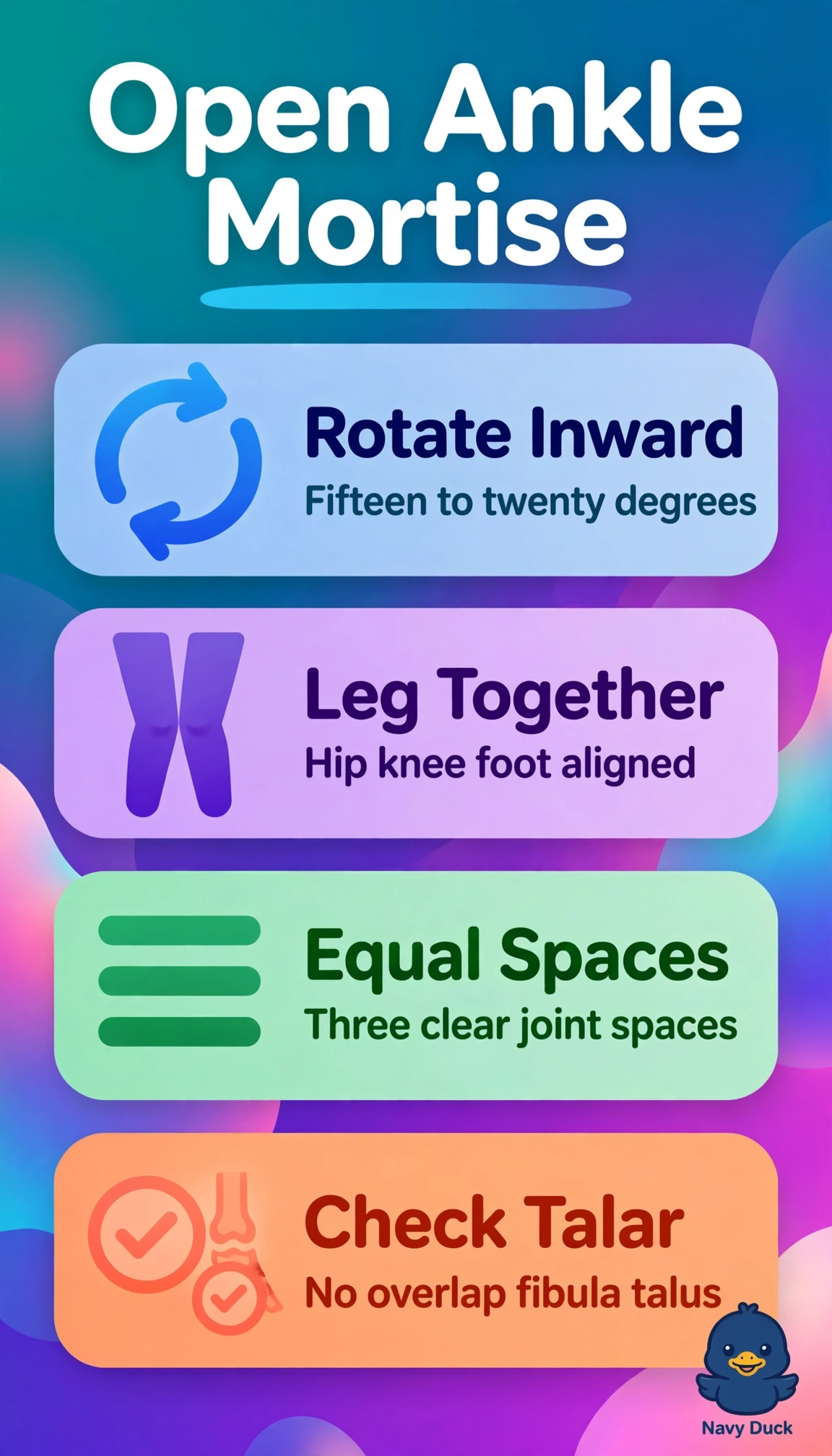
You’re turning the ankle just enough to unstack the puzzle pieces. A slight inward twist lines things up for mortise-opening and reveals the joint spaces.
Full Explanation
The tibiofibular mortise is angled relative to the coronal plane, so a true AP view leaves the distal fibula overlapping the lateral talus and closes the lateral clear space. Internal rotation of 15 to 20 degrees brings the intermalleolar line parallel to the receptor, opening the tibiotalar and tibiofibular spaces and producing symmetric medial and lateral clear spaces with minimal tibiofibular overlap. This AP mortise projection is therefore appropriate when routine views show overlap after a twisting injury with suspected fracture. External rotation of 30 to 45 degrees for an AP oblique does not align the intermalleolar line with the receptor; the routine AP oblique instead uses internal rotation, so external rotation fails to open the mortise as intended. A true lateral with 90-degree dorsiflexion helps assess tibiotalar alignment, effusion, posterior malleolar involvement, and talar dome position, but superimposed malleoli and a sagittal profile do not show uniform mortise clear spaces. A true AP with slight dorsiflexion is useful for baseline alignment and comparison, but without rotation it leaves the normal overlap unresolved. Exam caveat: internal versus external rotation is defined by toe direction, and rotation beyond 20 degrees begins to close the medial space and distort symmetry. In practice, check balanced malleolar prominence before exposure and confirm an open lateral mortise approximately equal in width to the medial space, with the talar dome in profile.