
A busy radiography department discovers a small cracked vial labeled radioactive material inside a storage cabinet near the general X-ray rooms, no staff touched the liquid, the area is cordoned off, and the radiation safety officer is unreachable for the first 15 minutes. The lead technologist must protect personnel until help arrives. Which personnel protection action should the team take first to handle this radioactive material incident?
Select an answer to reveal the explanation.
Short Explanation
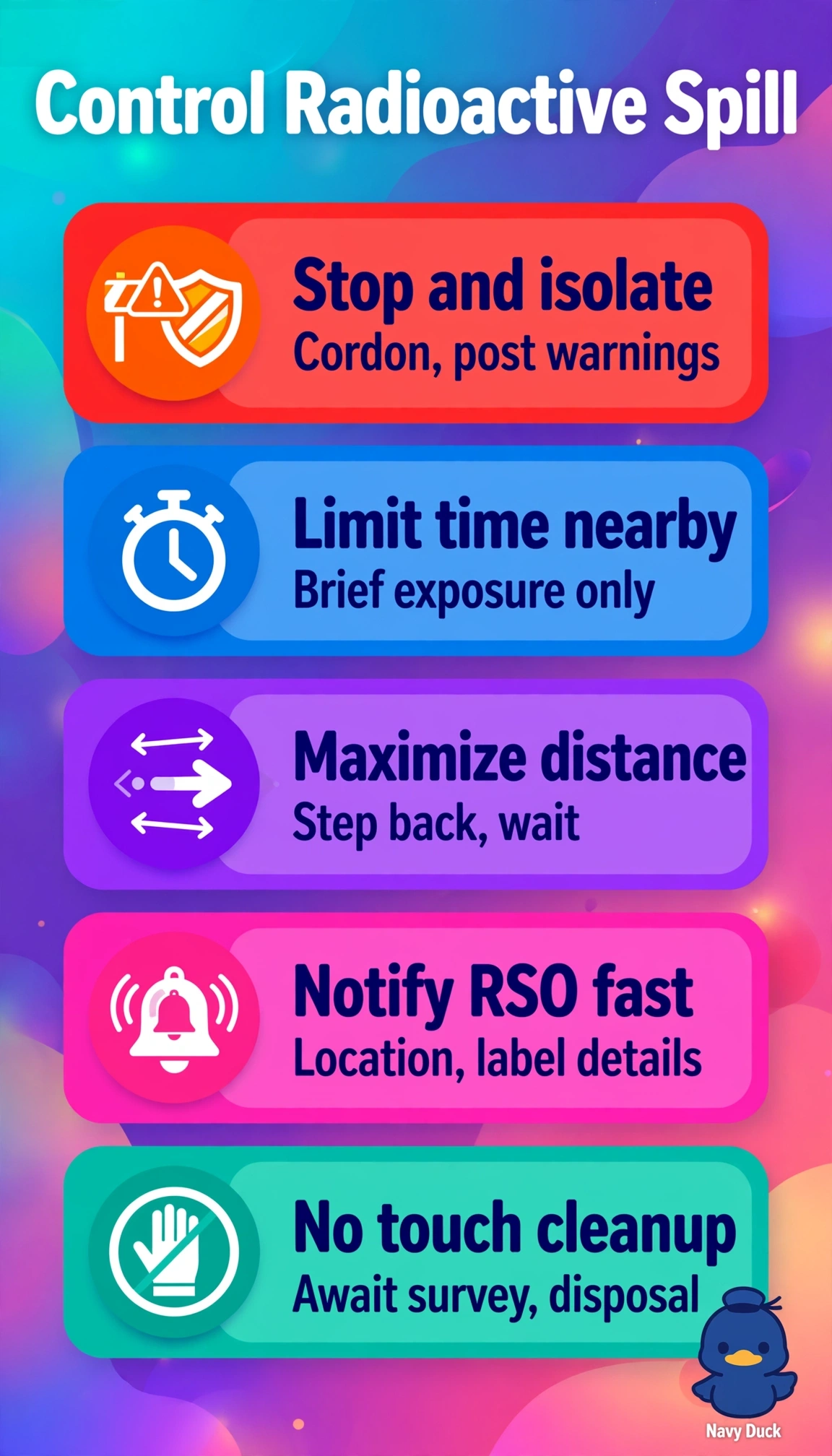
You do not clean what you do not understand. Time distance shielding plus a locked door keeps everyone safe until the expert arrives.
Full Explanation
The correct response is right because with an uncharacterized cracked vial, no contact with liquid, an already cordoned cabinet, and the radiation safety officer temporarily unavailable, immediate safety depends on strict access control, visible warnings, and time-distance discipline while continuing notification efforts, which protects the most people without creating new exposure pathways and preserves conditions for expert assessment. The protective-equipment containment approach fails on intervention timing because secondary containment is standard later spill control, yet any handling now increases close contact time with an unquantified source and risks spreading contamination before authorized guidance. The survey-meter and dosimetry approach fails on prioritization because calibrated monitoring and dose documentation are important for later evaluation, yet moving close to survey prolongs proximity without providing immediate protection and should follow isolation and escalation. The patient-relocation and selective service-limits approach fails on access control because managing workflow is prudent in a busy area, yet without formal restriction, posted warnings, explicit time-distance behavior, and continued escalation, boundaries remain incomplete. An exam caveat is to separate first personnel protection from subsequent characterization, cleanup, and medical follow-up and to choose least contact for the greatest number. A practical check is to verify cordon integrity, signage visibility, personnel accounted for at distance, minimized dwell time, and logged repeated attempts to reach the radiation safety officer with no re-entry for handling or surveying until authorized.