
A 45-year-old emergency patient needs an AP supine abdomen projection to evaluate bowel obstruction. The radiographer must use topographic landmarks and body planes to center and direct the central ray. Which landmark, plane, and central ray combination best produces the required anatomy?
Select an answer to reveal the explanation.
Short Explanation
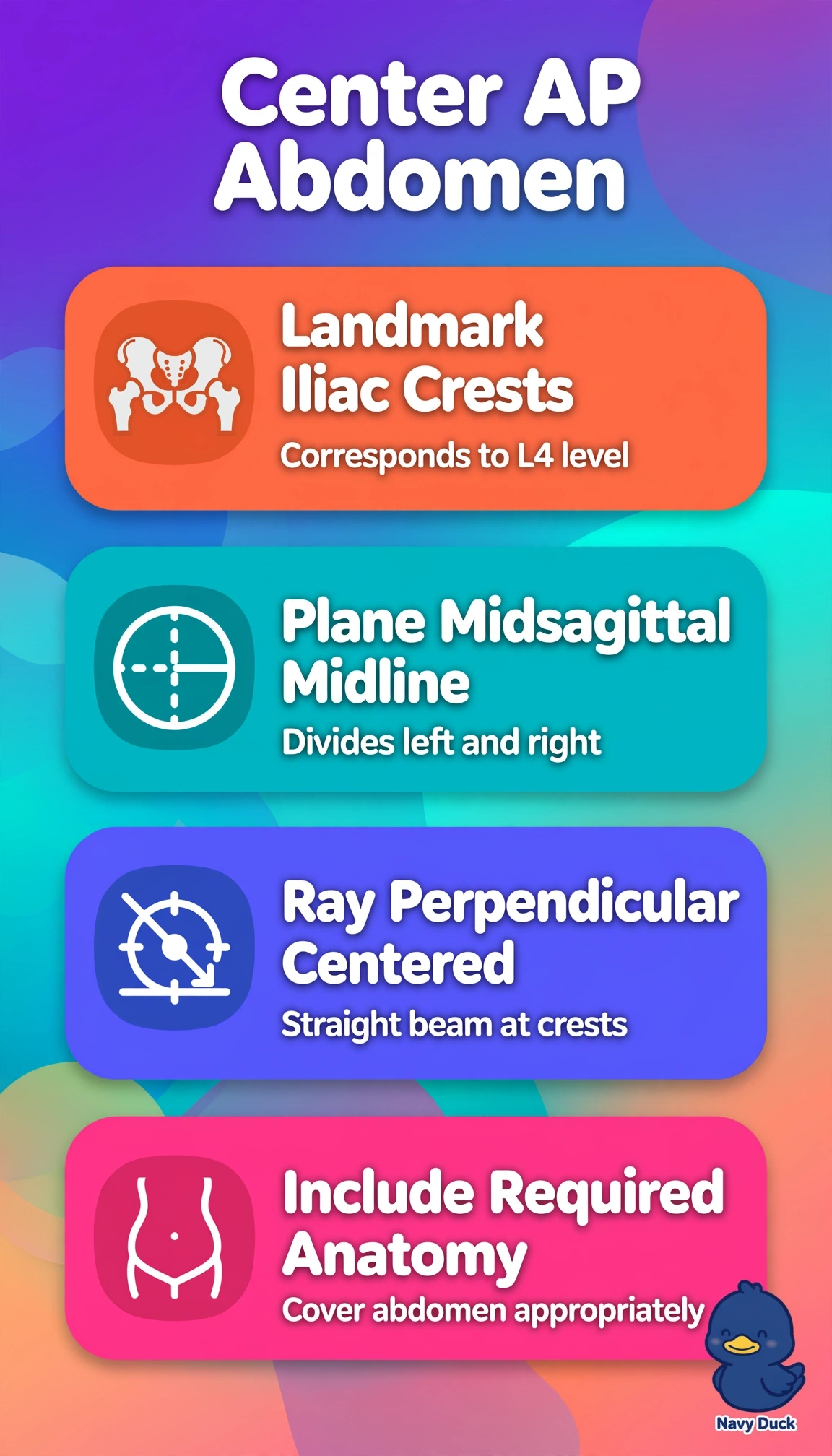
You're lining up belly anatomy like a map grid. Iliac crests at L4 in midline with a straight beam gives you that full midline-centering view.
Full Explanation
The supine AP abdomen for obstruction must include kidneys to pubic symphysis, and centering at iliac crests in midsagittal plane with perpendicular ray at L4 places the beam at mid-abdomen orthogonal to the detector for sharp uniform bowel detail without foreshortening. The technique centered 2 inches above crests in midsagittal plane with perpendicular ray at L2 is correct for erect abdomen to include diaphragms for free air and air-fluid levels, but for this supine task it shifts the field superiorly and may clip symphysis and sigmoid where distal obstruction signs appear. The technique centered at iliac crests in midcoronal plane with horizontal ray at L4 is correct for left lateral decubitus abdomen often added for obstruction to show free air, but it requires lateral recumbency and horizontal beam and thus fails the required supine AP geometry despite correct level. The technique centered at pubic symphysis in midsagittal plane with perpendicular ray at S1 is correct for dedicated AP pelvis to show bladder and pelvic bones, but it centers too low and excludes upper abdomen, kidneys and proximal dilated loops needed to assess obstruction level. An exam caveat is to read positioning terms first because erect and decubitus companions share obstruction indications but differ in centering and beam direction from supine. Practically palpate both iliac crests to locate L4, align midsagittal plane to midline without rotation, and verify perpendicular entry with collimation covering upper abdomen while always including symphysis inferiorly.