
A busy emergency room reports noisy lumbar spine images on larger patients and inconsistent dose records when grids are removed at bedside. The lead technologist must improve scatter control, leverage detector latitude, and ensure dose tracking. Which combined grid, detector, and documentation approach best minimizes patient exposure appropriately?
Select an answer to reveal the explanation.
Short Explanation
You’re balancing clean images with honest dose records. Right grid plus tuned exposure index targets beats guessing, like using the right sieve and writing down the recipe.
Full Explanation
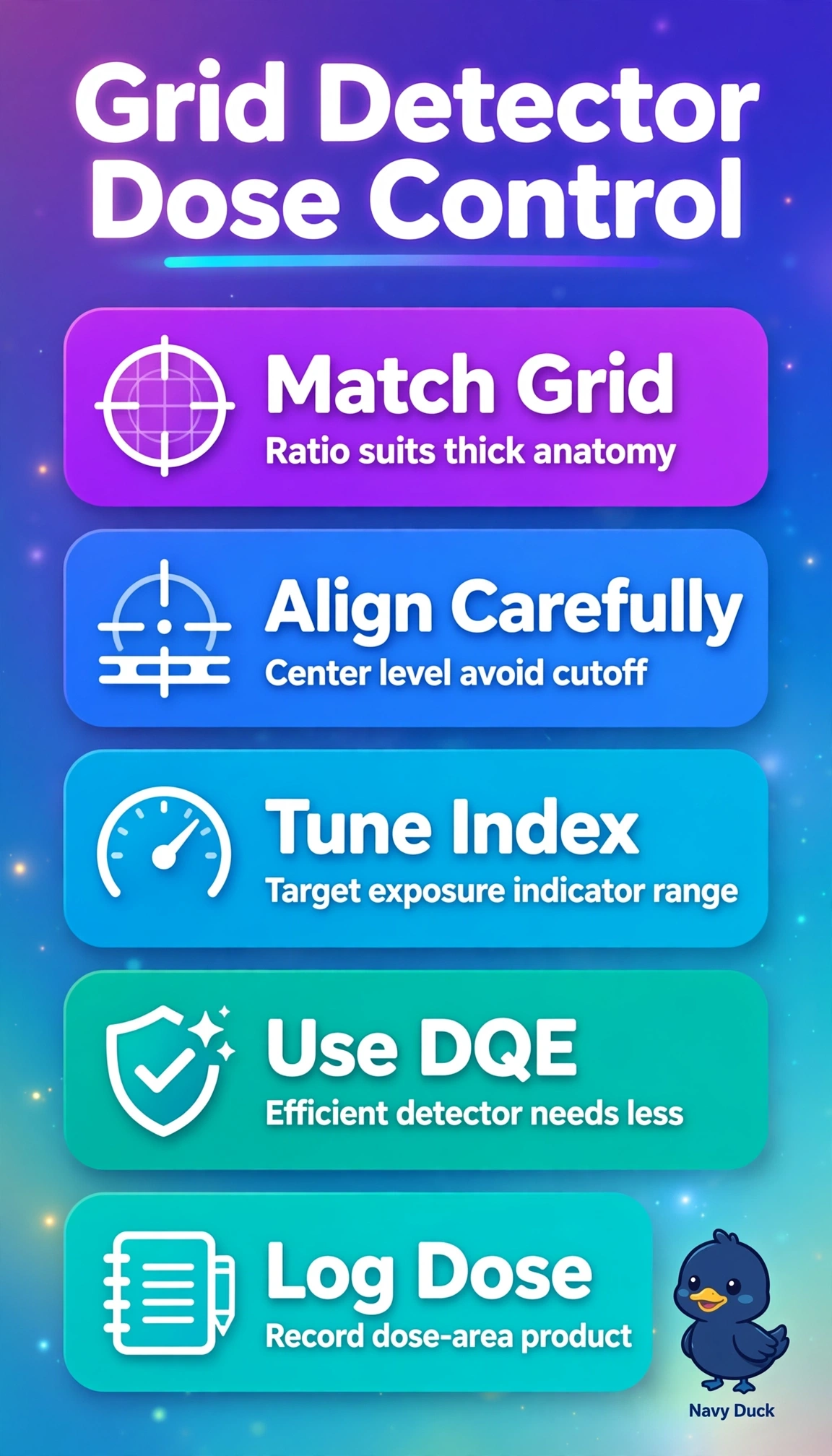
The correct approach succeeds because appropriate grid ratio with accurate alignment and focal distance controls scatter in thick lumbar tissue in larger patients to restore contrast without excessive technique escalation, calibrated exposure index targets exploit detector latitude to hold noise acceptable at the lowest workable dose, and measured dose-area product creates consistent dose records across bedside and room examinations. The software scatter-correction approach is widely used for portable examinations where a physical grid is impractical, yet for large lumbar spines with high scatter-to-primary ratios algorithmic cleanup cannot replace physical scatter removal so quantum noise and contrast loss persist. The standardized department chart approach supports consistency and with correct grid use and dose-area product recording appears complete, yet without calibration to validated exposure index and deviation index goals wide latitude masks overexposure and permits dose creep rather than appropriate minimization. The exposure-index audit approach manages scatter and detector signal correctly, but exposure index reflects detector incident air kerma under defined calibration rather than patient dose and field-size effects, so it cannot replace dose-area product for tracking or comparison. Examinations commonly conflate detector dose indicators with patient dose metrics and extend bedside gridless convenience to thick anatomy where a grid remains indicated. As a practical check, verify grid lines show no cutoff, deviation index averages near zero, and dose-area product is documented for every projection.