
A 52-year-old with severe abdominal pain and suspected bowel obstruction can stand briefly but cannot lie prone, has no trauma, and the surgeon needs both intraluminal gas patterns and possible free air. Which abdomen positioning combination best answers both requirements?
Select an answer to reveal the explanation.
Short Explanation
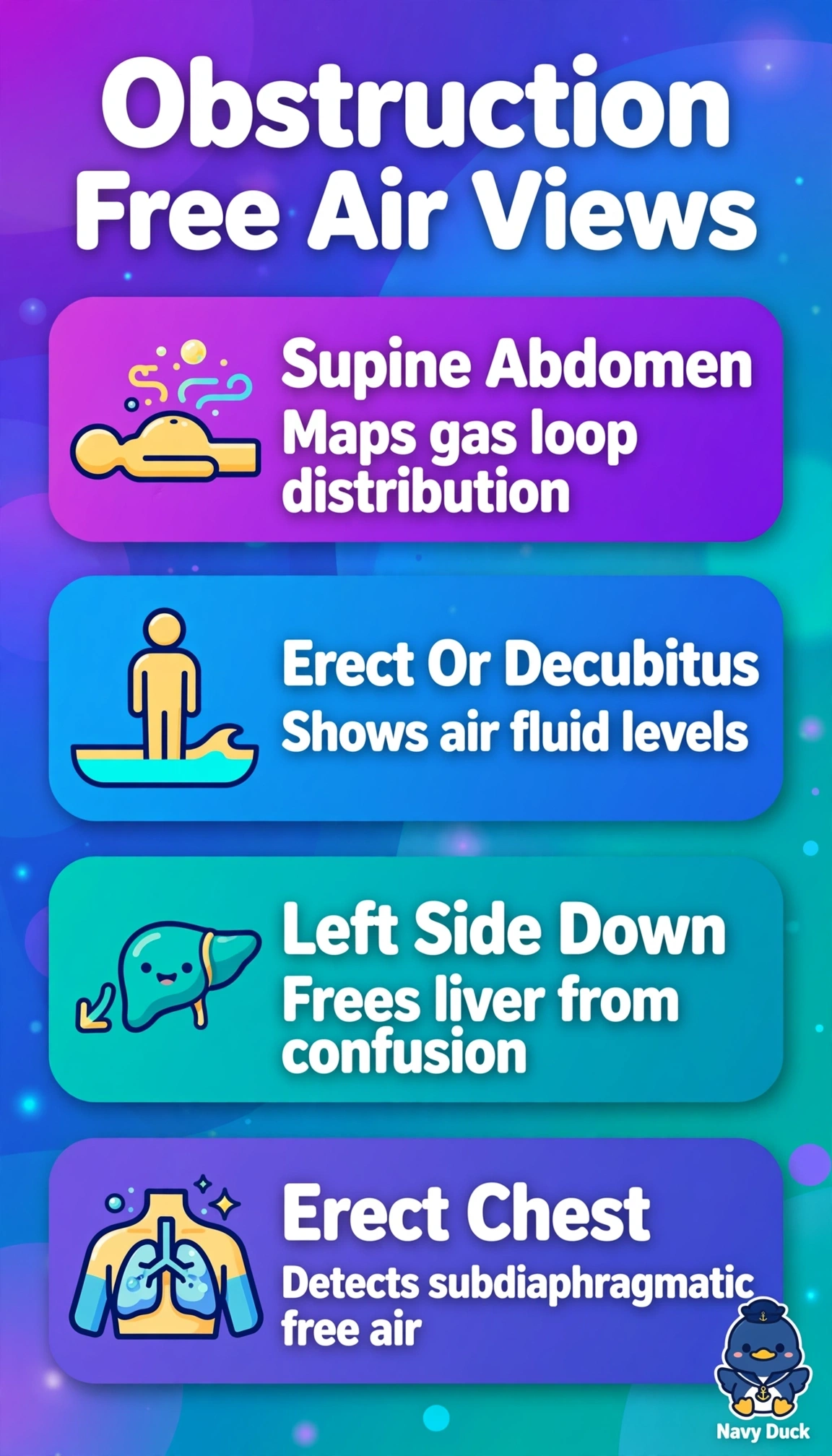
You need a map of the traffic jam and proof of a leak. The supine abdomen, left lateral decubitus abdomen, and erect chest capture air-fluid levels and help reveal small amounts of free air.
Full Explanation
The supine abdomen shows bowel-gas distribution, dilated loops, and abnormal calcifications; the left lateral decubitus abdomen demonstrates air-fluid levels and small amounts of free air when the patient cannot reliably stand. This decubitus position places free air over the liver, helping distinguish it from gastric air, while the erect chest is sensitive for air beneath the diaphragm. The prone abdomen plus right lateral decubitus abdomen with lateral chest is less suitable: prone positioning does not provide gravity-dependent air-fluid levels, and right lateral decubitus places free air over the liver, where small collections are harder to distinguish from the lung base. The supine abdomen plus erect abdomen with lordotic chest is not optimal because a lordotic chest alters anatomy for apical evaluation rather than free-air detection; an erect chest is more appropriate for that purpose. The Trendelenburg abdomen plus supine abdomen with supine chest keeps air dependent or layering, making small free-air collections harder to see against soft tissues. Exam caveat: left lateral decubitus imaging requires several minutes on the side and a horizontal beam with correct markers. Practical check: confirm the patient can safely assume the position, allow time for air to rise, include the diaphragm, and verify side markers.