
A rural ED has a 4-year-old with a swollen ankle after a playground fall who is crying and moving, and a 26-year-old with missed menses needing a KUB for flank pain. Both need imaging tonight with only one technologist available. Which paired dose-reduction actions align with Image Gently and Image Wisely and pregnancy precautions for these patients?
Select an answer to reveal the explanation.
Short Explanation
You're trimming dose at both ends of age and risk. Gentle immobilization plus tight technique calms repeats, while pregnancy verification ensures the KUB is justified and safe.
Full Explanation
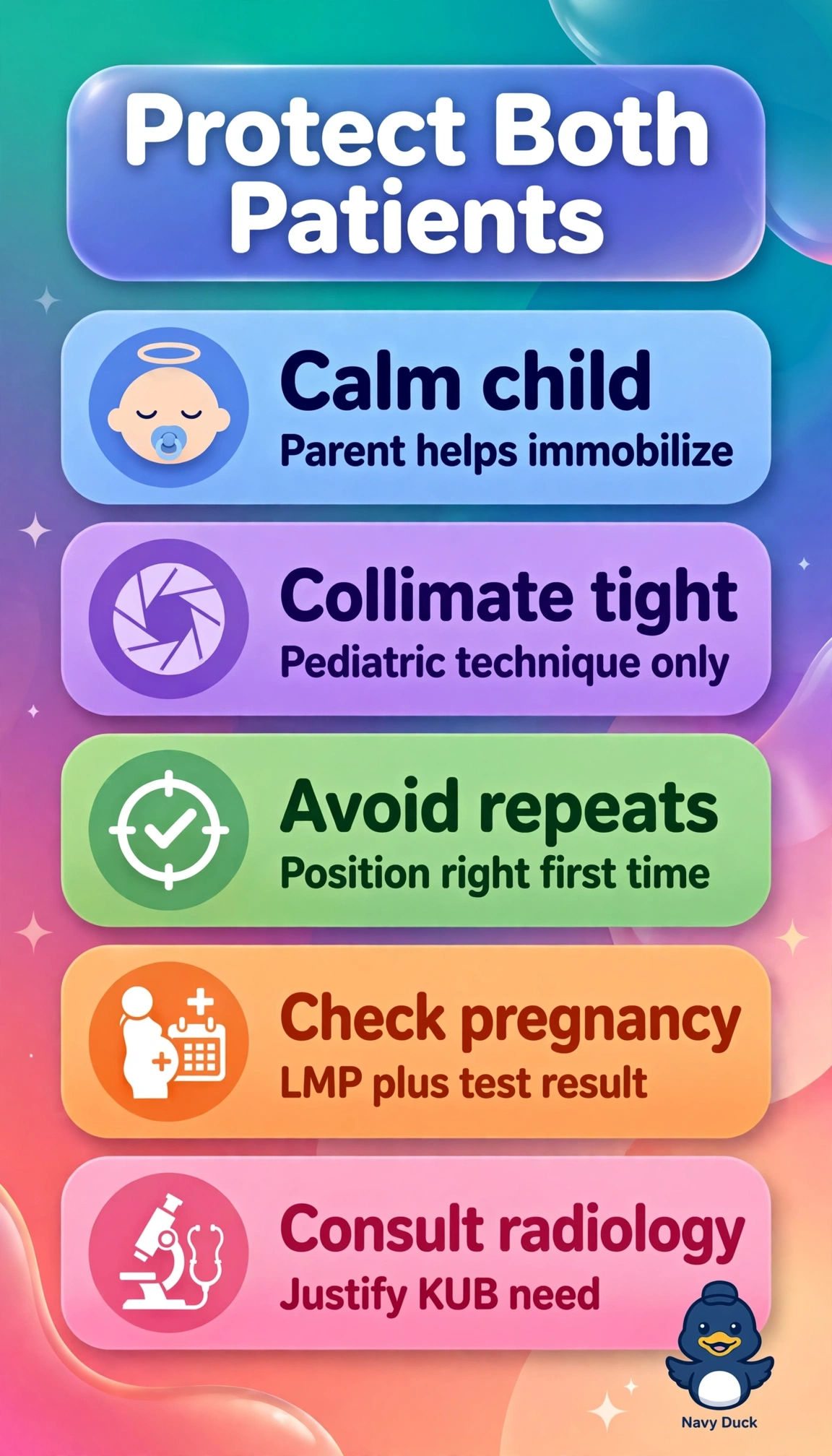
The correct pairing integrates Image Gently for the 4-year-old with Image Wisely and pregnancy precautions for the 26-year-old with missed menses. Parent-assisted immobilization controls motion while comforting a crying, moving preschooler and avoids repeats, tight collimation restricts the beam to the injured ankle, and pediatric technique lowers exposure factors for small anatomy and protects growth plates, while formal pregnancy verification plus radiology consultation before KUB ensures justification, consideration of non-ionizing alternatives or a modified low-dose protocol, and counseling. The low-dose KUB-after-negative-screen approach fails justification because missed menses implies potential fetal risk requiring physician review of indication, urgency, and protocol rather than technologist triage alone. The coaching-for-cooperation approach fails motion control because a crying preschooler cannot cooperate reliably, so blur and repeats increase dose contrary to Image Gently. The routine-exposure-with-standard-collimation approach fails size-based optimization because adult-like factors and a larger field needlessly irradiate sensitive tissue. Exam caveat: a negative screen alone does not authorize pelvic irradiation when the clinical question is unclear, documentation and consultation remain separately tested actions. Practical check: set pediatric ankle factors, keep the parent holding safely outside the primary beam, collimate closely, confirm last menstrual period and test result in the record, and hold the KUB until radiology confirms whether to proceed, modify, or substitute imaging.