
A 28-year-old emergency patient with a painful shoulder after a fall can stand but cannot abduct the arm, and the physician needs a true glenohumeral joint space to check for anterior dislocation. The clavicle and scapular body overlap the joint on the routine AP. Which shoulder projection best demonstrates the glenohumeral joint space for this patient?
Select an answer to reveal the explanation.
Short Explanation
You're peeking straight into a tricky joint without forcing sore movement. Angling the body to open that space is pure gold with Grashey-rotation.
Full Explanation
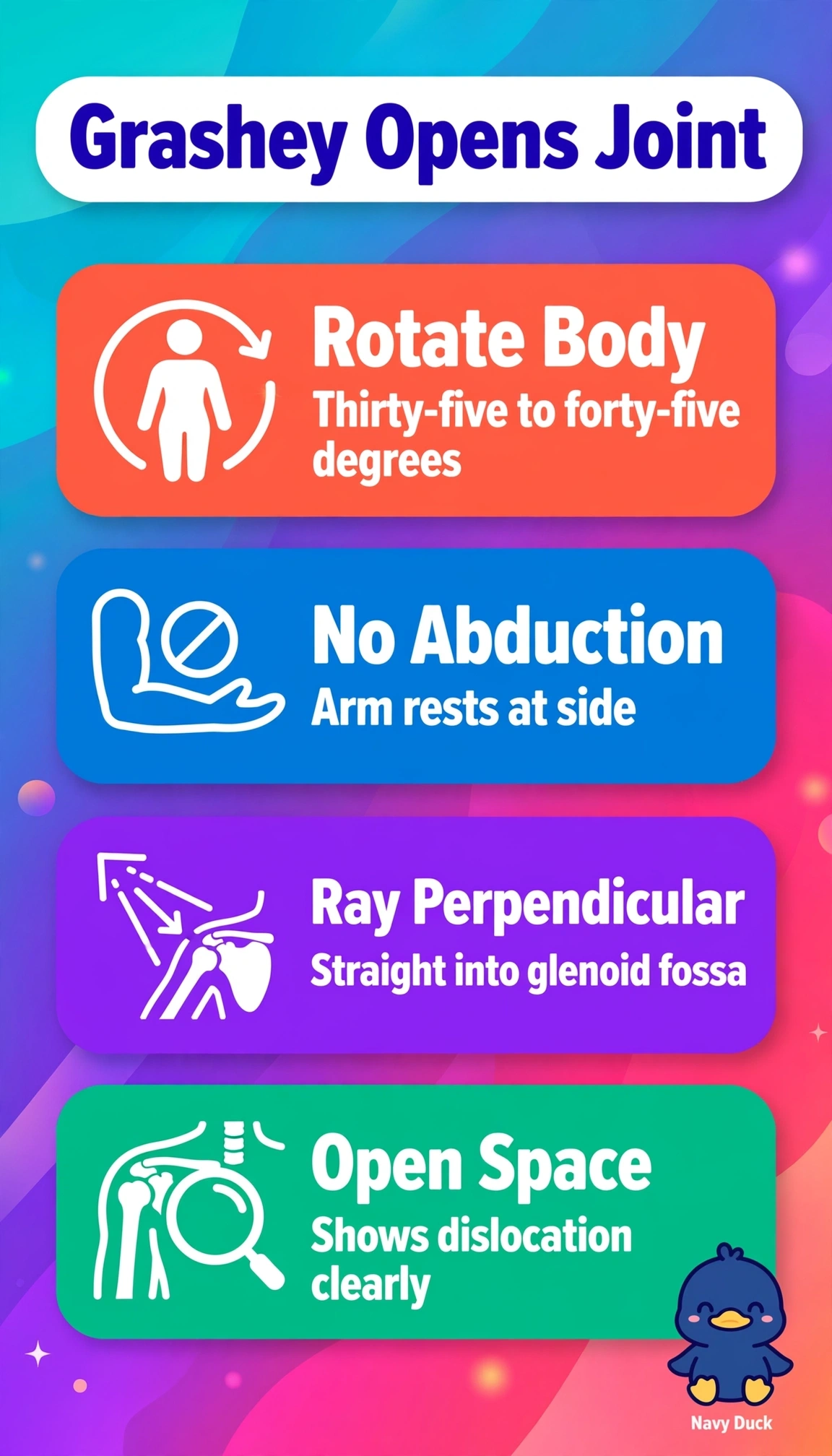
The Grashey method is a true AP of the glenohumeral joint obtained by rotating the body 35 to 45 degrees toward the affected side with the central ray perpendicular to the glenoid, which profiles the joint space without requiring abduction and is ideal for suspected dislocation in a patient who cannot move the arm. The scapular Y lateral superimposes the humeral head on the glenoid at the junction of the Y to confirm dislocation direction but does not open the joint space, so the Y-view approach fails for this specific need. The Neer supraspinatus outlet uses caudal angulation to project the acromion and humeral head for impingement assessment, not to profile the glenohumeral articulation, so the outlet-view approach fails. The Lawrence transthoracic lateral shoots through the thorax to show the proximal humerus when the arm cannot be moved, but it suffers from lung and rib superimposition and magnification and does not demonstrate the joint space tangentially, so the transthoracic approach fails; for the exam remember Grashey opens the joint, Y confirms position, and outlet shows acromion, and in practice support the arm in a sling and rotate the body rather than the painful arm.