
An emergency physician orders an esophagram for an older adult with severe chest pain after vomiting, suspected esophageal perforation, and no known iodine allergy, and the fluoroscopy team must choose contrast safely. Which contrast protocol should the radiographer prepare for the esophagram to evaluate suspected perforation?
Select an answer to reveal the explanation.
Short Explanation
You're protecting the mediastinum with this pick. Water-soluble contrast is safer when a leak could spill outside the esophagus.
Full Explanation
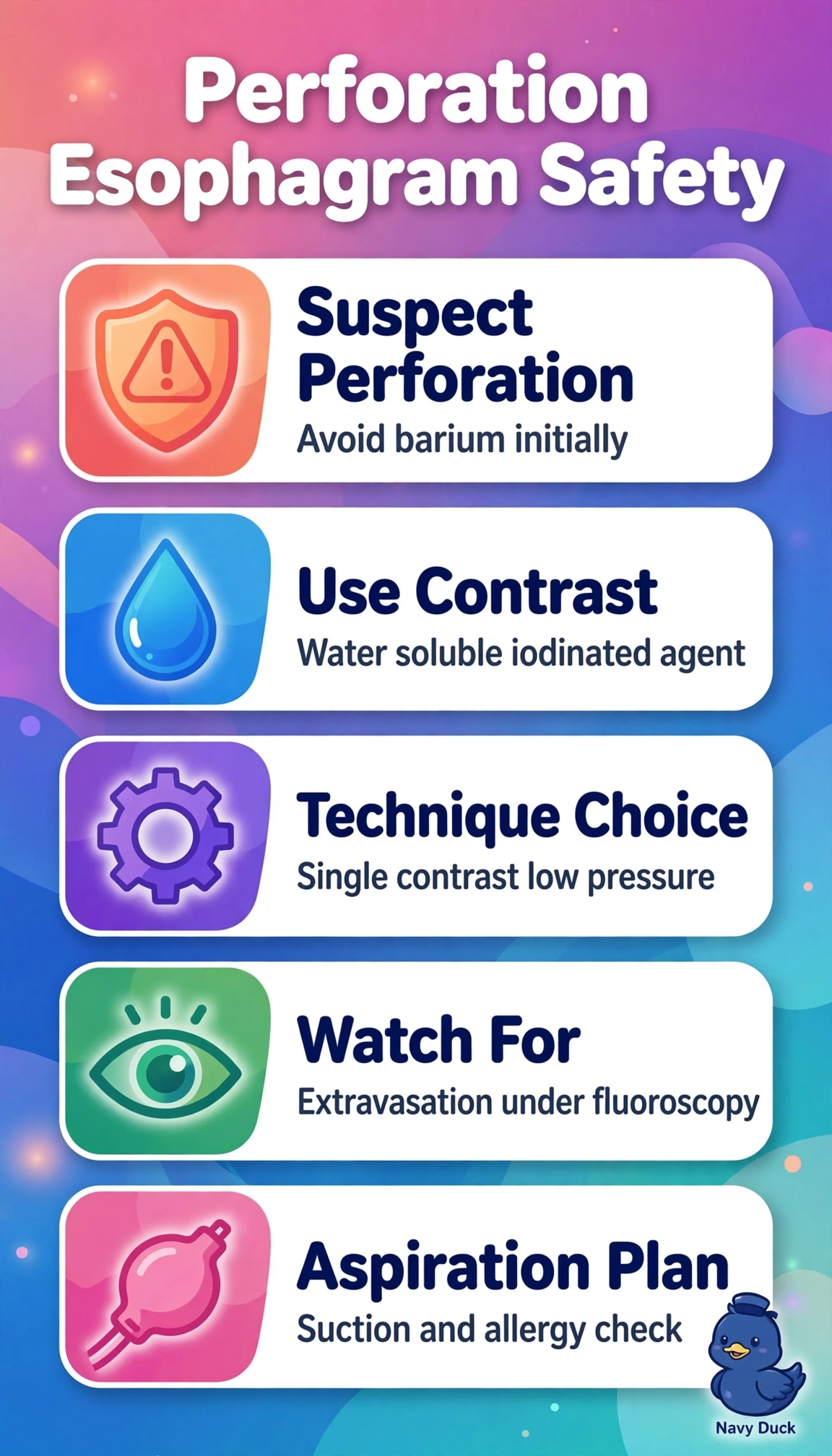
Suspected perforation requires water-soluble iodinated contrast for the initial esophagram because barium leaking into the mediastinum or pleura can cause severe chemical mediastinitis and fibrosis, while water-soluble agents are absorbed more readily, and a single-contrast technique limits pressure and volume while still demonstrating extravasation under fluoroscopy. The double-contrast barium approach fails because gas plus high-density barium is ideal for mucosal detail in stable dysphagia but is contraindicated when perforation is likely, the high-density barium paste approach fails for the same safety reason despite good distention, and the small-bowel follow-through approach fails because it studies distal transit rather than the urgent esophageal leak and delays diagnosis. Exam caveat: if the water-soluble study is negative but suspicion remains, a careful barium study may follow by physician order, but never start with barium. Practical check: confirm allergy history, have suction ready for aspiration risk, and document contrast type, volume, and fluoroscopic findings.